Results by title
8 books match the query 'Actions and defenses'
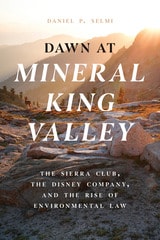
Dawn at Mineral King Valley
The Sierra Club, the Disney Company, and the Rise of Environmental LawDaniel P. Selmi
University of Chicago Press, 2022
In our current age of climate change–induced panic, it’s hard to imagine a time when private groups were not actively enforcing environmental protection laws in the courts. It wasn’t until 1972, however, that a David and Goliath–esque Supreme Court showdown involving the Sierra Club and Disney set a revolutionary legal precedent for the era of environmental activism we live in today.
Set against the backdrop of the environmental movement that swept the country in the late 1960s and early 1970s, Dawn at Mineral King Valley tells the surprising story of how the US Forest Service, the Disney company, and the Sierra Club each struggled to adapt to the new, rapidly changing political landscape of environmental consciousness in postwar America. Proposed in 1965 and approved by the federal government in 1969, Disney’s vast development plan would have irreversibly altered the practically untouched Mineral King Valley, a magnificently beautiful alpine area in the Sierra Nevada mountains. At first, the plan met with unanimous approval from elected officials, government administrators, and the press—it seemed inevitable that this expanse of wild natural land would be radically changed and turned over to a private corporation. Then the scrappy Sierra Club forcefully pushed back with a lawsuit that ultimately propelled the modern environmental era by allowing interest groups to bring litigation against environmentally destructive projects.
An expert on environmental law and appellate advocacy, Daniel P. Selmi uses his authoritative narrative voice to recount the complete history of this revolutionary legal battle and the ramifications that continue today, almost 50 years later.
Distorting the Law
Politics, Media, and the Litigation CrisisWilliam Haltom and Michael McCann
University of Chicago Press, 2004
Scholars have argued for years that this common view of the depraved ruin of our civil legal system is a myth, but their research and statistics rarely make the news. William Haltom and Michael McCann here persuasively show how popularized distorted understandings of tort litigation (or tort tales) have been perpetuated by the mass media and reform proponents. Distorting the Law lays bare how media coverage has sensationalized lawsuits and sympathetically portrayed corporate interests, supporting big business and reinforcing negative stereotypes of law practices.
Based on extensive interviews, nearly two decades of newspaper coverage, and in-depth studies of the McDonald's coffee case and tobacco litigation, Distorting the Law offers a compelling analysis of the presumed litigation crisis, the campaign for tort law reform, and the crucial role the media play in this process.
Lawsuits in a Market Economy
The Evolution of Civil LitigationStephen C. Yeazell
University of Chicago Press, 2018
Lawsuits in a Market Economy explains how contemporary civil litigation in the United States works and how it has changed over the past century. The book corrects common misconceptions—some of which have proved remarkably durable even in the face of contrary evidence—and explores how our constitutional structure, an evolving economy, and developments in procedural rules and litigation financing systems have moved us from expecting that lawsuits end in trial and judgments to expecting that they will end in settlements. Yeazell argues that today’s system has in some ways overcome—albeit inconsistently—disparities between the rich and poor in access to civil justice. Once upon a time, might regularly triumphed over right. That is slightly less likely today—even though we continue to witness enormous disparities in wealth and power.
The book concludes with an evaluation of recent changes and their possible consequences.
Regulation versus Litigation
Perspectives from Economics and LawEdited by Daniel P. Kessler
University of Chicago Press, 2010
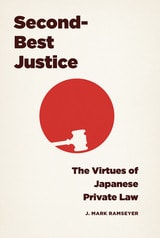
Second-Best Justice
The Virtues of Japanese Private LawJ. Mark Ramseyer
University of Chicago Press, 2015
With Second-Best Justice, J. Mark Ramseyer offers a more compelling, better-grounded explanation: the low rate of lawsuits in Japan results not from distrust of a dysfunctional system but from trust in a system that works—that sorts and resolves disputes in such an overwhelmingly predictable pattern that opposing parties rarely find it worthwhile to push their dispute to trial. Using evidence from tort claims across many domains, Ramseyer reveals a court system designed not to find perfect justice, but to “make do”—to adopt strategies that are mostly right and that thereby resolve disputes quickly and economically.
An eye-opening study of comparative law, Second-Best Justice will force a wholesale rethinking of the differences among alternative legal systems and their broader consequences for social welfare.
The Consciousness of the Litigator
Duffy Graham
University of Michigan Press, 2005
---Kimberly Kirkland, Franklin Pierce Law Center
The Consciousness of the Litigator investigates the role of the lawyer in modern American political and social life and in the judicial process, and plumbs lawyers' perceptions of themselves, their work, and, especially, their sense of right and wrong.
In so doing, the book sheds light on the unique and little-examined subject of the moral mind of the litigator, whose work extends to all corners of society and whose primary expertise---making legal arguments---is the fundamental skill of all lawyers.
The Consciousness of the Litigator stands with Michael Kelly's Lives of Lawyers as a must-read for the many law students, scholars, and practicing litigators who struggle to balance ethical questions with the dictates of their highly commercialized profession.

The Medical Malpractice Myth
Tom Baker
University of Chicago Press, 2005
This, according to Tom Baker, is the myth of medical malpractice, and as a reality check he offers The Medical Malpractice Myth, a stunning dismantling of this familiar, but inaccurate, picture of the health care industry. Are there too many medical malpractice suits? No, according to Baker; there is actually a great deal more medical malpractice, with only a fraction of the cases ever seeing the inside of a courtroom. Is too much litigation to blame for the malpractice insurance crisis? No, for that we can look to financial trends and competitive behavior in the insurance industry. Are these lawsuits frivolous? Very rarely. Point by point, Baker—a leading authority on insurance and law—pulls together the research that demolishes the myths that have taken hold about medical malpractice and suggests a series of legal reforms that would help doctors manage malpractice insurance while also improving patient safety and medical accountability.
President Bush has made medical malpractice reform a priority in his last term in office, but if history is any indication, legislative reform would only worsen the situation and perpetuate the gross misunderstanding of it. The debate surely will be transformed by The Medical Malpractice Myth, a book aimed squarely at general readers but with radical conclusions that speak to the highest level of domestic policymaking.
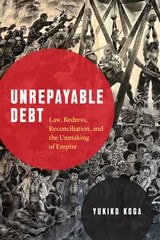
Unrepayable Debt
Law, Redress, Reconciliation, and the Unmaking of EmpireYukiko Koga
University of Chicago Press, 2026
What does it mean, and take, to repay the unrepayable?
Unrepayable Debt explores belated attempts to reckon with the savage plundering of labor and life under the Japanese empire. Located within global conversations on reparations for colonialism and slavery, and centered on slave labor lawsuits brought by Chinese victims seeking overdue justice in Japanese courts, Yukiko Koga traces a sea change in the legal sphere propelled by an unprecedented transnational redress movement. The lawsuits exposed not only the original violence but also a structure of transitional injustice etched onto the unmaking of the Japanese empire, which left victims silenced and unredressable for decades.
Challenging the idea of reckoning as a discrete event that brings closure through settlements, apology, or compensation, Koga’s ethnography details the slow and messy intergenerational work of reconciliation on the ground. The book shows how the re-pairing of severed relations, separated by lineages of victimhood and perpetration, lies at the core of repair. By bringing to the surface the prolonged and entangled processes of decolonization and deimperialization, Unrepayable Debt compels a rethinking of what redress, repair, and reconciliation mean, how they are practiced, and where accountability lies.