Results by title
90 books match the query 'Activism' and 9 start with a

A Border Son
My Life in Activism, Education, and PoliticsJorge B. Haynes, Jr.with Denise Gamino and Benton Graham
University of Texas Press, 2026
Behind the success of every great politician, inspiring activist, or business titan, there is a staffer; Jorge B. Haynes was that staffer for some of the most influential leaders in Texas, Florida, and California.
Jorge B. Haynes had a knack for finding his way into the rooms where history was being made. From his work boycotting farmworker conditions alongside Cesar Chavez and Dolores Huerta as a young man in California to his role in President Bill Clinton’s NAFTA war room in the 1990s, he was the man advising some of the country’s most influential leaders and he left an imprint on the monumental moments that defined their time. His career spanned almost five decades, beginning with his decision to leave home in Laredo to serve in the US Air Force. But his service to the country took many different forms. Haynes worked for the Bureau of the Census the first year Latinos were allowed to declare their Hispanic heritage. He wrote speeches and orchestrated pivotal meetings for top political leadership in Texas and later Florida. In the final years of his career, he fought to make college a more accessible path for under-represented students in California.
As his paternal grandmother used to say, “Cuando vas a un lugar donde nunca has estado, finge que has estado allí,” which means, “When you go somewhere that you've never been, pretend like you've been there before.” By the end of his career, there weren’t many places that Haynes hadn’t been.
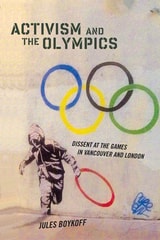
Activism and the Olympics
Dissent at the Games in Vancouver and LondonBoykoff, Jules
Rutgers University Press, 2014
In Activism and the Olympics, Boykoff provides a critical overview of the Olympic industry and its political opponents in the modern era. After presenting a brief history of Olympic activism, he turns his attention to on-the-ground activism through the lens of the Vancouver 2010 Winter Olympics and the 2012 Summer Olympics in London. Here we see how anti-Olympic activists deploy a range of approaches to challenge the Olympic machine, from direct action and the seizure of public space to humor-based and online tactics. Drawing on primary evidence from myriad personal interviews with activists, journalists, civil libertarians, and Olympics organizers, Boykoff angles in on the Games from numerous vantages and viewpoints.
Although modern Olympic authorities have strived—even through the Cold War era—to appear apolitical, Boykoff notes, the Games have always been the site of hotly contested political actions and competing interests. During the last thirty years, as the Olympics became an economic juggernaut, they also generated numerous reactions from groups that have sought to challenge the event’s triumphalism and pageantry. The 21st century has seen an increased level of activism across the world, from the Occupy Movement in the United States to the Arab Spring in the Middle East. What does this spike in dissent mean for Olympic activists as they prepare for future Games?
Activism, Majority Rule, and Local Democracy
Rethinking Public InfluenceBrian E. Adams
Temple University Press, 2026
Local democracy doesn’t work as it should, declares Brian Adams in Activism, Majority Rule, and Local Democracy. Local politics is where citizens have the most opportunity for direct participation, control, and influence, but that activism doesn’t necessarily translate into majority rule.
While greater local engagement can produce policy that better reflects activists’ strong preferences, Adams explains that activists are not representative of the public-at-large and states that a reconceptualization of how the public should be able to influence local officials is required. Based on interviews with activists in San Diego, California, Adams concludes that activism can be beneficial, but we need to view it as distinct from majority rule, with a focus on managing the tension between the two.
Improving local democracy is not just a matter of generating more activism. It requires articulating when we want policy to reflect majority preferences and when we want activists to hold sway.
African American Arts
Activism, Aesthetics, and Futurityweems, carrie mae
Bucknell University Press, 2020
Contributors: Carrie Mae Weems, Carmen Gillespie, Rikki Byrd, Amber Lauren Johnson, Doria E. Charlson, Florencia V. Cornet, Daniel McNeil, Lucy Caplan, Genevieve Hyacinthe, Sammantha McCalla, Nettrice R. Gaskins, Abby Dobson, J. Michael Kinsey, Shondrika Moss-Bouldin, Julie B. Johnson, Sharrell D. Luckett, Jasmine Eileen Coles, Tawnya Pettiford-Wates, Rickerby Hinds.
Published by Bucknell University Press. Distributed worldwide by Rutgers University Press.
African Asylum at a Crossroads
Activism, Expert Testimony, and Refugee RightsIris Berger
Ohio University Press, 2015
African Asylum at a Crossroads: Activism, Expert Testimony, and Refugee Rights examines the emerging trend of requests for expert opinions in asylum hearings or refugee status determinations. This is the first book to explore the role of court-based expertise in relation to African asylum cases and the first to establish a rigorous analytical framework for interpreting the effects of this new reliance on expert testimony.
Over the past two decades, courts in Western countries and beyond have begun demanding expert reports tailored to the experience of the individual claimant. As courts increasingly draw upon such testimony in their deliberations, expertise in matters of asylum and refugee status is emerging as an academic area with its own standards, protocols, and guidelines. This deeply thoughtful book explores these developments and their effects on both asylum seekers and the experts whose influence may determine their fate.
Contributors: Iris Berger, Carol Bohmer, John Campbell, Katherine Luongo, E. Ann McDougall, Karen Musalo, Tricia Redeker Hepner, Amy Shuman, Joanna T. Tague, Meredith Terretta, and Charlotte Walker-Said.

American Muslim Women, Religious Authority, and Activism
More Than a PrayerBy Juliane Hammer
University of Texas Press, 2012
Following the events of September 11, 2001, American Muslims found themselves under unprecedented scrutiny. Muslim communities in the United States suffered from negative representations of their religion, but they also experienced increased interest in aspects of their faith and cultures. They seized the opportunity to shape the intellectual contribution of American Muslims to contemporary Muslim thought as never before. Muslim women in particular—often assumed to be silenced, oppressed members of their own communities—challenged stereotypes through their writing, seeking to express what it means to be a Muslim woman in America and carrying out intra-Muslim debates about gender roles and women’s participation in society. Hammer looks at the work of significant female American Muslim writers, scholars, and activists, using their writings as a lens for a larger discussion of Muslim intellectual production in America and beyond.
Centered on the controversial women-led Friday prayer in March 2005, Hammer uses this event and its aftermath to address themes of faith, community, and public opinion. Tracing the writings of American Muslim women since 1990, the author covers an extensive list of authors, including Amina Wadud, Leila Ahmed, Asma Barlas, Riffat Hassan, Mohja Kahf, Azizah al-Hibri, Asra Normani, and Asma Gull Hasan. Hammer deftly examines each author’s writings, demonstrating that the debates that concern American Muslim women are at the heart of modern Muslim debates worldwide. While gender is the catalyst for Hammer’s study, her examination of these women’s intellectual output touches on themes central to contemporary Islam: authority, tradition, Islamic law, justice, and authenticity.

Art and Activism
Jazz Artists and Writers in the Civil Rights VanguardJack Marchbanks
Ohio University Press, 2026
Explore how jazz legends and literary icons united art and activism, shaping the civil rights movement and transforming American culture during the pivotal period between 1955 and 1965.
Art and Activism explores the powerful, symbiotic relationships among artists such as Nina Simone, Abbey Lincoln, and Lena Horne and their literary counterparts—Lorraine Hansberry, Maya Angelou, and Langston Hughes. These creative figures positioned themselves as cultural thought leaders within the evolving civil rights movement. While the Jim Crow South was the movement’s operational front, Jack Marchbanks argues that New York City’s intellectual, cultural, and fundraising communities functioned as its strategic command center.
Readers who admire jazz legends like Duke Ellington, Dave Brubeck, Miles Davis, and Charles Mingus—and those fascinated by prominent African American writers like James Baldwin and Ralph Ellison—will discover how these artists intertwined their work with the civil rights struggle. The book examines their involvement in pivotal confrontations and their connections with key leaders such as the Reverend Dr. Martin Luther King Jr., Daisy Bates, Ella Baker, and Malcolm X.
By illuminating the intersection of art and activism, this study offers a fresh perspective on the pivotal decade from 1955 to 1965. It is an essential resource for undergraduate courses and an engaging read for anyone seeking to understand the civil rights era through a cultural lens.

Art, Activism, and Oppositionality
Essays from AfterimageGrant Kester, ed.
Duke University Press, 1998
Forging a style of criticism where aesthetic, critical, theoretical, and activist concerns converge, Afterimage has shaped American debates around the politics of visual production and arts education while offering a voice to politically involved artists and scholars. Art, Activism, and Oppositionality insists not only on the continuing relevance of an activist stance to contemporary art practice and criticism, but also on the significance of an engaged art practice that is aligned with social or political activism. With essays that span fifteen years—roughly from Ronald Reagan’s 1980 presidential win to the 1994 Republican victories in Congress, a period marked by waning public support for the arts and growing antagonism toward activist art—Art, Activism, and Oppositionality confronts issues ranging from arts patronage, pedagogy, and the very definitions of art and activism to struggles involving AIDS, reproductive rights, sexuality, and racial identity.
Contributors. Maurice Berger, Richard Bolton, Ann Cvetkovich, Coco Fusco, Brian Goldfarb, Mable Haddock, Grant H. Kester, Ioannis Mookas, Chiquita Mullins Lee, Darrell Moore, Lorraine O’Grady, Michael Renov, Martha Rosler, Patricia Thomson, David Trend, Charles A. Wright Jr., Patricia R. Zimmerman
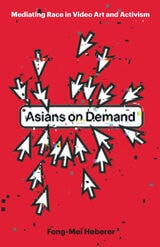
Asians on Demand
Mediating Race in Video Art and ActivismFeng-Mei Heberer
University of Minnesota Press, 2023
Does media representation advance racial justice?
While the past decade has witnessed a push for increased diversity in visual media, Asians on Demand grapples with the pressing question of whether representation is enough to advance racial justice. Surveying a contemporary, cutting-edge archive of video works from the Asian diaspora in North America, Europe, and East Asia, this book uncovers the ways that diasporic artists challenge the narrow—and damaging—conceptions of Asian identity pervading mainstream media.
Through an engagement with grassroots activist documentaries, experimental video diaries by undocumented and migrant workers, and works by high-profile media artists such as Hito Steyerl and Ming Wong, Feng-Mei Heberer showcases contemporary video productions that trouble the mainstream culture industry’s insistence on portraying ethnic Asians as congenial to dominant neoliberal values. Undermining the demands placed on Asian subjects to exemplify institutional diversity and individual exceptionalism, this book provides a critical and nuanced set of alternatives to the easily digestible forms generated by online streaming culture and multicultural lip service more broadly.
Employing feminist, racial, and queer critiques of the contemporary media landscape, Asians on Demand highlights how the dynamics of Asian representation play out differently in Germany, the United States, Taiwan, and Spain. Rather than accepting the notion that inclusion requires an uncomplicated set of appearances, the works explored in this volume spotlight a staunch resistance to formulating racial identity as an instantly accessible consumer product.