Results by title
6 books match the query 'Activist'
Athlete and Activist
28 Sports Stars Who Changed the GameJules Boykoff, Alex C. Davis, and Amira Rose Davis Illustrations by Martin French
University of Illinois Press, 2026
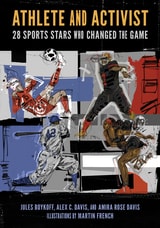
Athlete and Activist highlights sports figures who risked their popularity and even their careers to stand against injustice. Each profile takes readers inside the issues that motivated an athlete’s activism. Striking portraits by award-winning illustrator Martin French add a visual dimension to the dramatic stories. Throughout, the authors show athletes using different kinds of activism. Some spoke out. Others performed silent gestures. Still others let their success speak for itself.
A different kind of sports history, Athlete and Activist is an inspiring look at heroic acts beyond our favorite games.
Reclaiming Queer
Activist and Academic Rhetorics of ResistanceErin J. Rand
University of Alabama Press, 2014
An examination of the rhetorical linkage of queer theory in the academy with street-level queer activism in the 1980s and early 1990s
The late 1980s and early 1990s were a defining historical moment for both queer activism and queer theory in the United States. LGBTQ communities, confronted with the fatal indifference and homophobia of the AIDS crisis, often responded with angry, militant forms of activism designed not merely to promote acceptance or tolerance, but to forge identity and strength from victimization and assert loudly and forcefully their rights to safety and humanity. The activist reclamation of the word “queer” is one marker of this shift in ideology and practice, and it was mirrored in academic circles by the concurrent emergence of the new field of “queer theory.” That is, as queer activists were mobilizing in the streets, queer theorists were producing a similar foment in the halls and publications of academia, questioning regulatory categories of gender and sexuality, and attempting to illuminate the heteronormative foundations of Western thought. Notably, the narrative of queer theory’s development often describes it as arising from or being inspired by queer activism.
In Reclaiming Queer, Erin J. Rand examines both queer activist and academic practices during this period, taking as her primary object the rhetorical linkage of queer theory in the academy with street-level queer activism. Through this strategic conjuncture of activism and academia, Rand grapples with the specific conditions for and constraints on rhetorical agency in each context. She examines the early texts that inaugurated the field of queer theory, Queer Nation’s infamous “Queers Read This” manifesto, Larry Kramer’s polemic speeches and editorials, the Lesbian Avengers’ humorous and outrageous antics, the history of ACT UP, and the more recent appearance of Gay Shame activism. From these activist and academic discourses, Rand builds a theory of rhetorical agency that posits queerness as the very condition from which agency emerges.
Reclaiming Queer thus offers a critical look at the rhetoric of queer activism, engages the history of queer theory’s institutionalization and the politics of its proliferation, suggests a radically contextual understanding of rhetorical agency and form, and argues for the centrality of queerness to all rhetorical action.
The Diaries of Carol Lynn Pearson—Mormon Author, Feminist, and Activist
Volume 1: 1956–1990Pearson, Carol Lynn
Signature Books, 2025
“I feel somehow that of all the writing I am doing, my diary is the most important.” So wrote the beloved and bestselling author, poet, and playwright Carol Lynn Pearson in her 1979 diary. Several years before, she recorded, “I feel the imperative of history. . . . Add that to my being a household word to many and I cannot escape the feeling that in many years there might be a number of people interested in these pages.” That time has now come.
Unbeknownst to almost everyone but herself, Pearson kept a near-daily diary since she was a teenager, recording her remarkable story in the context of twentieth- and twenty-first-century Mormon America. In this first of a four-volume series, Pearson chronicles her love for her church but also her troubling experiences and concerns with its patriarchy, historic doctrine of polygamy, omission of a feminine divine, and homophobia. Readers will rejoice with her as her first book of poetry, Beginnings, sells an astonishing 150,000+ copies and puts her on the map in the 1960s, empathize with her as she watches her church help kill the Equal Rights Amendment in the 1970s, and mourn with her as her mixed-orientation marriage ends and she cares for her former husband in her home as he dies of AIDS in the 1980s. The sensitive-girl-turned-strong-woman who emerges in these diaries insists that we move from patriarchy into partnership, change our destructive policies towards Queer people, and invite God the Mother back into our heavenly family.
The Diaries of Carol Lynn Pearson—Mormon Author, Feminist, and Activist
Volume 2: 1990–2002Pearson, Carol Lynn
Signature Books, 2026
Of these years of her life, poet, writer, and feminist Carol Lynn Pearson says, “The plot thickens, as all good plots do. My life and your life—if we are brave enough—move into areas that we had not anticipated. We feel sometimes that we want to run back to safer ground, but life has decided otherwise and so we take those next steps. Volume two of my diaries gives us a closeup of the years 1990 to 2002, bringing us an abundance of both joy and distress.”
Throughout the 1990s, Pearson records and laments her church’s efforts to punish scholars and activists while celebrating the success of her books and one-woman play, Mother Wove the Morning. Along the way, she comforts the suffering, endures terrible personal loss, and witnesses the fall of the Twin Towers on 9/11. “Bless everyone who fights for what is right,” she writes. Few have fought harder than Carol Lynn Pearson.
The Diaries of Carol Lynn Pearson—Mormon Author, Feminist, and Activist
Volume 3: 2003–2014Pearson, Carol Lynn
Signature Books, 2026
Proposition 8, the 2008 California ballot initiative that overturned the state’s legalization of same-sex marriage, looms large in volume 3 of Carol Lynn Pearson’s diaries. The intense lobbying in favor of the measure by the Church of Jesus Christ of Latter-day Saints caused widespread protests against the church and rifts within congregations, families, and friendships that felt like they might never heal. Pearson documented it all.
When she learned through friends close to church leaders that members of the First Presidency and Quorum of Twelve Apostles were shocked by the backlash, she wondered, “How do 15 prophets, seers, and revelators not see this coming when the rest of us did?”
A lifelong feminist, Pearson’s diaries also reveal her concerns for gender equality. She chronicles her observations of Ordain Women, a movement by a group of Latter-day Saint feminists who lobbied to change the church’s all-male priesthood. At the end of this volume, Pearson takes on yet another issue: the ongoing Mormon doctrine that polygamy is practiced in the eternities. Pearson heard from thousands of women who feared that they would be forced to share their husbands in the afterlife. The pain of these women propelled her forward into her next book project, challenging the doctrine of “eternal polygamy.”
Even as she faced her own struggles, Pearson buoyed up those around her. She took phone calls, answered letters, and comforted visitors who were hurting because of the church’s policies. She was, for many, a symbol of hope.
The Diaries of Carol Lynn Pearson—Mormon Author, Feminist, and Activist
Volume 4: 2014–2024Pearson, Carol Lynn
Signature Books, 2026
This fourth and final volume of The Diaries of Carol Lynn Pearson is full of contradictions as it covers turbulent world events and intimate details in her life. Pearson remains a beacon of light and hope for many, even as she struggles with her own sorrows.
She embarks on a new project that consumes her: the Latter-day Saint doctrine that polygamy will exist in the afterlife. Pearson also continues to document contemporaneous events in the modern history of the Church of Jesus Christ of Latter-day Saints, including the church’s November 2015 policy that discriminated against LGBTQ+ members and their children. She has both a grassroots perspective as a member of a California congregation and special insight into the decisions of LDS leadership, thanks to friends who keep her informed of what’s happening at the highest levels of the church.
Through it all, Pearson mourns when she says goodbye to longtime friends who die. In July 2026, after she completed her diary project, death finally came for Carol Lynn Pearson after 86 years. Her unique voice cannot be replicated.