Results by title
4 books match the query 'Adams, John'
Abigail and John Adams
The Americanization of SensibilityG. J. Barker-Benfield
University of Chicago Press, 2010
During the many years that they were separated by the perils of the American Revolution, John and Abigail Adams exchanged hundreds of letters. Writing to each other of public events and private feelings, loyalty and love, revolution and parenting, they wove a tapestry of correspondence that has become a cherished part of American history and literature.
With Abigail and John Adams, historian G. J. Barker-Benfield mines those familiar letters to a new purpose: teasing out the ways in which they reflected—and helped transform—a language of sensibility, inherited from Britain but, amid the revolutionary fervor, becoming Americanized. Sensibility—a heightened moral consciousness of feeling, rooted in the theories of such thinkers as Descartes, Locke, and Adam Smith and including a “moral sense” akin to the physical senses—threads throughout these letters. As Barker-Benfield makes clear, sensibility was the fertile, humanizing ground on which the Adamses not only founded their marriage, but also the “abhorrence of injustice and inhumanity” they and their contemporaries hoped to plant at the heart of the new nation. Bringing together their correspondence with a wealth of fascinating detail about life and thought, courtship and sex, gender and parenting, and class and politics in the revolutionary generation and beyond, Abigail and John Adams draws a lively, convincing portrait of a marriage endangered by separation, yet surviving by the same ideas and idealism that drove the revolution itself.
A feast of ideas that never neglects the real lives of the man and woman at its center, Abigail and John Adams takes readers into the heart of an unforgettable union in order to illuminate the first days of our nation—and explore our earliest understandings of what it might mean to be an American.
John Adams vs Thomas Paine
Rival Plans for the Early RepublicJett B. Conner
Westholme Publishing, 2018
Initially admiring Thomas Paine’s efforts for independence, John Adams nevertheless was rattled by the political philosophy of Common Sense and responded to it by publishing his Thoughts on Government to counteract Paine’s proposals, which Adams said were far too “democratical.” Although John Adams is given credit for his substantive contributions to American constitutionalism, especially his notions of separation of powers, checks and balances, and representation, in John Adams vs Thomas Paine: Rival Plans for the Early Republic, historian Jett B. Conner makes the case that Thomas Paine was more than just a revolutionary figure who spurred Americans toward declaring independence. Common Sense made important contributions to American constitutional thought, too, particularly its call for more equal representation, popular sovereignty, a constitutional convention, and a federal system of governance with a strong central government. The book explores how the two rivals helped shape America’s first constitutions—the Articles of Confederation and those of several states— and how they continued contributing to American political thought as it developed during the so-called “critical period” between the adoption of the Articles of Confederation and the start of the Constitutional Convention of 1787. It also focuses on the creation of our democratic republic and compares Paine’s and Adams’s approaches to structuring constitutions to ensure free government while guarding against abuses of power and the excesses of democratic majorities. An abridged version of Common Sense and the short but complete Thoughts on Government are included in an appendix for easy reader reference.
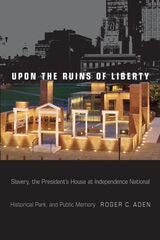
Upon the Ruins of Liberty
Slavery, the President's House at Independence National Historical Park, and Public MemoryRoger C. Aden
Temple University Press, 2014
In Upon the Ruins of Liberty, Roger Aden offers a compelling account that explores the development of this important historic site and how history, space, and public memory intersected with contemporary racial politics. Aden constructs this engrossing tale by drawing on archival material and interviews with principal figures in the controversy-including historian Ed Lawler, site activist Michael Coard, and site designer Emanuel Kelly.
Upon the Ruins of Liberty chronicles the politically-charged efforts to create a fitting tribute to the place where George Washington (and later, John Adams) shaped the presidency while denying freedom to the nine enslaved Africans in his household. From design to execution, the plans prompted advocates to embrace stories informed by race, and address difficulties that included how to handle the results of the site excavation. As such, this landmark project raised concerns and provided lessons about the role of public memory and how places are made to shape the nation's identity.
You and Your Deaf Child
A Self-Help Guide for Parents of Deaf and Hard of Hearing ChildrenJohn Adams
Gallaudet University Press, 1997
You and Your Deaf Child is a guide for parents of deaf or hard of hearing children that explores how parents and their children interact. It examines the special impact of having a deaf child in the family.
Eleven chapters focus on such topics as feelings about hearing loss, the importance of communication in the family, and effective behavior management. Many chapters contain practice activities and questions to help parents retain skills taught in the chapter and check their grasp of the material. Four appendices provide references, general resources, and guidelines for evaluating educational programs.
Once parents have worked through You and Your Deaf Child, this friendly guide can be referred to for specific information and advice as different situations arise.