Results by title
19 books match the query 'Aeschylus'
A Commentary on The Complete Greek Tragedies. Aeschylus
James C. Hogan
University of Chicago Press, 1985
James C. Hogan provides a general introduction to Aeschylean theater and drama, followed by a line-by-line commentary on each of the seven plays. He places Aeschylus in the historical, cultural, and religious context of fifth-century Athens, showing how the action and metaphor of Aeschylean theater can be illuminated by information on Athenian law athletic contests, relations with neighboring states, beliefs about the underworld, and countless other details of Hellenic life. Hogan clarifies terms that might puzzle modern readers, such as place names and mythological references, and gives special attention to textual and linguistic issues: controversial questions of interpretation; difficult or significant Greek words; use of style, rhetoric, and commonplaces in Greek poetry; and Aeschylus's place in the poetic tradition of Homer, Hesiod, and the elegiac poets. Practical information on staging and production is also included, as are maps and illustrations, a bibliography, indexes, and extensive cross-references between the seven plays. Forthcoming volumes will cover the works of Sophocles and Euripides.
Aeschylus I
The Persians, The Seven Against Thebes, The Suppliant Maidens, Prometheus BoundEdited and Translated by David Grene, Richmond Lattimore, Mark Griffith, and Glenn W. Most
University of Chicago Press, 2013
The most engaging and authoritative translation of some of the foundational works of Western culture
This volume collects careful, readable translations of some of the key works of Aeschylus by experts in the language and culture of the ancient Greek world in which he lived and wrote. Aeschylus I contains “The Persians,” translated by Seth Benardete; “The Seven Against Thebes,” translated by David Grene; “The Suppliant Maidens,” translated by Seth Benardete; and “Prometheus Bound,” translated by David Grene.
For this edition, series editors Mark Griffith and Glenn W. Most have carefully updated the translations to bring them even closer to the ancient Greek while retaining the vibrancy for which our English versions are famous.New introductions for each play offer essential information about its first production, plot, and reception in antiquity and beyond. In addition, each volume includes an introduction to the life and work of its tragedian, as well as notes addressing textual uncertainties and a glossary of names and places mentioned in the plays.
Aeschylus II
The OresteiaEdited and Translated by David Grene, Richmond Lattimore, Mark Griffith, and Glenn W. Most
University of Chicago Press, 2013
Aeschylus II contains “The Oresteia,” translated by Richmond Lattimore, and fragments of “Proteus,” translated by Mark Griffith.
Many years ago, the University of Chicago Press undertook a momentous project: a new translation of the Greek tragedies that would be the ultimate resource for teachers, students, and readers. They succeeded. Under the expert management of eminent classicists David Grene and Richmond Lattimore, those translations combined accuracy, poetic immediacy, and clarity of presentation to render the surviving masterpieces of Aeschylus, Sophocles, and Euripides in an English so lively and compelling that they remain the standard translations. The updated third editions of these classic works were designed to ensure that our Greek tragedies remain the leading English-language versions throughout the twenty-first century.
In this highly anticipated third edition, Mark Griffith and Glenn W. Most have carefully updated the translations to bring them even closer to the ancient Greek while retaining the vibrancy for which our English versions are famous. This edition also includes brand-new translations of Euripides’ Medea, The Children of Heracles, Andromache, and Iphigenia among the Taurians, fragments of lost plays by Aeschylus, and the surviving portion of Sophocles’s satyr-drama The Trackers. New introductions for each play offer essential information about its first production, plot, and reception in antiquity and beyond. In addition, each volume includes an introduction to the life and work of its tragedian, as well as notes addressing textual uncertainties and a glossary of names and places mentioned in the plays.
In addition to the new content, the volumes have been reorganized both within and between volumes to reflect the most up-to-date scholarship on the order in which the plays were originally written. The result is a set of handsome paperbacks destined to introduce new generations of readers to these foundational works of Western drama, art, and life.
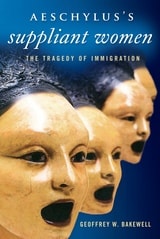
Aeschylus’s Suppliant Women
The Tragedy of ImmigrationGeoffrey W. Bakewell
University of Wisconsin Press, 2013
Agamemnon
Aeschylus, A verse translation by David Mulroy, with introduction and notes
University of Wisconsin Press, 2015
Aeschylus (525/4–456/5 B.C.E.) was the first of the three great tragic dramatists of ancient Greece, a forerunner of Sophocles and Euripides. His early tragedies were largely choral pageants with minimal plots. In Agamemnon, choral songs still predominate, but Aeschylus infuses them with such dramatic feeling that the spectator or reader is constantly spellbound.
Translator David Mulroy brings this ancient tragedy to life for modern readers and audiences. Using end rhyme and strict metrics, he combines the buoyant lyricism of the Greek text with a faithful rendering of its meaning in lucid English.
City of Suppliants
Tragedy and the Athenian EmpireBy Angeliki Tzanetou
University of Texas Press, 2012
After fending off Persia in the fifth century BCE, Athens assumed a leadership position in the Aegean world. Initially it led the Delian League, a military alliance against the Persians, but eventually the league evolved into an empire with Athens in control and exacting tribute from its former allies. Athenians justified this subjection of their allies by emphasizing their fairness and benevolence towards them, which gave Athens the moral right to lead. But Athenians also believed that the strong rule over the weak and that dominating others allowed them to maintain their own freedom. These conflicting views about Athens’ imperial rule found expression in the theater, and this book probes how the three major playwrights dramatized Athenian imperial ideology.
Through close readings of Aeschylus’ Eumenides, Euripides’ Children of Heracles, and Sophocles’ Oedipus at Colonus, as well as other suppliant dramas, Angeliki Tzanetou argues that Athenian tragedy performed an important ideological function by representing Athens as a benevolent and moral ruler that treated foreign suppliants compassionately. She shows how memorable and disenfranchised figures of tragedy, such as Orestes and Oedipus, or the homeless and tyrant-pursued children of Heracles were generously incorporated into the public body of Athens, thus reinforcing Athenians’ sense of their civic magnanimity. This fresh reading of the Athenian suppliant plays deepens our understanding of how Athenians understood their political hegemony and reveals how core Athenian values such as justice, freedom, piety, and respect for the laws intersected with imperial ideology.
Claudel & Aeschylus
A Study of Claudel's Translation of the OresteiaWilliam H. Matheson
University of Michigan Press, 1965
Electras
Aeschylus, Sophocles, and EuripidesMichael Davis
St. Augustine's Press, 2023
Davis accomplishes much more than an exegetical bridge as he connects us with ancient memory and wisdom. "When we cannot resist the temptation to recoil morally from their terminology, we risk the tragedy of losing their profound thoughts about our humanity––their philosophical anthropology." Davis has remarkably made of a niche study a stunning source material for more universal questions. This is a book that is as timely as it is ageless.
Greek Tragedies 2
Aeschylus: The Libation Bearers; Sophocles: Electra; Euripides: Iphigenia among the Taurians, Electra, The Trojan WomenEdited by Mark Griffith, Glenn W. Most, David Grene, and Richmond Lattimore
University of Chicago Press, 2013
Greek Tragedies 3
Aeschylus: The Eumenides; Sophocles: Philoctetes, Oedipus at Colonus; Euripides: The Bacchae, AlcestisEdited by Mark Griffith, Glenn W. Most, David Grene, and Richmond Lattimore
University of Chicago Press, 2013
Intimate Commerce
Exchange, Gender, and Subjectivity in Greek TragedyBy Victoria Wohl
University of Texas Press, 1997
Exchanges of women between men occur regularly in Greek tragedy—and almost always with catastrophic results. Instead of cementing bonds between men, such exchanges rend them. They allow women, who should be silent objects, to become monstrous subjects, while men often end up as lifeless corpses. But why do the tragedies always represent the transferal of women as disastrous?
Victoria Wohl offers an illuminating analysis of the exchange of women in Sophocles' Trachiniae, Aeschylus' Agamemnon, and Euripides' Alcestis. She shows how the attempts of women in these plays to become active subjects rather than passive objects of exchange inevitably fail. While these failures seem to validate male hegemony, the women's actions, however futile, blur the distinction between male subject and female object, calling into question the very nature of the tragic self. What the tragedies thus present, Wohl asserts, is not only an affirmation of Athens' reigning ideologies (including its gender hierarchy) but also the possibility of resistance to them and the imagination of alternatives.
Musical Design in Aeschylean Theater
William C. Scott
Dartmouth College Press, 2000
Reciprocity, Truth, and Gender in Pindar and Aeschylus
Arum Park
University of Michigan Press, 2023

The Complete Greek Tragedies, Volume 1
AeschylusEdited by David Grene and Richmond Lattimore
University of Chicago Press, 1992
For the Centennial Edition two of the original translations have been replaced. In the original publication David Grene translated only one of the three Theban plays, Oedipus the King. Now he has added his own translations of the remaining two, Oedipus at Colonus and Antigone, thus bringing a new unity of tone and style to this group. Grene has also revised his earlier translation of Prometheus Bound and rendered some of the former prose sections in verse. These new translations replace the originals included in the paperback volumes Sophocles I (which contains all three Theban plays), Aeschylus II, Greek Tragedies, Volume I, and Greek Tragedies, Volume III, all of which are now being published in second editions.
All other volumes contain the translations of the tragedies of Aeschylus, Sophocles, and Euripides for the most part from the original versions first published in the 1940s and 1950s. These translations have been the choice of generations of teachers and students, selling in the past forty years over three million copies.
The Complete Greek Tragedies
Aeschylus IEdited by David Grene and Richmond Lattimore
University of Chicago Press, 1969
"This is it. No qualifications. Go out and buy it everybody."—Kenneth Rexroth, The Nation
"The translations deliberately avoid the highly wrought and affectedly poetic; their idiom is contemporary....They have life and speed and suppleness of phrase."—Times Education Supplement
"These translations belong to our time. A keen poetic sensibility repeatedly quickens them; and without this inner fire the most academically flawless rendering is dead."—Warren D. Anderson, American Oxonian
"The critical commentaries and the versions themselves...are fresh, unpretentious, above all, functional."—Commonweal
"Grene is one of the great translators."—Conor Cruise O'Brien, London Sunday Times
"Richmond Lattimore is that rara avis in our age, the classical scholar who is at the same time an accomplished poet."—Dudley Fitts, New York Times Book Review
The Complete Greek Tragedies
Aeschylus IIEdited by David Grene and Richmond Lattimore
University of Chicago Press, 1991
For the Centennial Edition two of the original translations have been replaced. In the original publication David Grene translated only one of the three Theban plays, Oedipus the King. Now he has added his own translations of the remaining two, Oedipus at Colonus and Antigone, thus bringing a new unity of tone and style to this group. Grene has also revised his earlier translation of Prometheus Bound and rendered some of the former prose sections in verse. These new translations replace the originals included in the paperback volumes Sophocles I (which contains all three Theban plays), Aeschylus II, Greek Tragedies, Volume I, and Greek Tragedies, Volume III, all of which are now being published in second editions.
All other volumes contain the translations of the tragedies of Aeschylus, Sophocles, and Euripides for the most part from the original versions first published in the 1940s and 1950s. These translations have been the choice of generations of teachers and students, selling in the past forty years over three million copies.
The Greek Tragedies
Seventeen Plays by Aeschylus, Sophocles, and EuripidesAeschylus, Sophocles, and Euripides
University of Chicago Press, 2025
The most authoritative, accessible, and poetic translations of the Greek Tragedies ever produced, now in one volume!
Drawn from the authoritative third editions of David Grene and Richmond Lattimore’s collections of the complete Greek tragedies, expertly updated by Mark Griffith and Glenn W. Most, this collection brings together seventeen of the greatest surviving plays of ancient Greece. Combining accuracy, poetic immediacy, and clarity of presentation, the masterpieces of Aeschylus, Sophocles, and Euripides have been rendered so compellingly in English that they remain the definitive translations. Each text has been carefully updated to bring it even closer to the ancient Greek original while retaining the vibrancy for which Chicago’s versions are famous.
Alongside the plays, this edition includes an introduction to the life and work of each tragedian; an introduction to each play offering essential information about its first production, plot, and reception through the centuries; and notes addressing textual uncertainties. Featuring lively translations by eminent classicists and authors including Anne Carson, Robert Fitzgerald, David Grene, Richmond Lattimore, Oliver Taplin, Emily Townsend Vermeule, and Elizabeth Wyckoff, this is an indispensable anthology for any reader of the foundational works of Western drama, art, and life.
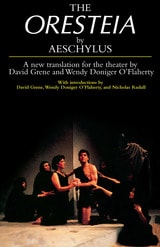
The Oresteia
Aeschylus
University of Chicago Press, 1989
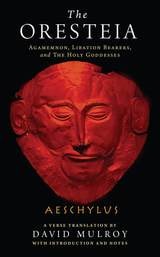
The Oresteia
Agamemnon, Libation Bearers, and The Holy GoddessesAeschylus, A verse translation by David Mulroy, with introduction and notes
University of Wisconsin Press, 2018
This drama of the House of Atreus catches everyone in a bloody net. Queen Clytaemestra of Argos murders her husband Agamemnon. Their son Orestes avenges his father by killing his mother. The Furies, hideous deities who punish the murder of blood kin, pursue Orestes. Into this horrific cycle steps Athena, goddess of wisdom, who establishes the rule of law to replace fatal vengeance. Orestes is tried in court before a jury of Athenians and found not guilty. Athena transforms the Furies into benevolent goddesses and extols the virtue of mercy.
An important historical document as well as gripping entertainment, the Oresteia conveys beliefs and values of the ancient Athenians as they established the world's first great democracy. Aeschylus (525/4–456/5 B.C.E.) was the first of the three great tragic dramatists of ancient Greece, forerunner of Sophocles and Euripides. In this trilogy he created a new dramatic form with characters and plot, infused with spellbinding emotion. David Mulroy's fluid, accessible English translation with its rhyming choral songs does full justice to the meaning and theatricality of the ancient Greek. In an introduction and appendixes, he provides cultural background for modern readers, actors, and students.