Results by title
4 books match the query 'Aesthetic Experience'
Aesthetic Experience and Literary Hermeneutics
Jauss, Hans Robert
University of Minnesota Press, 1982
[more]

Intelligent Action
A History of Artistic Research, Aesthetic Experience, and Artists in AcademiaTimothy Ridlen
Rutgers University Press, 2024
Through archival research and analysis of artworks by Gyorgy Kepes, Allan Kaprow, Mel Bochner, and Suzanne Lacy, among others, Intelligent Action examines how these artists brought alternatives to dominant conceptions of research and knowledge production. The book is organized around specific institutional formations—artistic research centers, proposals, exhibitions on college campuses, and the establishment of new schools or pedagogic programs. Formal and social analysis demonstrate how artists responded to ideas of research, knowledge production, information, and pedagogy. Works discussed were produced between 1958 and 1975, a moment when boundaries between media were breaking down in response to technological, cultural, and generational change. In the context of academia, these artistic practices have taken up the look, feel, or language of various research and teaching practices. In some cases, artists bent to the demands of the cold war research university, while in others, artists developed new modes of practice and pedagogy. Reading these works through their institutional histories, author Tim Ridlen shows how artistic research practices and artistic subjectivity developed in the long 1960s within and alongside academia, transforming the role of artists in the process.
[more]
The Phenomenology of Aesthetic Experience
Mikel Dufrenne
Northwestern University Press, 1973
The Phenomenology of Aesthetic Experience (Fr. Phénoménologie de l'expérience esthétique) was first published in 1953. In the first of four parts, Dufrenne distinguishes the "aesthetic object" from the "work of art." In the second, he elucidates types of works of art, especially music and painting. He devotes his third section to aesthetic perception. In the fourth, he describes a Kantian critique of aesthetic experience.
A perennial classic in the SPEP series, the work is rounded out by a detailed "Translator's Foreword" especially helpful to readers in aesthetics interested in the context and circumstances around which the original was published as well as the phenomenological background of the book.
A perennial classic in the SPEP series, the work is rounded out by a detailed "Translator's Foreword" especially helpful to readers in aesthetics interested in the context and circumstances around which the original was published as well as the phenomenological background of the book.
[more]
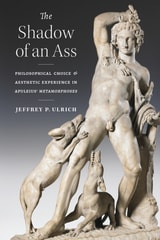
The Shadow of an Ass
Philosophical Choice and Aesthetic Experience in Apuleius' MetamorphosesJeffrey P. Ulrich
University of Michigan Press, 2024
Jeffrey Ulrich’s The Shadow of an Ass addresses fundamental questions about the reception and aesthetic experience of Apuleius’ Metamorphoses, popularly known as The Golden Ass, by situating the novel in a contemporaneous literary and philosophical discourse emerging in the Second Sophistic. This unique Latin novel follows a man who is accidentally turned into a donkey because of his curiosity, viewing the world through a donkey’s eyes until he is returned to human form by the Egyptian goddess Isis. In the end, he chooses to become a cult initiate and priest instead of a debased and overindulgent ass. On the one hand, the novel encourages readers to take pleasure in the narrator’s experiences, as he relishes food, sex, and forbidden forms of knowledge. Simultaneously, it challenges readers to reconsider their participation in the story by exposing its donkey-narrator as a failed model of heroism and philosophical investigation. Ulrich interprets the Metamorphoses as a locus of philosophical inquiry, positioning the act of reading as a choice of how much to invest in this tale of pleasurable transformation and unanticipated conversion. The Shadow of an Ass further explores how Apuleius, as a North African philosopher translating an originally Greek novel into a Latin idiolect, transforms himself into an intermediary of Platonic philosophy for his Carthaginian audience.
Situating the novel in a long history of philosophical and literary conversations, Ulrich suggests that the Metamorphoses anticipates much of the philosophical burlesque we tend to associate with early modern fiction, from Don Quixote to Lewis Carroll.
Situating the novel in a long history of philosophical and literary conversations, Ulrich suggests that the Metamorphoses anticipates much of the philosophical burlesque we tend to associate with early modern fiction, from Don Quixote to Lewis Carroll.
[more]