Results by title
2 books match the query 'Aesthetics, French'
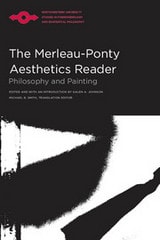
The Merleau-Ponty Aesthetics Reader
Philosophy and PaintingEdited and with an Introduction by Galen A. Johnson; Michael B. Smith, Translation Editor
Northwestern University Press, 1993
Merleau-Ponty's essays on aesthetics are some of the major accomplishments of his philosophical career, and rank even today among the most sophisticated reflections on art in all of twentieth-century philosophy. His essays on painting, "Cezanne's Doubt" (1945), "Indirect Language and the Voices of Silence" (1952), and "Eye and Mind" (1960), have inspired new approaches to epistemology, ontology, and the philosophy of history. Galen A. Johnson has gathered these essays for the first time into a single volume and augmented them with essays by distinguished scholars and artists, including M.C. Dillon, Mikel Dufrenne, and René Magritte. Together the essays demonstrate the continuing significance of Merleau-Ponty's ideas about art for contemporary philosophy on both sides of the Atlantic.
[more]

The Surprising Effects of Sympathy
Marivaux, Diderot, Rousseau, and Mary ShelleyDavid Marshall
University of Chicago Press, 1988
Through readings of works by Marivaux, Diderot, Rousseau, and Mary Shelley, David Marshall provides a new interpretation of the eighteenth-century preoccupation with theatricality and sympathy. Sympathy is seen not as an instance of sensibility or natural benevolence but rather as an aesthetic and epistemological problem that must be understood in relation to the problem of theatricality.
Placing novels in the context of eighteenth-century writing about theater, fiction, and painting, Marshall argues that an unusual variety of authors and texts were concerned with the possibility of entering into someone else's thoughts and feelings. He shows how key eighteenth-century works reflect on the problem of how to move, touch, and secure the sympathy of readers and beholders in the realm of both "art" and "life." Marshall discusses the demands placed upon novels to achieve certain effects, the ambivalence of writers and readers about those effects, and the ways in which these texts can be read as philosophical meditations on the differences and analogies between the experiences of reading a novel, watching a play, beholding a painting, and witnessing the spectacle of someone suffering. The Surprising Effects of Sympathy traces the interaction of sympathy and theater and the artistic and philosophical problems that these terms represent in dialogues about aesthetics, moral philosophy, epistemology, psychology, autobiography, the novel, and society.
Placing novels in the context of eighteenth-century writing about theater, fiction, and painting, Marshall argues that an unusual variety of authors and texts were concerned with the possibility of entering into someone else's thoughts and feelings. He shows how key eighteenth-century works reflect on the problem of how to move, touch, and secure the sympathy of readers and beholders in the realm of both "art" and "life." Marshall discusses the demands placed upon novels to achieve certain effects, the ambivalence of writers and readers about those effects, and the ways in which these texts can be read as philosophical meditations on the differences and analogies between the experiences of reading a novel, watching a play, beholding a painting, and witnessing the spectacle of someone suffering. The Surprising Effects of Sympathy traces the interaction of sympathy and theater and the artistic and philosophical problems that these terms represent in dialogues about aesthetics, moral philosophy, epistemology, psychology, autobiography, the novel, and society.
[more]