Results by title
8 books match the query 'Africa, Central'
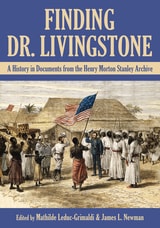
Finding Dr. Livingstone
A History in Documents from the Henry Morton Stanley ArchivesMathilde Leduc-Grimaldi
Ohio University Press, 2020
This eye-opening perspective on Stanley’s expedition reveals new details about the Victorian explorer and his African crew on the brink of the colonial Scramble for Africa.
In 1871, Welsh American journalist Henry M. Stanley traveled to Zanzibar in search of the “missing” Scottish explorer and missionary David Livingstone. A year later, Stanley emerged to announce that he had “found” and met with Livingstone on Lake Tanganyika. His alleged utterance there, “Dr. Livingstone, I presume,” was one of the most famous phrases of the nineteenth century, and Stanley’s book, How I Found Livingstone, became an international bestseller.
In this fascinating volume Mathilde Leduc-Grimaldi and James L. Newman transcribe and annotate the entirety of Stanley’s documentation, making available for the first time in print a broader narrative of Stanley’s journey that includes never-before-seen primary source documents—worker contracts, vernacular plant names, maps, ruminations on life, lines of poetry, bills of lading—all scribbled in his field notebooks.
Finding Dr. Livingstone is a crucial resource for those interested in exploration and colonization in the Victorian era, the scientific knowledge of the time, and the peoples and conditions of Tanzania prior to its colonization by Germany.
Forgotten Friendships
Yugoslavia and the Anticolonial Francophone WorldAlexandra Perišic
Amherst College Press, 2025
Forgotten Friendships: Yugoslavia and the Anticolonial Francophone World examines transnational friendships and alliances between intellectuals from Yugoslavia and the Francophone African and Caribbean world during the mid-twentieth century. The book argues that transnational political friendships helped shape major intellectual movements like Négritude, African socialism, and global socialist feminisms, which surged beyond national, regional, and even diasporic spaces. Blending archival research, literary analysis, and biography, the book fills a significant gap in our understanding of how intellectuals from the Global South and the socialist world collaborated on shared goals of decolonization, anti-racism, and socialist worldmaking.
Forgotten Friendships emphasizes the ways in which writers, intellectuals, and activists envisioned alternative futures rooted in collaboration across peripheries. Personal bonds of friendship were not mere footnotes to the anti-colonial struggle, but vital political tools for rethinking global solidarity.
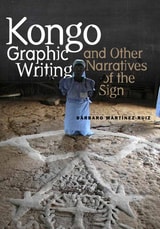
Kongo Graphic Writing and Other Narratives of the Sign
Barbaro Martinez-Ruiz
Temple University Press, 2013
Author Bárbaro Martínez-Ruiz, a practitioner of the Palo Monte devotional arts, illustrates with graphics and rock art how the Bakongo’s ideographic and pictographic signs are used to organize daily life, enable interactions between humans and the natural and spiritual worlds, and preserve and transmit cosmological and cosmogonical belief systems.
Exploring cultural diffusion and exchange, collective memory and identity, Kongo Graphic Writing and Other Narratives of the Sign artfully brings together analyses of the complex interconnections among Kongo traditions of religion, philosophy and visual/gestural communication on both sides of the African Atlantic world.
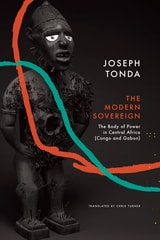
Modern Sovereign
The Body of Power in Central Africa (Congo and Gabon)Joseph Tonda
Seagull Books, 2020
Paths in the Rainforests
Toward a History of Political Tradition in Equatorial AfricaJan M. Vansina
University of Wisconsin Press, 1990
Vansina’s scope is breathtaking: he reconstructs the history of the forest lands that cover all or part of southern Cameroon, Gabon, Equatorial Guinea, the Congo, Zaire, the Central African Republic, and Cabinda in Angola, discussing the original settlement of the forest by the western Bantu; the periods of expansion and innovation in agriculture; the development of metallurgy; the rise and fall of political forms and of power; the coming of Atlantic trade and colonialism; and the conquest of the rainforests by colonial powers and the destruction of a way of life.
“In 400 elegantly brilliant pages Vansina lays out five millennia of history for nearly 200 distinguishable regions of the forest of equatorial Africa around a new, subtly paradoxical interpretation of ‘tradition.’” —Joseph Miller, University of Virginia
“Vansina gives extended coverage . . . to the broad features of culture and the major lines of historical development across the region between 3000 B.C. and A.D. 1000. It is truly an outstanding effort, readable, subtle, and integrative in its interpretations, and comprehensive in scope. . . . It is a seminal study . . . but it is also a substantive history that will long retain its usefulness.”—Christopher Ehret, American Historical Review
Rational Empires
Institutional Incentives and Imperial ExpansionLeo J. Blanken
University of Chicago Press, 2012
The nineteenth century marked the high point of imperialism, when tsarist Russia expanded to the Pacific and the sun was said never to set on the British Empire. Imperialism remains a perennial issue in international relations today, and nowhere is this more evident than in the intensifying competition for global resources.
Leo J. Blanken explains imperialism through an analysis of the institutions of both the expanding state and its targets of conquest. While democratic states favoring free trade generally resort to imperialism only to preempt aggressive rivals—or when they have reason to believe another state’s political institutions will not hold up when making bargains—authoritarian states tend toward imperialism because they don’t stand to benefit from free trade. The result is three distinct strategies toward imperialism: actors fighting over territory, actors peaceably dividing territory among themselves, and actors refraining from seizing territory altogether. Blanken examines these dynamics through three case studies: the scramble for Africa, the unequal treaties imposed on Qing Dynasty China, and the evolution of Britain’s imperial policy in India. By separating out the different types of imperialism, Blanken provides insight into its sources, as well as the potential implications of increased competition in the current international arena.
The Gun in Central Africa
A History of Technology and PoliticsGiacomo Macola
Ohio University Press, 2016
Why did some central African peoples embrace gun technology in the nineteenth century, and others turn their backs on it? In answering this question, The Gun in Central Africa offers a thorough reassessment of the history of firearms in central Africa. Marrying the insights of Africanist historiography with those of consumption and science and technology studies, Giacomo Macola approaches the subject from a culturally sensitive perspective that encompasses both the practical and the symbolic attributes of firearms.
Informed by the view that the power of objects extends beyond their immediate service functions, The Gun in Central Africa presents Africans as agents of technological re-innovation who understood guns in terms of their changing social structures and political interests. By placing firearms at the heart of the analysis, this volume casts new light on processes of state formation and military revolution in the era of the long-distance trade, the workings of central African gender identities and honor cultures, and the politics of the colonial encounter.
The Steamer Parish
The Rise and Fall of Missionary Medicine on an African FrontierCharles M. Good
University of Chicago Press, 2003
In The Steamer Parish, Charles M. Good Jr. traces the Mission's history and its lasting impact on public health care in south-central Africa-and shows how steam and medicine, together with theology, allowed the Mission to impose its will, indelibly, on hundreds of thousands of people. What's more, many of the issues he discusses-rural development, the ecological history of disease, and competition between western and traditional medicine-are as relevant today as they were 100 years ago.