Results by title
10 books match the query 'Africa, French-speaking West'
A Ritual Geology
Gold and Subterranean Knowledge in Savanna West AfricaRobyn d'Avignon
Duke University Press, 2022
Africa's Last Colonial Currency
The CFA Franc StoryFanny Pigeaud
Pluto Press, 2021

Africa's Last Colonial Currency
The CFA Franc StoryFanny Pigeaud
Pluto Press, 2021
Militarizing Marriage
West African Soldiers’ Conjugal Traditions in Modern French EmpireSarah J. Zimmerman
Ohio University Press, 2020
Following tirailleurs sénégalais’ deployments in West Africa, Congo, Madagascar, North Africa, Syria-Lebanon, Vietnam, and Algeria from the 1880s to 1962, Militarizing Marriage historicizes how African servicemen advanced conjugal strategies with women at home and abroad. Sarah J. Zimmerman examines the evolution of women’s conjugal relationships with West African colonial soldiers to show how the sexuality, gender, and exploitation of women were fundamental to the violent colonial expansion and the everyday operation of colonial rule in modern French Empire.
These conjugal behaviors became military marital traditions that normalized the intimate manifestation of colonial power in social reproduction across the empire. Soldiers’ cross-colonial and interracial households formed at the intersection of race and sexuality outside the colonizer/colonized binary. Militarizing Marriage uses contemporary feminist scholarship on militarism and violence to portray how the subjugation of women was indispensable to military conquest and colonial rule.
Paths of Accommodation
Muslim Societies and French Colonial Authorities in Senegal and Mauritania, 1880–1920David Robinson
Ohio University Press, 2000
Between 1880 and 1920, Muslim Sufi orders became pillars of the colonial regimes and economies of Senegal and Mauritania. In Paths of Accommodation, David Robinson examines the ways in which the leaders of the orders negotiated relations with the Federation of French West Africa in order to preserve autonomy within the religious, social, and economic realms while abandoning the political sphere to their non-Muslim rulers.
This was a striking development because the local inhabitants had a strong sense of belonging to the Dar al-Islam, the “world of Islam” in which Muslims ruled themselves.
Drawing from a wide variety of archival, oral, and Arabic sources, Robinson describes the important roles played by Muslim merchants and the mulatto community of St. Louis, Senegal. He also examines the impact of the electoral institutions established by the Third Republic, and the French effort to develop a reputation as a “Muslim power”—a European imperial nation with a capacity for ruling over Islamic subjects.
By charting the similarities and differences of the trajectories followed by leading groups within the region as they responded to the colonial regimes, Robinson provides an understanding of the relationship between knowledge and power, the concepts of civil society and hegemony, and the transferability of symbolic, economic, and social capital.

Rift
V.Y. Mudimbe
University of Minnesota Press, 1993
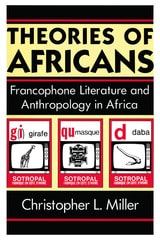
Theories of Africans
Francophone Literature and Anthropology in AfricaChristopher L. Miller
University of Chicago Press, 1990
". . . a superb cross-disciplinary analysis."—Y. Mudimbe
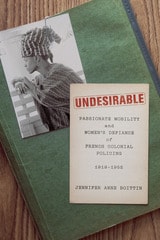
Undesirable
Passionate Mobility and Women’s Defiance of French Colonial Policing, 1919–1952Jennifer Anne Boittin
University of Chicago Press, 2022
Examining little-known policing archives in France, Senegal, and Cambodia, Jennifer Anne Boittin unearths the stories of hundreds of women labeled “undesirable” by the French colonial police and society in the early twentieth century. These “undesirables” were often women traveling alone, women who were poor or ill, women of color, or women whose intimate lives were deemed unruly. To refute the label and be able to move freely, they spoke out or wrote impassioned letters: some emphasized their “undesirable” qualities to suggest that they needed the care and protection of the state to support their movements, while others used the empire’s own laws around Frenchness and mobility to challenge state or societal interference. Tacking between advocacy and supplication, these women summoned intimate details to move beyond, contest, or confound surveillance efforts, bringing to life a practice that Boittin terms “passionate mobility.” In considering how ordinary women pursued autonomy, security, companionship, or simply a better existence in the face of surveillance and control, Undesirable illuminates pressing contemporary issues of migration and violence.
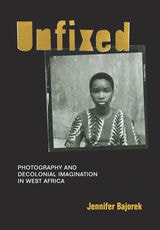
Unfixed
Photography and Decolonial Imagination in West AfricaJennifer Bajorek
Duke University Press, 2020
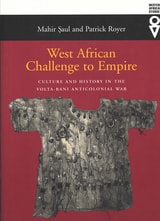
West African Challenge To Empire
Culture and History in the Volta-Bani Anticolonial WarMahir Saul
Ohio University Press, 2002
West African Challenge to Empire examines the anticolonial war in the Volta and Bani region in 1915–16. It was the largest challenge that the French ever faced in their West African colonial empire, and one of the largest armed oppositions to colonialism anywhere in Africa. How such a movement could be organized in the face of European technological superiority despite the fact that this region is generally described as having consisted of rival villages and descent groups is a puzzle. In this jointly written book the two authors provide a detailed political and military history of this event based on archival research and ethnographic fieldwork. Using cultural and sociological analysis, it probes the origins of the movement, its internal organization, its strategy, and the reasons for its initial success and why it spread.
In 2001 the authors of West African Challenge to Empire were awarded the Amaury Talbot Prize for African Anthropology by the Royal Anthropological Institute.