Results by title
18 books match the query 'Africa, Southern'
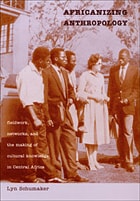
Africanizing Anthropology
Fieldwork, Networks, and the Making of Cultural Knowledge in Central AfricaLyn Schumaker
Duke University Press, 2001
Schumaker shows how local conditions and local ideas about culture and history, as well as previous experience of outsiders’ interest, shape local people’s responses to anthropological fieldwork and help them, in turn, to influence the construction of knowledge about their societies and lives. Bringing to the fore a wide range of actors—missionaries, administrators, settlers, the families of anthropologists—Schumaker emphasizes the daily practices of researchers, demonstrating how these are as centrally implicated in the making of anthropological knowlege as the discipline’s methods. Selecting a prominent group of anthropologists—The Manchester School—she reveals how they achieved the advances in theory and method that made them famous in the 1950s and 1960s.
This book makes important contributions to anthropology, African history, and the history of science.

Allies In Adversity
The Frontline States In SouthernGilbert M. Khadiagala
Ohio University Press, 1994
Breeds of Empire
The Invention of the Horse in Southeast Asia and Southern Africa 1500-1950Edited by Greg Bankoff and Sandra Swart
National University of Singapore Press, 2007
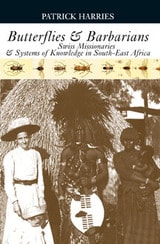
Butterflies & Barbarians
Swiss Missionaries and Systems of Knowledge in South-East AfricaPatrick Harries
Ohio University Press, 2007
Central to this group was Junod, who became a pioneering collector in the fields of entomology and botany. He would later examine African society with the methodology, theories, and confidence of the natural sciences. On the way he came to depend on the skills of African observers and collectors. Out of this work emerged, in three stages between 1898 and 1927, an influential classic in the field of South African anthropology, Life of a South African Tribe.
Environment, Power, and Justice
Southern African HistoriesGraeme Wynn
Ohio University Press, 2022
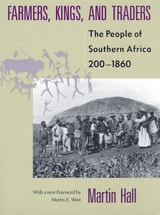
Farmers, Kings, and Traders
The People of Southern Africa, 200-1860Martin Hall
University of Chicago Press, 1990
Through a close reading of the accounts of early travelers, colonialists, archaeologists, and historians, Hall places in context the often contradictory histories that have been written of this region. The result is an illuminating look at how ideas about the past have themselves changed over time.

Flora Zambesiaca Volume 3 Part 4
Papilionoideae: IndigofereaeEdited by J. R. Timberlake and E. S. Martins
Royal Botanic Gardens, Kew, 2013
Gather Your Ancestors
Gender, Language, and Belonging in Southeast AfricaRaevin Jimenez
University of Wisconsin Press, 2026
Historically, southeasternmost Africa has been home to a large variety of speech communities, including Nguni, East Bantu, Khoi, and San—the legacy of a long and complicated history of migration, interaction, assimilation, and disaggregation between many peoples. With detailed, careful analysis, Raevin Jimenez guides readers through a thousand years of human movement, cultural contact, and social development in this region. Taking a historical linguistics approach, she sheds new light on this history by focusing on Nguni speakers’ use of gendered practices—including initiation, marriage, and avoidant speech known as hlónipha—to blend multilingual and diverse communities.
Use of gendered institutions inaugurated variable social spaces that could either elide or accommodate difference and thus enabled a multiplicity of community types. Contrary to previous assumptions about the roles of men and women in precolonial southeasternmost Africa, Jimenez shows that gender impacted life and social interactions across a large variety of important domains and became a way of forming, negotiating, and maintaining community. These developments shaped and remain visible in southeastern African speech communities today, and understanding them is vital to understanding the region’s long history and current linguistic society.
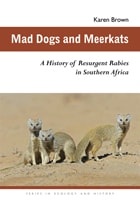
Mad Dogs and Meerkats
A History of Resurgent Rabies in Southern AfricaKaren Brown
Ohio University Press, 2011
Through the ages, rabies has exemplified the danger of diseases that transfer from wild animals to humans and their domestic stock. In South Africa, rabies has been on the rise since the latter part of the twentieth century despite the availability of postexposure vaccines and regular inoculation campaigns for dogs.
In Mad Dogs and Meerkats: A History of Resurgent Rabies in Southern Africa, Karen Brown links the increase of rabies to the HIV/AIDS epidemic. Her study shows that the most afflicted regions of South Africa have seen a dangerous rise in feral dog populations as people lack the education, means, or will to care for their pets or take them to inoculation centers. Most victims are poor black children. Ineffective disease control, which in part depends on management policies in neighboring states and the diminished medical and veterinary infrastructures in Zimbabwe, has exacerbated the problem.
This highly readable book is the first study of rabies in Africa, tracing its history in South Africa and neighboring states from 1800 to the present and showing how environmental and economic changes brought about by European colonialism and global trade have had long-term effects.
Mad Dogs and Meerkats is recommended for public health policy makers and anyone interested in human-animal relations and how societies and governments have reacted to one of the world’s most feared diseases.
Networked Poetics
The Digital Turn in Southern African PoetrySusanna L. Sacks
University of Massachusetts Press, 2024
Winner of the 2025 MLA Scaglione Prize for African Studies
Simultaneously transnational and local, poetry in the twenty-first century is produced across digital networks, shaped through local communities, and evaluated on a global scale. It might start on social media, where a video of a poet circulates and goes viral, gaining international attention without ever going through traditional modes of publication. In Networked Poetics, Susanna L. Sacks introduces readers to the southern African poetry scene in Malawi, Zimbabwe, and South Africa, illustrating how contemporary poetry is shaped, from inception to canonization, by the influence of digital media publication.
Interweaving ethnographic observation and extensive literary analysis, Sacks demonstrates that, as more artists in Africa reach wider audiences through online publication, poetic form has shifted to reflect social media’s aesthetic norms of urgency, immediacy, and populism. These changes have, in turn, challenged elite processes of valuation, forcing literary institutions like prizes, festivals, and curricula to accommodate the digital turn.

San Rock Art
J.D. Lewis-Williams
Ohio University Press, 2011
San rock paintings, scattered over the range of southern Africa, are considered by many to be the very earliest examples of representational art. There are as many as 15,000 known rock art sites, created over the course of thousands of years up until the nineteenth century. There are possibly just as many still awaiting discovery.
Taking as his starting point the magnificent Linton panel in the Iziko-South African Museum in Cape Town, J. D. Lewis-Williams examines the artistic and cultural significance of rock art and how this art sheds light on how San image-makers conceived their world. It also details the European encounter with rock art as well as the contentious European interaction with the artists’ descendants, the contemporary San people.

Story
Harold Scheub
University of Wisconsin Press, 1998
What is the essence of story? How does the storyteller convey meaning? Leading scholar Harold Scheub tackles these questions and more, demonstrating that the power of story lies in emotion.
While others have focused on the importance of structure in the art of story, Scheub emphasizes emotion. He shows how an expert storyteller uses structural elements—image, rhythm, and narrative—to shape a story's fundamental emotional content. The storyteller uses traditional images, repetition, and linear narrative to move the audience past the story’s surface of morals and ideas, and make connections to their past, present, and future. To guide the audience on this emotional journey is the storyteller’s art.
The traditional stories from South African, Xhosa, and San cultures included in the book lend persuasive support to Scheub’s. These stories speak for themselves, demonstrating that a skilled performer can stir emotions despite the obstacles of space, time, and culture.

The Hot 'Cold War'
The USSR in Southern AfricaVladimir Shubin
Pluto Press, 2008
This book analyses the causes of armed conflicts in Southern Africa during the Cold War. It examines the influence of the various external forces in the region during this period and their relationship to local movements and governments.
The book focuses on states experiencing violent internal conflict and foreign intervention, that is Angola, Mozambique, Namibia , South Africa and Zimbabwe.
The author provides an unique history of the key part that the Soviet Union played in these developments. Spanning 30 years, the book explores how each country struggled for genuine independence against colonialism and apartheid and their place in the wider conflicts encompassed by the Cold War.
The Hunters or the Hunted?
An Introduction to African Cave TaphonomyC. K. Brain
University of Chicago Press, 1981

Tragic History Of The Sea
C.R. Boxer
University of Minnesota Press, 2001
Compelling stories of shipwreck, adventure, and death on the high seas, now back in print.
The sixteenth and seventeenth centuries were a time of great colonial expansion, marked by a mercantile frenzy of ships carrying merchants, aristocrats, missionaries, sailors, Inquisitors, botanists, and statesmen pursuing the spoils of empire. Among the narratives that chronicled these voyages, those of the Portuguese are unequaled. C. R. Boxer’s fascinating translations of famous Portuguese shipwreck stories detail the disasters and terrors plaguing the perilous sea trading route between Portugal and India.
In the tradition of Homer, Virgil, Shakespeare, Defoe, and Poe, these dramatic stories of shipwreck—and those who lived to tell about it—represent existence and survival pushed to the limits. They describe disastrous turns of fate and miraculous rescues, heroism and cowardice, and offer the exhilaration and sheer emotive appeal of a tale of adventure well told. Often circulated in pamphlet form, these stories recounting the dangers and terrors of storm-tossed ocean voyages and the fate of castaways in distant lands were a popular genre, rife with compelling and often gory details. This first ever paperback edition includes a new translation of the tragic tale of Captain Manuel de Sousa Sepúlveda, shipwrecked with his family on the sands of Africa in 1552, the previous English versions of which have long been unavailable. Vividly descriptive and engrossing, these tales of selfishness, cruelty, despair, pirates, mayhem, and harrowing storms will captivate readers.
Transforming the Frontier
Peace Parks and the Politics of Neoliberal Conservation in Southern AfricaBram Büscher
Duke University Press, 2013
Based on extensive research in southern Africa with the Maloti-Drakensberg Transfrontier Conservation and Development Project, Büscher explains how the successful promotion of transfrontier conservation as a "win-win" solution happens not only in spite of troubling contradictions and problems, but indeed because of them. This is what he refers to as the "politics of neoliberal conservation," which receives its strength from effectively combining strategies of consensus, antipolitics, and marketing. Drawing on long-term, multilevel ethnographic research, Büscher argues that transfrontier conservation projects are not as concerned with on-the-ground development as they are purported to be. Instead, they are reframing environmental protection and sustainable development to fit an increasingly contradictory world order.

Ubuntu Relational Love
Decolonizing Black MasculinitiesDevi Dee Mucina
University of Manitoba Press, 2019

Ujamaa’s Army
The Creation and Evolution of the Tanzania People's Defence Force, 1964–1979Charles G. Thomas
Ohio University Press, 2024
The immediate postcolonial moment brought both promise and peril for the states of Africa and their security. The process of decolonization generated instability, and the emergent Cold War caught up the still-fragile independent states in a global ideological struggle between superpowers. While the political story of these states has been written in detail, the story of their militaries has been largely inaccessible, leaving only sketches of the coups, mutinies, and overall failures of security that outside observers could chronicle.
Ujamaa’s Army traces the evolution of the Tanzania People’s Defence Force from its inception in 1964 following the broader East African uprisings to its fully realized form on the eve of Tanzania’s 1978 conflict with Uganda. The book gathers primary interviews with key military actors within Tanzania and interweaves their narratives with archival sources to produce a detailed history of the culmination of President Julius Nyerere’s ideological project and the military leadership’s vision of a professional and effective force for guarding the nation and supporting liberation struggles across Southern Africa.