Results by title
7 books match the query 'African American Baptists'
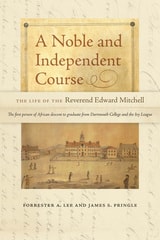
A Noble and Independent Course
The Life of the Reverend Edward MitchellForrester A. Lee and James S. Pringle
Dartmouth College Press, 2018
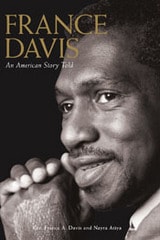
France Davis
An American Story ToldDavis, France
University of Utah Press, 2007
As I was coming up, it was painful to me not to have been given my own nickname. It made me feel different, or rather that I was being treated differently from other family members. I wondered why everybody else was spoken to in terms of their identity, their character, their behavior, and I was simply identified by the 'tag,' my given name. But then, when I read in a book that France meant free, I began to think of it as imbuing me with a sense of flight, of movement. Ultimately, I came to believe my name spoke for itself and that I did not need any other.'—from the book
Imbued with rich detail of family life in a rural community, as well as a system of values at a time of transition in American history, this is the life story of France Davis, the dynamic pastor of the Calvary Baptist Church in Salt Lake City. It is an engaging story of courage and vision that describes coming of age in the segregation-era South, of dreaming, enduring with honor, and living at the forefront of major issues within the United States.
Recorded and skillfully written by Nayra Atiya, France Davis: An American Story Told, is an oral history, ethnography, memoir, perhaps even a life-enhancing sermon delivered with the strong voice of a preacher. The gathered strands of a life lived with conviction and grace will appeal to a broad spectrum of readers from the curious to those seeking inspiration.
Winner of the Utah Book Award in Nonfiction.
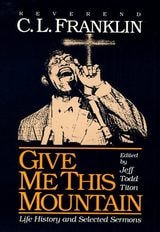
Give Me This Mountain
LIFE HISTORY AND SELECTED SERMONSReverend C. L. Franklin
University of Illinois Press, 1989
Few black preachers have been better known that the Reverend C. L. Franklin; none has been considered a better preacher. This collection of twenty of Franklin's best sermons shows the development of his style. A learned man, Franklin had attended both seminary and college, yet in his sermons used the old-fashioned, extemporaneous style of preaching, "whooping" or chanting, combining oratory and intoned poetry to reach both head and heart.
Dozens of Franklin's sermons were released on record albums, and he went on preaching tours with gospel groups that included his daughter, Aretha Franklin, reaching virtually every corner of the United States.
This volume begins with Franklin's life history, told in his own words.
In an afterword, Jeff Titon reviews the African-American sermon tradition
and Franklin's place in it.
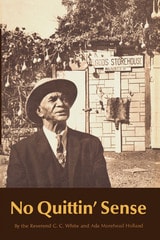
No Quittin' Sense
By the Reverend C. C. White and Ada Morehead Holland
University of Texas Press, 1994
This story, set in the Piney Woods country of East Texas, spans most of a century, from shortly after the close of the Civil War to the 1960's. It is the story of Charley White, who was born in the middle of those woods—in a decaying windowless log cabin a few years after his mother and father were freed from slavery. His childhood, lived in almost unbelievable poverty, was followed by financial stability achieved in middle age through years of struggle. And then, in order to obey God's will, he abandoned this secure life, and for forty years he waged a one-man war on poverty and intolerance.
Winner of the Carr P. Collins Award (best nonfiction book) of the Texas Institute of Letters, No Quittin' Sense presents the story of Rev. C. C. "Charley" White, whose life has inspired thousands of readers since the book was first published in 1969.
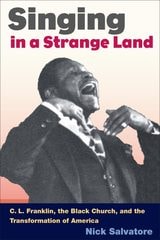
SINGING IN A STRANGE LAND
C. L. Franklin, the Black Church, and the Transformation of AmericaNick Salvatore
University of Illinois Press, 2000
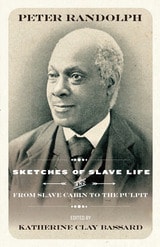
Sketches of Slave Life and From and From Slave Cabin to the Pulpit
Peter Randolph
West Virginia University Press, 2016
This book is the first anthology of the autobiographical writings of Peter Randolph, a prominent nineteenth-century former slave who became a black abolitionist, pastor, and community leader.
Randolph’s story is unique because he was freed and relocated from Virginia to Boston, along with his entire plantation cohort. A lawsuit launched by Randolph against his former master’s estate left legal documents that corroborate his autobiographies.
Randolph's writings give us a window into a different experience of slavery and freedom than other narratives currently available and will be of interest to students and scholars of African American literature, history, and religious studies, as well as those with an interest in Virginia history and mid-Atlantic slavery.
Uplifting the People
Three Centuries of Black Baptists in AlabamaWilson Fallin Jr.
University of Alabama Press, 2007
Three centuries of faith, leadership, and community building in Alabama's Black Baptist tradition.
Uplifting the People is a history of the Alabama Missionary Baptist State Convention—its origins, churches, associations, conventions, and leaders. Fallin demonstrates that a distinctive Afro-Baptist faith emerged as slaves in Alabama combined the African religious emphasis on spirit possession, soul-travel, and rebirth with the evangelical faith of Baptists. The denomination emphasizes a conversion experience that brings salvation, spiritual freedom, love, joy, and patience, and also stresses liberation from slavery and oppression and highlights the exodus experience. In examining the social and theological development of the Afro-Baptist faith over the course of three centuries, Uplifting the People demonstrates how black Baptists in Alabama used faith to cope with hostility and repression.
Fallin reveals that black Baptist churches were far more than places of worship. They functioned as self-help institutions within black communities and served as gathering places for social clubs, benevolent organizations, and political meetings. Church leaders did more than conduct services; they protested segregation and disfranchisement, founded and operated schools, and provided community leaders for the civil rights movement of the mid-20th century.
Through black churches, members built banking systems, insurance companies, and welfare structures. Since the gains of the civil rights era, black Baptists have worked to maintain the accomplishments of that struggle, church leaders continue to speak for social justice and the rights of the poor, and churches now house day care and Head Start programs. Uplifting the People also explores the role of women, the relations between black and white Baptists, and class formation within the black church.