Results by title
6 books match the query 'African American Poetry'
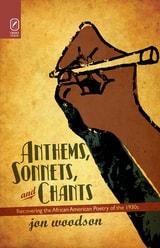
Anthems, Sonnets, and Chants
Recovering the African American Poetry of the 1930sJon Woodson
The Ohio State University Press, 2011
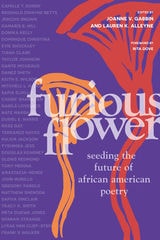
Furious Flower
Seeding the Future of African American PoetryEdited by Joanne V. Gabbin and Lauren K. Alleyne; Foreword by Rita Dove
Northwestern University Press, 2020
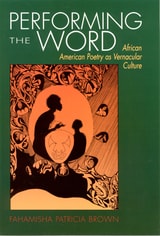
Performing The Word
African American Poetry As Vernacular CultureBrown, Fahamisha Patricia
Rutgers University Press, 1999
Fahamista Patricia Brown examines elements of African American expressive culture- its language practices, both fold and popular. Her book is an excellent introduction to a diverse group of poets and the common basis of their work in language practices and performativity, in the expressive culture of a people. Performing the Word is an important contribution to the understanding of African American culture and American poetry as a whole.
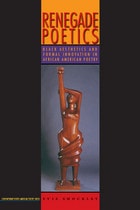
Renegade Poetics
Black Aesthetics and Formal Innovation in African American PoetryEvie Shockley
University of Iowa Press, 2011
Beginning with a deceptively simple question—What do we mean when we designate behaviors, values, or forms of expression as “black”?—Evie Shockley’s Renegade Poetics separates what we think we know about black aesthetics from the more complex and nuanced possibilities the concept has long encompassed. The study reminds us, first, that even among the radicalized young poets and theorists who associated themselves with the Black Arts Movement that began in the mid-1960s, the contours of black aesthetics were deeply contested and, second, that debates about the relationship between aesthetics and politics for African American artists continue into the twenty-first century.
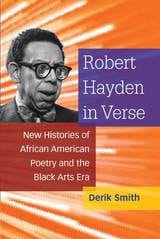
Robert Hayden in Verse
New Histories of African American Poetry and the Black Arts EraDerik Smith
University of Michigan Press, 2018
This book sheds new light on the work of Robert Hayden (1913–80) in response to changing literary scholarship. While Hayden’s poetry often reflected aspects of the African American experience, he resisted attempts to categorize his poetry in racial terms. This fresh appreciation of Hayden’s work recontextualizes his achievements against the backdrop of the Black Arts Movement and traces his influence on contemporary African American poets. Placing Hayden at the heart of a history of African American poetry and culture spanning the Harlem Renaissance to the Hip-Hop era, the book explains why Hayden is now a canonical figure in 20th-century American literature.
In deep readings that focus on Hayden’s religiousness, class consciousness, and historical vision, author Derik Smith inverts earlier scholarly accounts that figure Hayden as an outsider at odds with the militancy of the Black Arts movement. Robert Hayden in Verse offers detailed descriptions of the poet’s vigorous contributions to 1960s discourse about art, modernity, and blackness to show that the poet was, in fact, an earnest participant in Black Arts-era political and aesthetic debates.
The Black Arts Enterprise and the Production of African American Poetry
Howard Rambsy II
University of Michigan Press, 2013
The outpouring of creative expression known as the Black Arts Movement of the 1960s and 1970s spawned a burgeoning number of black-owned cultural outlets, including publishing houses, performance spaces, and galleries. Central to the movement were its poets, who in concert with editors, visual artists, critics, and fellow writers published a wide range of black verse and advanced new theories and critical approaches for understanding African American literary art.
The Black Arts Enterprise and the Production of African American Poetry offers a close examination of the literary culture in which BAM's poets (including Amiri Baraka, Nikki Giovanni, Sonia Sanchez, Larry Neal, Haki Madhubuti, Carolyn Rodgers, and others) operated and of the small presses and literary anthologies that first published the movement's authors. The book also describes the role of the Black Arts Movement in reintroducing readers to poets such as Langston Hughes, Robert Hayden, Margaret Walker, and Phillis Wheatley.
Focusing on the material production of Black Arts poetry, the book combines genetic criticism with cultural history to shed new light on the period, its publishing culture, and the writing and editing practices of its participants. Howard Rambsy II demonstrates how significant circulation and format of black poetic texts—not simply their content—were to the formation of an artistic movement. The book goes on to examine other significant influences on the formation of Black Arts discourse, including such factors as an emerging nationalist ideology and figures such as John Coltrane and Malcolm X.