Results by title
14 books match the query 'African American abolitionists'
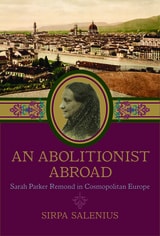
An Abolitionist Abroad
Sarah Parker Remond in Cosmopolitan EuropeSirpa Salenius
University of Massachusetts Press, 2016
Remond's extensive travels and diverse acquaintances demonstrate that the nineteenth-century grand tour of Europe was not exclusively the privilege of white intellectuals but included African American travelers, among them women. This biography, based on international archival research, tells the fascinating story of how Remond forged a radical path, establishing relationships with fellow activists, artists, and intellectuals across Europe.
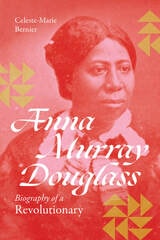
Anna Murray Douglass
Biography of a RevolutionaryCeleste-Marie Bernier
Duke University Press, 2026
Working with family descendants and based on thirty years of research digging through public and private archives, Celeste-Marie Bernier presents the first standalone biography of Anna Murray Douglass, wife and co-revolutionary of Frederick Douglass, honoring her history-making role as a campaigner, liberator, and freedom-fighter.
Anna Murray Douglass was born legally free in Maryland to Mary and Bambarra Murray. From working with her future husband, Frederick Douglass, to secure his self-liberation from enslavement to converting her family homes to command centers for the Underground Railroad, she dedicated her entire life to the fight for all freedoms and to supporting loved ones and strangers alike in their fight for equal, independent lives. Her deeds have long gone unsung until now.
In this first-ever standalone biography of the wife and co-revolutionary of Frederick Douglass, Celeste-Marie Bernier provides a detailed and illustrated history of Anna Murray Douglass’s leadership roles in fighting against the injustices of enslavement, racism, and white supremacy, as well as how she laid the foundation for her family to follow in her and her husband’s footsteps. After over three decades of archival research, Bernier presents a wide-ranging collection of stories, writings, letters, and photographs in a comprehensive and illuminating biography of Anna Murray Douglass’s life and work as an educator, activist, intellectual, orator, political thinker, artist, philosopher, and strategist. Ultimately, Bernier aims to combat the widespread misrepresentation that the liberation movement bearing the Douglass name was the work of one individual when it was, in reality, a family institution. Anna Murray Douglass is the first book in a ten-volume collection detailing the life and work of the entire Douglass family including their children, Rosetta, Lewis Henry, Frederick, Jr., Charles Remond and Annie Douglass, all freedom-fighters in their own right.
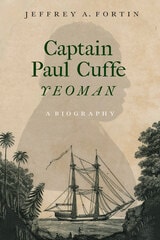
Captain Paul Cuffe, Yeoman
A BiographyJeffrey A. Fortin
University of Massachusetts Press, 2024
Paul Cuffe is best understood as a member of the Black founding fathers—a group of pre-eminent African Americans who built institutions and movements during the first decades of the United States. While he is known amongst scholars, his astounding life story deserves a much wider audience. Jeffrey A. Fortin has crafted a beautiful, moving portrait of this important maritime figure that will appeal to anyone interested in early American history and who loves great story telling.
Born on Cuttyhunk Island, Massachusetts in 1759 to a formerly enslaved African father and a Wampanoag Indian mother, Cuffe emerged from anonymity to become the most celebrated African-American sea captain during the Age of Sail. An abolitionist, veteran, and community activist, celebrity followed Cuffe as he built a shipping empire that traded both in American coastal waters and across the wider Atlantic Ocean. Cuffe and his Black crews shook the foundations of systemic racism, challenging norms by sailing into Charleston and other ports where slavery was legal, and thus demonstrating that business and profits were more powerful than social limitations. He founded America’s first racially integrated school in Westport, Massachusetts, and is considered the leader of the nation’s first back-to-Africa movement. Newspapers in England, the United States, and the Caribbean reported his whereabouts and adventures, and abolitionists hailed him for his Quaker beliefs, sobriety, and commitment to advancing opportunities for persons of African descent.
Drawing on pamphlets, letters, and other documents, and painstakingly reconstructing his genealogy, Fortin vividly describes Cuffe’s experiences and places them within the broader history of the Early Republic to help reveal the central role of African Americans in the founding of the United States. Unlike previous biographies, Fortin situates Cuffe within an Atlantic world where race and identity were fluid, and Africans and African Americans sought to build and govern a free Black nation in West Africa.
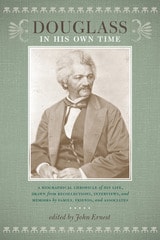
Douglass in His Own Time
A Biographical Chronicle of His Life, Drawn from Recollections, Interviews, and Memoirs by Family, Friends, and AssociatesJohn Ernest
University of Iowa Press, 2014
As valuable as these writings are in illuminating the man, the story Douglass told in 1845 has become rather too easy to tell, obscuring as much as it reveals. Less a living presence than an inspiring tale, Frederick Douglass remains relatively unknown even to many of those who celebrate his achievements. Douglass in His Own Time offers an introduction to Douglass the man by those who knew him. The book includes a broad range of writings, some intended for public viewing and some private correspondence, all of which contend with the force of Douglass’s tremendous power over the written and spoken word, his amazing presence before crowds, his ability to improvise, to entertain, to instruct, to inspire—indeed, to change lives through his eloquent appeals to righteous self-awareness and social justice. In approaching Douglass through the biographical sketches, memoirs, letters, editorials, and other articles about him, readers will encounter the complexity of a life lived on a very public stage, the story of an extraordinary black man in an insistently white world.
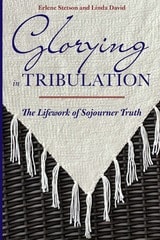
Glorying in Tribulation
The Lifework of Sojourner TruthErlene Stetson
Michigan State University Press, 1994
In Glorying in Tribulation, Stetson presents a new dimension of Sojourner Truth's character. Much of the information regarding this oft-quoted African American woman is either the stuff of legend or is in dispute. This important new biography takes both legend and fact and sets them into a larger historical context. The authors utilize archival sources, and other forms of direct and indirect evidence to create a better understanding of Truth. We see her victories as well as her defeats--we see her as a real person. Truth comes alive in the pages of this book through her poignant, prophetic words and we realize that what she spoke of in the nineteenth century is just as relevant to us today.
Glorying in Tribulation offers students, scholars, and teachers of American history and culture studies a comprehensive look and a new perspective on Truth's contribution to American history. It is a long-overdue, exciting interpretation of the meaning of Sojourner Truth's life.
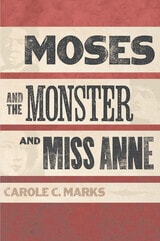
Moses and the Monster and Miss Anne
Carole C. Marks
University of Illinois Press, 2008
All three women lived for a time in close proximity on the Eastern Shore of Maryland, an isolated region that thrived on tobacco and then lost it, procured slaves and then lost them, and produced strong-minded women and then condemned them. Though they never actually met, and their backgrounds and beliefs differed drastically, these women's lives converged through their active experiences of the conflict over slavery in Maryland and beyond, the uncertainties of economic transformation, the struggles in the legal foundation of slavery and, most of all, the growing dispute in gender relations in America.
Throughout this book, Carole C. Marks gleans historical fact and sociological insight from the persistent myths and exaggerations that color the women's legacies, and she investigates the common roots and motivations of three remarkable figures who bucked the era's expectations for women. She also considers how each woman's public identity reflected changing ideas of domesticity and the public sphere, spirituality, and legal rights and limitations. Cannon, Carroll, and Tubman, each in her own way, passionately fought for the future of Maryland and the United States, and from these unique vantage points, Moses and the Monster and Miss Anne portrays the intersecting and conflicting forces of race, economics, and gender that threatened to rend a nation apart.
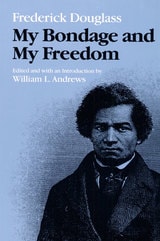
My Bondage and My Freedom
Frederick Douglass
University of Illinois Press, 1988
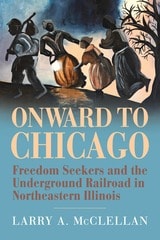
Onward to Chicago
Freedom Seekers and the Underground Railroad in Northeastern IllinoisLarry A. McClellan
Southern Illinois University Press, 2023
Uncovering stories of the freedom network in northeastern Illinois
Decades before the Civil War, Illinois’s status as a free state beckoned enslaved people, particularly those in Kentucky and Missouri, to cross porous river borders and travel toward new lives. While traditional histories of the Underground Railroad in Illinois start in 1839, and focus largely on the romanticized tales of white men, Larry A. McClellan reframes the story, not only introducing readers to earlier freedom seekers, but also illustrating that those who bravely aided them were Black and white, men and women. McClellan features dozens of individuals who made dangerous journeys to reach freedom as well as residents in Chicago and across northeastern Illinois who made a deliberate choice to break the law to help.
Onward to Chicago charts the evolution of the northeastern Illinois freedom network and shows how, despite its small Black community, Chicago emerged as a point of refuge. The 1848 completion of the I & M Canal and later the Chicago to Detroit train system created more opportunities for Black men, women, and children to escape slavery. From eluding authorities to confronting kidnapping bands working out of St. Louis and southern Illinois, these stories of valor are inherently personal. Through deep research into local sources, McClellan presents the engrossing, entwined journeys of freedom seekers and the activists in Chicagoland who supported them.
McClellan includes specific freedom seeker journey stories and introduces Black and white activists who provided aid in a range of communities along particular routes. This narrative highlights how significant biracial collaboration led to friendships as Black and white abolitionists worked together to provide support for freedom seekers traveling through the area and ultimately to combat slavery in the United States.
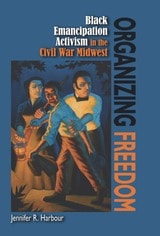
Organizing Freedom
Black Emancipation Activism in the Civil War MidwestJennifer R. Harbour
Southern Illinois University Press, 2020
Despite banning slavery, Illinois and Indiana share an antebellum history of severely restricting rights for free black people while protecting the rights of slaveholders. Nevertheless, as Harbour shows, black Americans settled there, and in a liminal space between legal slavery and true freedom, they focused on their main goals: creating institutions like churches, schools, and police watches; establishing citizenship rights; arguing against oppressive laws in public and in print; and, later, supporting their communities throughout the Civil War.
Harbour’s sophisticated gendered analysis features black women as being central to the seeking of emancipated freedom. Her distinct focus on what military service meant for the families of black Civil War soldiers elucidates how black women navigated life at home without a male breadwinner at the same time they began a new, public practice of emancipation activism. During the tumult of war, Midwestern black women negotiated relationships with local, state, and federal entities through the practices of philanthropy, mutual aid, religiosity, and refugee and soldier relief.
This story of free black people shows how the ideal of equality often competed against reality in an imperfect nation. As they worked through the sluggish, incremental process to achieve abolition and emancipation, Midwestern black activists created a unique regional identity.
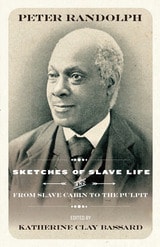
Sketches of Slave Life and From and From Slave Cabin to the Pulpit
Peter Randolph
West Virginia University Press, 2016
This book is the first anthology of the autobiographical writings of Peter Randolph, a prominent nineteenth-century former slave who became a black abolitionist, pastor, and community leader.
Randolph’s story is unique because he was freed and relocated from Virginia to Boston, along with his entire plantation cohort. A lawsuit launched by Randolph against his former master’s estate left legal documents that corroborate his autobiographies.
Randolph's writings give us a window into a different experience of slavery and freedom than other narratives currently available and will be of interest to students and scholars of African American literature, history, and religious studies, as well as those with an interest in Virginia history and mid-Atlantic slavery.
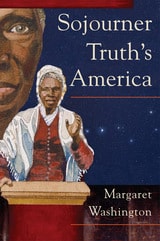
Sojourner Truth's America
Margaret Washington
University of Illinois Press, 2009
The Divided North
Black and White Families in the Age of SlaveryCarol Gardner
University of Massachusetts Press, 2025
Winner, 2026 New England Historical Association James P. Hanlan Book Prize
Finalist, 2026 New England Society Book Award in Nonfiction
Reuben Ruby and Nathaniel Gordon II were born eleven months apart in 1798 and 1799 and spent much of their boyhoods roaming the noisy, bustling waterfront of Portland, Maine. They lived just blocks from one another, attended school together, and went to the same church with their families. But they were worlds apart, separated by family, culture, and race. Reuben Ruby was Black and Nathaniel Gordon was White.
The Rubys became prominent antislavery activists, equal rights advocates, and operatives on the Underground Railroad. Their neighbors, the Gordons, became well-to-do ship masters, owners, and merchants: among them, the most notorious American slave ship captain of the century, Nathaniel Gordon III. As activists, sea captains, businessmen, prospectors, and politicians, members of these two families traveled to New York, California, Texas, Louisiana, Africa, Haiti, and Brazil, where their experiences were shaped by their racial identities. At home in the “Free North,” they faced social and political divisions nearly as sharp as those they encountered elsewhere.
To understand the issues that divided nineteenth-century America—and, in many ways, still divide the nation—few have looked to the far North. In this compelling narrative history and intimate dual-family biography, Carol Gardner traces the Rubys and Gordons as they navigate the turbulent 1800s. As families and individuals, they demonstrate that the North was a critical proving ground for American notions of freedom and equality, as telling as any town, plantation, or battlefield in the South. Their experiences help reveal what it meant to live in a free state during the age of slavery, with all the promise, disappointment, irony, and hope that the notion entailed.
The Powers of Dignity
The Black Political Philosophy of Frederick DouglassNick Bromell
Duke University Press, 2021
Till the Dark Angel Comes
Abolitionism and the Road to the Second American RevolutionWilliam S. King
Westholme Publishing, 2016
Establishing himself as a fresh and important voice in the history of African American emancipation,William S. King provides a critical introduction to the lead-up to the Civil War. A skilled and judicious chronicler, King seamlessly weaves multiple and seemingly disparate threads, including early nineteenth-century Revivalism, the emergence of the Republic of Texas, the fugitive slave laws—and even the explosion of a cannon aboard the U.S.S. Princeton in 1844—to explain how the opposition to slavery in America changed from producing speeches and pamphlets to embracing the reality that slavery could be eradicated only through armed conflict. By tracing this transformation through the life of John Brown, King provides an entirely new assessment of this enigmatic figure who was characterized as a “mad man” in the wake of his butchering of proslavery settlers in Kansas and the inept raid on Harpers Ferry, Virginia. King puts these actions in context to explain the paradox of Brown’s legacy. On one hand he was vilified as an unstable threat to American democracy or a fanatical sideshow to the history of the Civil War, while on the other he was an inspiration to the oppressed, a man who garnered the indomitable Harriet Tubman’s commitment to the righteousness of his endeavor.
Elegantly written with a command of period sources, Till the Dark Angel Comes: Abolitionism and the Road to the Second American Revolution is the story of interracial opposition to slavery, the important debates among free blacks as to their future in America, and the arguments and compromises at the highest levels of government. Here we encounter many personalities of the time, some well known, such as Frederick Douglass,William Lloyd Garrison, and John C. Calhoun, and others less so, but no less important—Martin Delany, Henry Highland Garnet, and Elijah Lovejoy.