Results by title
2 books match the query 'African American comedians'
Laughing Mad
The Black Comic Persona in Post-Soul AmericaHaggins, Bambi
Rutgers University Press, 2007
Winner of the 2008 Katherine Singer Kovacs Book Award
Prior to the civil rights movement, comedians performed for audiences that were clearly delineated by race. Black comedians performed for black audiences and white comedians performed for whites. Yet during the past forty-five years, black comics have become progressively more central to mainstream culture.
In Laughing Mad , Bambi Haggins looks at how this transition occurred in a variety of media and shows how this integration has paved the way for black comedians and their audiences to affect each other. Historically, African American performers have been able to use comedy as a pedagogic tool, interjecting astute observations about race relations while the audience is laughing. And yet, Haggins makes the convincing argument that the potential of African American comedy remains fundamentally unfulfilled as the performance of blackness continues to be made culturally digestible for mass consumption.
Rather than presenting biographies of individual performers, Haggins focuses on the ways in which the comic persona is constructed and changes across media, from stand-up, to the small screen, to film. She examines the comic televisual and cinematic personae of Dick Gregory, Bill Cosby, Flip Wilson, and Richard Pryor and considers how these figures set the stage for black comedy in the next four decades. She reads Eddie Murphy and Chris Rock as emblematic of the first and second waves of post-civil rights era African American comedy, and she looks at the socio-cultural politics of Whoopi Goldberg's comic persona through the lens of gender and crossover. Laughing Mad also explores how the comedy of Dave Chappelle speaks to and for the post-soul generation.
A rigorous analytic analysis, this book interrogates notions of identity, within both the African American community and mainstream popular culture. Written in engaging and accessible prose, it is also a book that will travel from the seminar room, to the barbershop, to the kitchen table, allowing readers to experience the sketches, stand-up, and film comedies with all the laughter they deserve.
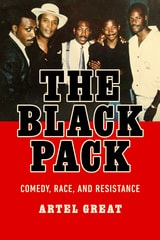
The Black Pack
Comedy, Race, and ResistanceArtel Great
Rutgers University Press, 2025
Working together as writers, directors, producers, actors, and consultants, the Black Pack created some of the most provocative and enduring Black films and television shows of the twentieth century, including classic productions like In Living Color, Coming to America, Hollywood Shuffle, and The Arsenio Hall Show. The Black Pack collective was armed with a signature comedic style which combined politically-Black satire with edgy social humor that entertained millions, shattered box-office records, and slyly critiqued America’s racial condition. Amid escalating social tensions in the 1980s, the Black Pack’s comedic output transformed anger into art, wielding the cloak of humor as a rebellious tool to confront unjust business practices in Hollywood and challenge racial narratives embedded in American culture. Their work empowered unapologetically Black voices and expanded creative possibilities for Black artists in the entertainment industry.
In The Black Pack, Artel Great delivers the most comprehensive analysis of this groundbreaking comedy collective, uncovering how the group’s socially and politically-charged humor defied systemic barriers to achieve unprecedented commercial success and establish a cultural legacy that continues to inspire media creators today and across new generations.