Results by title
3 books match the query 'African American evangelists'
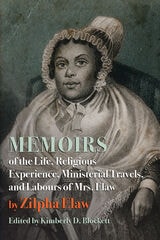
Memoirs of the Life, Religious Experience, Ministerial Travels, and Labours of Mrs. Elaw
Zilpha Elaw
West Virginia University Press, 2021
As a young Black orphan indentured to a Quaker family in Bristol, Pennsylvania, Zilpha Elaw (c. 1793–1873) decided to join the upstart Methodists in 1808. She preached her first sermon a decade later, ignoring her husband and the many church leaders, clergy, and laity who tried to silence her. Elaw’s memoir chronicles the first twenty years of her forty-year itinerant ministry during massive Protestant revivalism in the United States and England.
Elaw preached from Maine to Virginia, attracting multiracial and multidenominational audiences that included powerful men, wealthy White women, poor families, and enslaved communities. She moved from Bristol to Burlington, New Jersey, then to Nantucket, Massachusetts, and finally, in 1840, to London’s East End. In England, Elaw’s celebrity expanded, and at least twice she drew crowds so large they caused human stampedes and multiple injuries.
Blockett’s introduction and extensive annotations draw on newly unearthed information about the entirety of Elaw’s evangelism to provide context for this remarkable story of an antebellum Black woman’s personal and professional mobility.
Preacher Woman Sings the Blues
The Autobiographies of Nineteenth-Century African American EvangelistsRichard J. Douglass-Chin
University of Missouri Press, 2001
In this thorough and detailed study, Richard Douglass-Chin examines collectively for the first time the autobiographies of nineteenth-century African American women evangelists, along with their eighteenth-century forerunner "Belinda." By studying how black women evangelists employed dialogue created by socioeconomic conditions, the author shows how their writings form the groundwork for a contemporary womanist literature rooted in spirituality. Arguing that the writings have their own unique figurations and forms that develop and alter over time, Douglass-Chin claims that the changing black female spiritual narrative traces an important line in the ongoing traditions of black women's writing, a line that has only now begun to be reclaimed and validated. Through references to the writings of black male autobiographers Frederick Douglass, Richard Allen, Daniel Payne, and John Jea as well as the works of white female autobiographers Harriet Livermore and Phoebe Palmer, Douglass-Chin is able to make valuable comparisons.
Preacher Woman Sings the Blues begins with the study of black evangelists Belinda, Jarena Lee, and Zilpha Elaw, continuing with Rebecca Cox Jackson, Sojourner Truth, Julia Foote, Amanda Smith, Elizabeth, and Virginia Broughton. The author's discussion of Zora Neale Hurston focuses on how Hurston operates as a connection between early black women evangelist writers and black women writing in America today. He ends with the works of Alice Walker, Toni Morrison, and Toni Cade Bambara.
By examining the early traditions prefiguring contemporary African American women's texts and the impact that race and gender have on them, Douglass-Chin shows how the nineteenth-century black women's works are still of utmost importance to many African American women writers today. Preacher Woman Sings the Blues makes a valuable contribution to literary criticism and theoretical analysis and will be welcomed by scholars and students alike.
To Save My Race from Abuse
The Life of Samuel Robert CassiusEdward J. Robinson
University of Alabama Press, 2009
Samuel Robert Cassius was born to a slave mother and a white father in Virginia in 1853 and became a member of the Restorationist Movement (Disciples of Christ) while a coal miner in Indiana. For the rest of his long life (he died in 1931 at age 78), Cassius was an active evangelist, prolific publicist, dedicated leader of black Disciples, and an outspoken and uncompromising opponent of racism in religion and society.
An indefatigable preacher, Cassius ranged throughout the Midwest, California, and the southwestern states, founding and encouraging black Stone-Campbell Restorationist congregations. After entering the Oklahoma Territory in 1891, he worked for three decades as an educator, newspaper editor, social activist, postmaster, and Justice of the Peace. Because he consistently incorporated social and racial issues into his religious writings, Cassius often found himself at odds with whites in the Stone-Campbell Movement, the very people he relied on for monetary support. He advocated a Booker T. Washington-style self-help ethos while at the same time firmly resisting racism wherever he encountered it. Largely invisible in a world dominated by such towering figures as Washington, Frederick Douglass, Ida B. Wells, and W. E. B. DuBois, Cassius lived a life of virtual obscurity beyond the circle of the Stone-Campbell Movement. His story is important because, as a racial militant and separatist, he presaged the schism that would engulf and fracture the Churches of Christ in the 1960s, when blacks and whites went their separate ways and formed two distinct groups in one religious fellowship.
By combing through a plethora of primary sources that Cassius left behind in both religious and nonreligious journals, Edward J. Robinson has successfully reconstructed and recaptured the essence of Cassius’ complex and extraordinary life. This book offers the first full-length study of a man of remarkable attainment despite daily obstacles and resistance.