Results by title
4 books match the query 'African American pioneers'
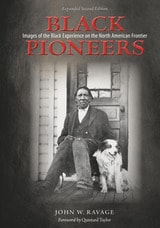
Black Pioneers
Images of the Black Experience on the North American FrontierJohn Ravage
University of Utah Press, 1997
Using public and private collections in every western state and in Canada, Ravage has gathered more than three hundred photographs, line drawings, lithographs, stereoviews, and other images. This new edition also adds sections on black entertainers and ranchers, a chapter on the dating of historic photographs and their genealogical significance, as well as an expanded bibliography. All aid understanding of the black frontier experience.
Ravage goes beyond the stereotypical photography of the era, which often reflected white fears and prejudices, to present the works of frontier photographers. Galveston’s Lucius Harper, Denver’s John Green, and the Northwest’s nomadic James Presley Ball all bring life to their subjects and meaning to their presence in the American West. Black Pioneers is a vibrant visual document of the profound influence blacks had on communal and frontier history.
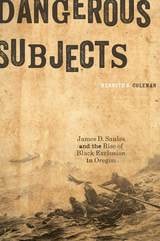
Dangerous Subjects
James D. Saules and the Rise of Black Exclusion in OregonKenneth R. Coleman
Oregon State University Press, 2017
In Oregon, Saules encountered a multiethnic population already transformed by colonialism—in particular, the fur industry and Protestant missionaries. Once the Oregon Trail emigrants began arriving in large numbers, in 1843, Saules had to adapt to a new reality in which Anglo-American settlers persistently sought to marginalize and exclude black residents from the region. Unlike Saules, who adapted and thrived in Oregon’s multiethnic milieu, the settler colonists sought to remake Oregon as a white man’s country. They used race as shorthand to determine which previous inhabitants would be included and which would be excluded. Saules inspired and later had to contend with a web of black exclusion laws designed to deny black people citizenship, mobility, and land.
In Dangerous Subjects, Kenneth Coleman sheds light on a neglected chapter in Oregon’s history. His book will be welcomed by scholars in the fields of western history and ethnic studies, as well as general readers interested in early Oregon and its history of racial exclusion.
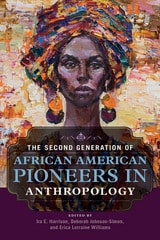
The Second Generation of African American Pioneers in Anthropology
Ira E. Harrison, Deborah Johnson-Simon, Erica Lorraine Williams
University of Illinois Press, 2018
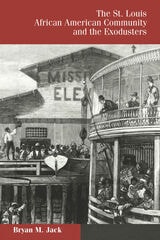
The St. Louis African American Community and the Exodusters
Bryan M. Jack
University of Missouri Press, 2021
In the aftermath of the Civil War, thousands of former slaves made their way from the South to the Kansas plains. Called “Exodusters,” they were searching for their own promised land. Bryan Jack now tells the story of this American exodus as it played out in St. Louis, a key stop in the journey west.
Many of the Exodusters landed on the St. Louis levee destitute, appearing more as refugees than as homesteaders, and city officials refused aid for fear of encouraging more migrants. To the stranded Exodusters, St. Louis became a barrier as formidable as the Red Sea, and Jack tells how the city’s African American community organized relief in response to this crisis and provided the migrants with funds to continue their journey.
The St. Louis African American Community and the Exodusters tells of former slaves such as George Rogers and Jacob Stevens, who fled violence and intimidation in Louisiana and Mississippi. It documents the efforts of individuals in St. Louis, such as Charlton Tandy, Moses Dickson, and Rev. John Turner, who reached out to help them. But it also shows that black aid to the Exodusters was more than charity. Jack argues that community support was a form of collective resistance to white supremacy and segregation as well as a statement for freedom and self-direction—reflecting an understanding that if the Exodusters’ right to freedom of movement was limited, so would be the rights of all African Americans. He also discusses divisions within the African American community and among its leaders regarding the nature of aid and even whether it should be provided.
In telling of the community’s efforts—a commitment to civil rights that had started well before the Civil War—Jack provides a more complete picture of St. Louis as a city, of Missouri as a state, and of African American life in an era of dramatic change. Blending African American, southern, western, and labor history, The St. Louis African American Community and the Exodusters offers an important new lens for exploring the complex racial relationships that existed within post-Reconstruction America.