Results by title
8 books match the query 'African American prisoners'
Invisible Men
Mass Incarceration and the Myth of Black ProgressBecky Pettit
Russell Sage Foundation, 2012
Listening to the Lomax Archive
The Sonic Rhetorics of African American Folksong in the 1930sJonathan W. Stone
University of Michigan Press, 2021
In 1933, John A. Lomax and his son Alan set out as emissaries for the Library of Congress to record the folksong of the “American Negro” in several southern African-American prisons. Listening to the Lomax Archive: The Sonic Rhetorics of African American Folksong in the 1930s asks how the Lomaxes’ field recordings—including their prison recordings and a long-form oral history of jazz musician Jelly Roll Morton—contributed to a new mythology of Americana for a nation in the midst of financial, social, and identity crises. Jonathan W. Stone argues that folksongs communicate complex historical experiences in a seemingly simple package, and can thus be a key element—a sonic rhetoric—for interpreting the ebb and flow of cultural ideals within contemporary historical moments. He contends that the Lomaxes, aware of the power folk music, used the folksongs they collected to increase national understanding of and agency for the subjects of their recordings (including the reconstitution of prevailing stereotypes about African American identity) even as they used the recordings to advance their own careers. Listening to the Lomax Archive gives readers the opportunity to listen in on these seemingly contradictory dualities, demonstrating that they are crucial to the ways that we remember and write about the subjects of the Lomaxes archive and other repositories of historicized sound.
Love and Abolition
The Social Life of Black Queer PerformanceAlison Rose Reed
The Ohio State University Press, 2022
Reed identifies abolition literature as an emergent field of inquiry that emphasizes social relationships in the ongoing struggle to dismantle systems of coercion, criminalization, and control. Focusing on love as an affective modality and organizing tool rooted in the Black radical tradition’s insistence on collective sociality amidst unrelenting state violence, Reed provides fresh readings of visionaries such as James Baldwin, Ntozake Shange, Sharon Bridgforth, and vanessa german. Both abolitionist manifesto and examination of how Black queer performance offers affective modulations of tough and tender love, Love and Abolition ultimately calls for a critical reconsideration of the genre of prison literature—and the role of the humanities—during an age of mass incarceration.
Malcolm Before X
Patrick Parr
University of Massachusetts Press, 2024
A Kirkus Reviews Best Nonfiction Book of 2024
A Spectator Best Book of the Year
Finalist for the 2025 ASALH Book Prize
Drawing upon interviews, correspondence, and nearly 2000 pages of never-before-used prison records, Malcolm Before X is the definitive examination of the prison years of civil rights icon Malcolm X.
In February 1946, when 20-year-old Malcolm Little was sentenced to eight to ten years in a maximum-security prison, he was a petty criminal and street hustler in Boston. By the time he was paroled in August 1952, he had transformed into a voracious reader, joined the Black Muslims, and was poised to become Malcolm X, one of the most prominent and important intellectuals of the civil rights era. While scholars and commentators have exhaustively detailed, analyzed, and debated Malcolm X’s post-prison life, they have not explored these six and a half transformative years in any depth.
Paying particular attention to his time in prison, Patrick Parr’s Malcolm Before X provides a comprehensive and groundbreaking examination of the first twenty-seven years of Malcolm X’s life (1925–1965). Parr traces Malcolm’s African lineage, explores his complicated childhood in the Midwest, and follows him as he moves east to live with his sister Ella in Boston’s Roxbury neighborhood, where he is convicted of burglary and sentenced.
Parr utilizes a trove of previously overlooked documents that include prison files and prison newspapers to immerse the reader into the unique cultures—at times brutal and at times instructional—of Charlestown State Prison, the Concord Reformatory, and the Norfolk Prison Colony. It was at these institutions that Malcolm devoured books, composed poetry, boxed, debated, and joined the Nation of Islam, changing the course of his life and setting the stage for a decade of antiracist activism that would fundamentally reshape American culture.
In this meticulously researched and beautifully written biography, the inspiring story of how Malcolm Little became Malcolm X is finally told.
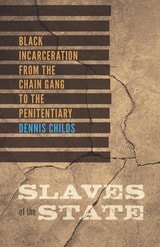
Slaves of the State
Black Incarceration from the Chain Gang to the PenitentiaryDennis Childs
University of Minnesota Press, 2015
The Thirteenth Amendment to the United States Constitution, passed in 1865, has long been viewed as a definitive break with the nation’s past by abolishing slavery and ushering in an inexorable march toward black freedom. Slaves of the State presents a stunning counterhistory to this linear narrative of racial, social, and legal progress in America.
Dennis Childs argues that the incarceration of black people and other historically repressed groups in chain gangs, peon camps, prison plantations, and penitentiaries represents a ghostly perpetuation of chattel slavery. He exposes how the Thirteenth Amendment’s exception clause—allowing for enslavement as “punishment for a crime”—has inaugurated forms of racial capitalist misogynist incarceration that serve as haunting returns of conditions Africans endured in the barracoons and slave ship holds of the Middle Passage, on plantations, and in chattel slavery.
Childs seeks out the historically muted voices of those entombed within terrorizing spaces such as the chain gang rolling cage and the modern solitary confinement cell, engaging the writings of Toni Morrison and Chester Himes as well as a broad range of archival materials, including landmark court cases, prison songs, and testimonies, reaching back to the birth of modern slave plantations such as Louisiana’s “Angola” penitentiary.
Slaves of the State paves the way for a new understanding of chattel slavery as a continuing social reality of U.S. empire—one resting at the very foundation of today’s prison industrial complex that now holds more than 2.3 million people within the country’s jails, prisons, and immigrant detention centers.
The Healing Stage
Black Women, Incarceration, and the Art of TransformationLisa Biggs
The Ohio State University Press, 2022
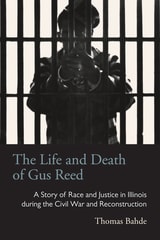
The Life and Death of Gus Reed
A Story of Race and Justice in Illinois during the Civil War and ReconstructionThomas Bahde
Ohio University Press, 2014
Gus Reed was a freed slave who traveled north as Sherman’s March was sweeping through Georgia in 1864. His journey ended in Springfield, Illinois, a city undergoing fundamental changes as its white citizens struggled to understand the political, legal, and cultural consequences of emancipation and black citizenship. Reed became known as a petty thief, appearing time and again in the records of the state’s courts and prisons. In late 1877, he burglarized the home of a well-known Springfield attorney—and brother of Abraham Lincoln’s former law partner—a crime for which he was convicted and sentenced to the Illinois State Penitentiary.
Reed died at the penitentiary in 1878, shackled to the door of his cell for days with a gag strapped in his mouth. An investigation established that two guards were responsible for the prisoner’s death, but neither they nor the prison warden suffered any penalty. The guards were dismissed, the investigation was closed, and Reed was forgotten.
Gus Reed’s story connects the political and legal cultures of white supremacy, black migration and black communities, the Midwest’s experience with the Civil War and Reconstruction, and the resurgence of nationwide opposition to African American civil rights in the late nineteenth century. These experiences shaped a nation with deep and unresolved misgivings about race, as well as distinctive and conflicting ideas about justice and how to achieve it.
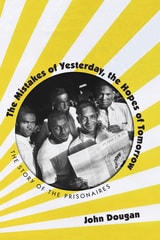
The Mistakes of Yesterday, the Hopes of Tomorrow
The Story of the PrisonairesJohn Dougan
University of Massachusetts Press, 2012
Early in the morning on June 1, 1953, five African American men boarded a van to make the 200-mile trip from Nashville to Memphis for a daylong recording session at the legendary Sun Studios, to be overseen by Sun founder Sam Phillips. One of the two tracks cut that day, “Just Walkin' in the Rain,” would go on to become a regional R&B hit, Sun Records' biggest record of the pre-Elvis era. It would, however, be the group's only hit. They were the Prisonaires, a vocal quintet who had honed their skills while inmates at the Tennessee State Penitentiary in Nashville.
In this book, John Dougan tells the story of the Prisonaires, their hit single, and the afterlife of this one remarkable song. The group and the song itself represent a compelling concept: imprisoned men using music as a means of cultural and personal survival. The song was re-recorded by white singer Johnnie Ray, who made it a huge hit in 1956. Over the years, other singers and groups would move the song further away from its origins, recasting the deep emotions that came from creating music in a hostile, controlled environment.
The story of the Prisonaires, for all of its triumphs, reflects the disappointment of men caught in a paradoxical search for personal independence while fully cognizant of a future consigned to prison. Their brief career and the unusual circumstances under which it flourished sheds light on the harsh realities of race relations in the pre–Civil Rights South. The book also provides a portrait of Nashville just as it was gaining traction as a nationally recognized music center.