Results by title
7 books match the query 'African American singers'
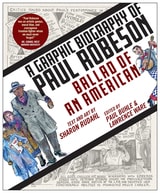
Ballad of an American
A Graphic Biography of Paul RobesonSharon Rudahl
Rutgers University Press, 2021
The first-ever graphic biography of Paul Robeson, Ballad of an American, charts Robeson’s career as a singer, actor, scholar, athlete, and activist who achieved global fame. Through his films, concerts, and records, he became a potent symbol representing the promise of a multicultural, multiracial American democracy at a time when, despite his stardom, he was denied personal access to his many audiences.
Robeson was a major figure in the rise of anti-colonialism in Africa and elsewhere, and a tireless campaigner for internationalism, peace, and human rights. Later in life, he embraced the civil rights and antiwar movements with the hope that new generations would attain his ideals of a peaceful and abundant world. Ballad of an American features beautifully drawn chapters by artist Sharon Rudahl, a compelling narrative about his life, and an afterword on the lasting impact of Robeson’s work in both the arts and politics. This graphic biography will enable all kinds of readers—especially newer generations who may be unfamiliar with him—to understand his life’s story and everlasting global significance.
Ballad of an American: A Graphic Biography of Paul Robeson is published in conjunction with Rutgers University’s centennial commemoration of Robeson’s 1919 graduation from the university.
Study guide for Ballad of an American: A Graphic Biography of Paul Robeson (https://d3tto5i5w9ogdd.cloudfront.net/wp-content/uploads/2021/05/10201015/YA_Adult-Study-Guide-for-A-Graphic-Biography-of-Paul-Robeson.pdf).
View the blad for Ballad of an American.
Everything Man
The Form and Function of Paul RobesonShana L. Redmond
Duke University Press, 2020
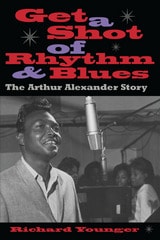
Get a Shot of Rhythm and Blues
The Arthur Alexander StoryRichard Younger
University of Alabama Press, 2000
The first book-length biography of an influential country/soul legend whose songs have been recorded by the Beatles, the Rolling Stones, and Bob Dylan.
Get a Shot of Rhythm and Blues chronicles the rise, fall, and rebirth of Arthur Alexander, an African American singer-songwriter whose music influenced many of the rock and soul musicians of the 1960s. Although his name is not well known today, Alexander's musical legacy is vast. His 1962 song "You Better Move On" was the first hit to emerge from the fledgling Muscle Shoals FAME studio in Alabama, and his fusion of country and soul and his heartfelt vocals on such songs as "Anna (Go to Him)" and "Every Day I Have to Cry" were revered by musicians including the Beatles, the Rolling Stones, and Bob Dylan, all of whom recorded his songs.
Alexander's story is a tragic one, with a brief, redemptive finale. His meteoric rise after the release of "You Better Move On" gave way to lean years caused both by his drug and alcohol abuse and by the mishandling of his career by producers and managers. In 1977, he quit the music business, but his music lived on. In 1992, Alexander returned to
the studio and recorded the critically praised album Lonely Just Like Me. Just three months after the album's release in March 1993, he suffered a heart attack in the offices of his music publisher in Nashville and died three days later.
In telling Alexander's story, Richard Younger captures the burgeoning music scenes in Muscle Shoals and Nashville during the 1960s and 1970s and recovers the life of a fascinating musician whose influence was international. Younger's account is enriched by his interviews with more than 200 artists, family members, and friends--such as Rick Hall, Billy Sherrill, Charlie McCoy, Chuck Jackson, Gerry Marsden, and Kris Kristofferson--and includes an abundance of never-before-seen photographs.
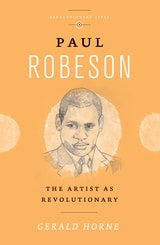
Paul Robeson
The Artist as RevolutionaryGerald Horne
Pluto Press, 2015
“A fine, taut analysis of the great African American athlete, singer, actor, and political activist.”
—Choice, Highly Recommended
Paul Robeson should be remembered today as the forerunner of Malcolm X, Dr. Martin Luther King, Jr. and Muhammad Ali. He sacrificed his fame and fortune a performer and athlete in order to fight for the rights of African Americans during the time of Jim Crow and U.S. Apartheid.
A world-famous singer and actor, a trained lawyer, an early star of American professional football and a polyglot who spoke over a dozen languages: these could be the crowning achievements of a life well-lived. Yet for Paul Robeson the higher calling of social justice led him to abandon both the NFL and Hollywood and become one of the most important political activists of his generation, a crusader for freedom and equality who battled both Jim Crow and US Senator Joseph McCarthy during the communist witch hunt of the 1950s.
In Paul Robeson: The Artist as Revolutionary, Gerald Horne discovers within Robeson's remarkable and revolutionary life the story of the twentieth century's great political struggles: against racism, against colonialism, against poverty—and for international socialism. Chapters include:
*”The Best Known American in the World"
*Rising Revolutionary
*From Moscow to Madrid
*"Black Stalin"?
*Robeson: Primary Victim of the "Blacklist"
*Triumph—and Tragedy
*Death of a Revolutionary
In the Introduction, Horne writes: “Paul Robeson—activist, artist, athlete—experienced a dramatic rise and fall, perhaps unparalleled in U.S. history. From mingling with the elite of London society and Hollywood in the 1930s, by the time he died in 1976, he was a virtual recluse in a plain abode in a working-class neighborhood of Philadelphia. What helps to explicate this tragic art of his life is a fateful decision he made when fascism was rising: he threw in his lot with those battling for socialism and decide to sacrifice his thriving artistic career on behalf of the struggle against Jim Crow—or U.S. apartheid.”
This critical and searching biography provides an opportunity for readers to comprehend the triumphs and tragedies of the revolutionary progressive movement of which Paul Robeson was not just a part, but perhaps its most resonant symbol.
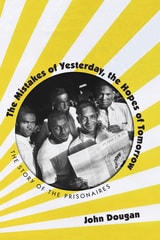
The Mistakes of Yesterday, the Hopes of Tomorrow
The Story of the PrisonairesJohn Dougan
University of Massachusetts Press, 2012
Early in the morning on June 1, 1953, five African American men boarded a van to make the 200-mile trip from Nashville to Memphis for a daylong recording session at the legendary Sun Studios, to be overseen by Sun founder Sam Phillips. One of the two tracks cut that day, “Just Walkin' in the Rain,” would go on to become a regional R&B hit, Sun Records' biggest record of the pre-Elvis era. It would, however, be the group's only hit. They were the Prisonaires, a vocal quintet who had honed their skills while inmates at the Tennessee State Penitentiary in Nashville.
In this book, John Dougan tells the story of the Prisonaires, their hit single, and the afterlife of this one remarkable song. The group and the song itself represent a compelling concept: imprisoned men using music as a means of cultural and personal survival. The song was re-recorded by white singer Johnnie Ray, who made it a huge hit in 1956. Over the years, other singers and groups would move the song further away from its origins, recasting the deep emotions that came from creating music in a hostile, controlled environment.
The story of the Prisonaires, for all of its triumphs, reflects the disappointment of men caught in a paradoxical search for personal independence while fully cognizant of a future consigned to prison. Their brief career and the unusual circumstances under which it flourished sheds light on the harsh realities of race relations in the pre–Civil Rights South. The book also provides a portrait of Nashville just as it was gaining traction as a nationally recognized music center.
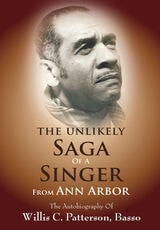
The Unlikely Saga of a Singer from Ann Arbor
The Autobiography of Willis C. Patterson, BassoWillis Patterson
Michigan Publishing Services, 2015
The book’s main character begins his life, similar to a diamond in the rough, and over time evolves into a rare gem at maturity. These pages will reveal how Willis Patterson of Ann Arbor, Michigan developed from somewhat of a lost child in the 1930s into a: sophisticated academician (Ph.D. in Higher Education Administration and Supervision from Wayne State University in Detroit, MI); a superior vocal performer; Voice Department Chair, Fulbright Scholar; esteemed Master Voice Teacher; Choral and Glee Club director extraordinaire; University Leader in the recruitment and retention of Minority students (Voice/Performing/Composition); an established Church Choir Director; and Associate Academic Dean of the School of Music at one of America’s finest universities, the University of Michigan.
This book is about a very humble man of significant stature. Although he was motivated and driven to become the best he could be in his quest for excellence—by kicking open the door of opportunity whenever it was presented (audition ready)—he never forgot his family members or hometown acquaintances.
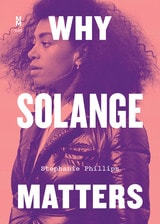
Why Solange Matters
By Stephanie Phillips
University of Texas Press, 2021
Growing up in the shadow of her superstar sister, Solange Knowles became a pivotal musician in her own right. Defying an industry that attempted to bend her to its rigid image of a Black woman, Solange continually experimented with her sound and embarked on a metamorphosis in her art that continues to this day.
In Why Solange Matters, Stephanie Phillips chronicles the creative journey of an artist who became a beloved voice for the Black Lives Matter generation. A Black feminist punk musician herself, Phillips addresses not only the unpredictable trajectory of Solange Knowles's career but also how she and other Black women see themselves through the musician's repertoire. First, she traces Solange’s progress through an inflexible industry, charting the artist’s development up to 2016, when the release of her third album, A Seat at the Table, redefined her career. Then, with A Seat at the Table and 2019’s When I Get Home, Phillips describes how Solange embraced activism, anger, Black womanhood, and intergenerational trauma to inform her remarkable art. Why Solange Matters not only cements the place of its subject in the pantheon of world-changing twenty-first century musicians, it introduces its writer as an important new voice.