Results by title
3 books match the query 'African American women educators'
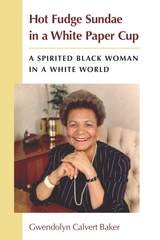
Hot Fudge Sundae in a White Paper Cup
A Spirited Black Woman in a White WorldGwendolyn Calvert Baker
University of Michigan Press, 2014
Gwendolyn Calvert Baker has had an extraordinary career and has witnessed a dramatic change in the ways that U.S. schools provide education to and about our multiethnic, multicultural society. But Baker hasn’t just lived through the progression of multicultural considerations—she has been singularly instrumental in the creation and acceptance of multicultural education. In Hot Fudge Sundae in a White Paper Cup, she shares her memories and experience of a lifetime spent serving and leading the causes for multicultural education.
[more]
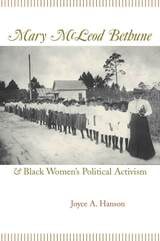
Mary McLeod Bethune and Black Women's Political Activism
Joyce A. Hanson
University of Missouri Press, 2003
Mary McLeod Bethune was a significant figure in American political history. She devoted her life to advancing equal social, economic, and political rights for blacks. She distinguished herself by creating lasting institutions that trained black women for visible and expanding public leadership roles. Few have been as effective in the development of women’s leadership for group advancement. Despite her accomplishments, the means, techniques, and actions Bethune employed in fighting for equality have been widely misinterpreted.
Mary McLeod Bethune and Black Women’s Political Activism seeks to remedy the misconceptions surrounding this important political figure. Joyce A. Hanson shows that the choices Bethune made often appear contradictory, unless one understands that she was a transitional figure with one foot in the nineteenth century and the other in the twentieth. Bethune, who lived from 1875 to 1955, struggled to reconcile her nineteenth-century notions of women’s moral superiority with the changing political realities of the twentieth century. She used two conceptually distinct levels of activism—one nonconfrontational and designed to slowly undermine systemic racism, the other openly confrontational and designed to challenge the most overt discrimination—in her efforts to achieve equality.
Hanson uses a wide range of never- or little-used primary sources and adds a significant dimension to the historical discussion of black women’s organizations by such scholars as Elsa Barkley Brown, Sharon Harley, and Rosalyn Terborg-Penn. The book extends the current debate about black women’s political activism in recent work by Stephanie Shaw, Evelyn Brooks-Higginbotham, and Glenda Elizabeth Gilmore.
Examining the historical evolution of African American women’s activism in the critical period between 1920 and 1950, a time previously characterized as “doldrums” for both feminist and civil rights activity, Mary McLeod Bethune and Black Women’s Political Activism is important for understanding the centrality of black women to the political fight for social, economic, and racial justice.
Examining the historical evolution of African American women’s activism in the critical period between 1920 and 1950, a time previously characterized as “doldrums” for both feminist and civil rights activity, Mary McLeod Bethune and Black Women’s Political Activism is important for understanding the centrality of black women to the political fight for social, economic, and racial justice.
[more]
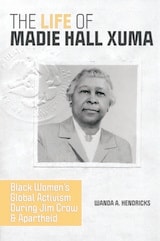
The Life of Madie Hall Xuma
Black Women's Global Activism during Jim Crow and ApartheidWanda A. Hendricks
University of Illinois Press, 2022
Revered in South Africa as "An African American Mother of the Nation," Madie Beatrice Hall Xuma spent her extraordinary life immersed in global women's activism. Wanda A. Hendricks's biography follows Hall Xuma from her upbringing in the Jim Crow South to her leadership role in the African National Congress (ANC) and beyond. Hall Xuma was already known for her social welfare work when she married South African physician and ANC activist Alfred Bitini Xuma. Becoming president of the ANC Women’s League put Hall Xuma at the forefront of fighting racial discrimination as South Africa moved toward apartheid. Hendricks provides the long-overlooked context for the events that undergirded Hall Xuma’s life and work. As she shows, a confluence of history, ideas, and organizations both shaped Hall Xuma and centered her in the histories of Black women and women’s activism, and of South Africa and the United States.
[more]