Results by title

3 books match the query 'African American women in higher education'

cover of Open Admissions: The Poetics and Pedagogy of Toni Cade Bambara, June Jordan, Audre Lorde, and Adrienne Rich in the Era of Free College

Open Admissions

The Poetics and Pedagogy of Toni Cade Bambara, June Jordan, Audre Lorde, and Adrienne Rich in the Era of Free College

Danica Savonick

Duke University Press, 2024
In Open Admissions Danica Savonick traces the largely untold story of the teaching experience of Toni Cade Bambara, June Jordan, Audre Lorde, and Adrienne Rich at the City University of New York (cuny) in the late 1960s and early 1970s. This period, during which cuny guaranteed tuition-free admission to every city high school graduate, was one of the most controversial in US educational history. Analyzing their archival teaching materials—syllabi, lesson plans, and assignments—alongside their published work, Savonick reveals how these renowned writers were also transformative educators who developed creative methods of teaching their students to navigate and change the world. In fact, many of their methods—such as student-led courses, collaborative public projects, and the publication of student writing—anticipated the kinds of student-centered and antiracist pedagogies that have become popular in recent years. In addition to recovering the pedagogical legacy of these writers, Savonick shows how teaching in cuny’s free and open classrooms fundamentally altered their writing and, with it, the course of American literature and feminist criticism.
[more]
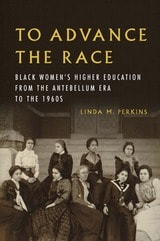
cover of To Advance the Race: Black Women's Higher Education from the Antebellum Era to the 1960s

To Advance the Race

Black Women's Higher Education from the Antebellum Era to the 1960s

Linda M. Perkins

University of Illinois Press, 2024

From the United States' earliest days, African Americans considered education essential for their freedom and progress. Linda M. Perkins’s study ranges across educational and geographical settings to tell the stories of Black women and girls as students, professors, and administrators. Beginning with early efforts and the establishment of abolitionist colleges, Perkins follows the history of Black women's post–Civil War experiences at elite white schools and public universities in northern and midwestern states. Their presence in Black institutions like Howard University marked another advancement, as did Black women becoming professors and administrators. But such progress intersected with race and education in the postwar era. As gender questions sparked conflict between educated Black women and Black men, it forced the former to contend with traditional notions of women’s roles even as the 1960s opened educational opportunities for all African Americans.

A first of its kind history, To Advance the Race is an enlightening look at African American women and their multi-generational commitment to the ideal of education as a collective achievement.
[more]
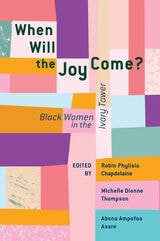
cover of When Will the Joy Come?: Black Women in the Ivory Tower

When Will the Joy Come?

Black Women in the Ivory Tower

Edited by Robin Phylisia Chapdelaine, Michelle Dionne Thompson, and Abena Ampofoa Asare

University of Massachusetts Press, 2023

How do Black women in higher education create, experience, and understand joy? What sustains them? While scholars have long documented sexism, racism, and classism in the academy, one topic has been conspicuously absent from the literature—how Black women academics have found joy in the midst of adversity. Moving beyond questions of resilience, labor for others, and coping, When Will the Joy Come? focuses on the journeys of over thirty Black women at various stages of their careers.

Joy is a mixture of well-being, pleasure, alignment, and purpose that can be elusive for Black women scholars. With racial reckoning and a global pandemic as context, this volume brings together honest and vital essays that ponder how Black women balance fatigue and frustrations in the halls of the ivory tower, and explore where, when, and if joy enters their lives. By carefully contemplating the emotional, physical, and material consequences of their labor, this collection demonstrates that joy is a tactical and strategic component of Black women’s struggle.

[more]