Results by title
157 books match the query 'African Americans in literature' and 9 start with a
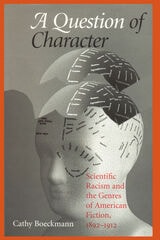
A Question of Character
Scientific Racism and the Genres of American Fiction, 1892-1912Catherine Ann Boeckmann
University of Alabama Press, 2005
Boeckmann links character, literary genre, and science, revealing how major literary works both contributed to and disrupted the construction of race in turn-of-the-century America.
In A Question of Character, Cathy Boeckmann establishes a strong link between racial questions and the development of literary traditions at the end of the 19th century in America. This period saw the rise of "scientific racism," which claimed that the races were distinguished not solely by exterior appearance but also by a set of inherited character traits. As Boeckmann explains, this emphasis on character meant that race was not only a thematic concern in the literature of the period but also a generic or formal one as well.
Boeckmann explores the intersections between race and literary history by tracing the language of character through both scientific and literary writing. Nineteenth-century pseudo-sciences such as phrenology and physiognomy had a vocabulary for discussing racial character that overlapped conceptually with the conventions for portraying race in literature. Through close readings of novels by Thomas Dixon, Mark Twain, William Dean Howells, Charles Chesnutt, and James Weldon Johnson—each of which deals with a black character "passing" as white—Boeckmann shows how this emphasis on character relates to the shift from romantic and sentimental fiction to realism. Because each of these genres had very specific conventions regarding the representation of character, genres often dictated how races could be depicted.
Aberrations In Black
Toward a Queer of Color CritiqueRoderick A. Ferguson
University of Minnesota Press, 2003
A hard-hitting look at the regulation of sexual difference and its role in circumscribing African American culture
The sociology of race relations in America typically describes an intersection of poverty, race, and economic discrimination. But what is missing from the picture—sexual difference—can be as instructive as what is present. In this ambitious work, Roderick A. Ferguson reveals how the discourses of sexuality are used to articulate theories of racial difference in the field of sociology. He shows how canonical sociology—Gunnar Myrdal, Ernest Burgess, Robert Park, Daniel Patrick Moynihan, and William Julius Wilson—has measured African Americans’s unsuitability for a liberal capitalist order in terms of their adherence to the norms of a heterosexual and patriarchal nuclear family model. In short, to the extent that African Americans’s culture and behavior deviated from those norms, they would not achieve economic and racial equality.
Aberrations in Black tells the story of canonical sociology’s regulation of sexual difference as part of its general regulation of African American culture. Ferguson places this story within other stories—the narrative of capital’s emergence and development, the histories of Marxism and revolutionary nationalism, and the novels that depict the gendered and sexual idiosyncrasies of African American culture—works by Richard Wright, Ralph Ellison, James Baldwin, Audre Lorde, and Toni Morrison. In turn, this book tries to present another story—one in which people who presumably manifest the dysfunctions of capitalism are reconsidered as indictments of the norms of state, capital, and social science. Ferguson includes the first-ever discussion of a new archival discovery—a never-published chapter of Invisible Man that deals with a gay character in a way that complicates and illuminates Ellison’s project.
Unique in the way it situates critiques of race, gender, and sexuality within analyses of cultural, economic, and epistemological formations, Ferguson’s work introduces a new mode of discourse—which Ferguson calls queer of color analysis—that helps to lay bare the mutual distortions of racial, economic, and sexual portrayals within sociology.
Act Like You Know
African-American Autobiography and White IdentityCrispin Sartwell
University of Chicago Press, 1998
There is, Sartwell contends, a fundamental elusiveness to that identity. Whiteness defines itself as normative, as a neutral form of the human condition, marking all other forms of identity as "racial" or "ethnic" deviations. Invisible to itself, white identity seeks to define its essence over and against those other identities, in effect defining itself through opposition and oppression. By maintaining fictions of black licentiousness, violence, and corruption, white identity is able to cast itself as humane, benevolent, and pure; the stereotype fabricates not only the oppressed but the oppressor as well. Sartwell argues that African-American autobiography perceives white identity from a particular and unique vantage point; one that is knowledgeable and intimate, yet fundamentally removed from the white world and thus unencumbered by its obfuscating claims to normativity.
Throughout this provocative work, Sartwell steadfastly recognizes the many ways in which he too is implicated in the formulation and perpetuation of racial attitudes and discourse. In Act Like You Know, he challenges both himself and others to take a long, hard look in the mirror of African-American autobiography, and to find there, in the light of those narratives, the visible features of white identity.
African American Satire
The Sacredly Profane NovelDarryl Dickson-Carr
University of Missouri Press, 2001
Satire's real purpose as a literary genre is to criticize through humor, irony, caricature, and parody, and ultimately to defy the status quo. In African American Satire, Darryl Dickson-Carr provides the first book-length study of African American satire and the vital role it has played. In the process he investigates African American literature, American literature, and the history of satire.
Dickson-Carr argues that major works by such authors as Rudolph Fisher, Ishmael Reed, Ralph Ellison, Langston Hughes, and George S. Schuyler should be read primarily as satires in order to avoid misinterpretation and to gain a greater understanding of their specific meanings and the eras in which they were written. He also examines the satirical rhetoric and ideological bases of complex works such as John Oliver Killens's The Cotillion and Cecil Brown's The Life and Loves of Mr. Jiveass Nigger—books that are currently out of print and that have received only scant critical attention since they were first published.
Beginning with the tradition of folk humor that originated in West Africa and was forcibly transplanted to the Americas through chattel slavery, Dickson-Carr focuses in each chapter on a particular period of the twentieth century in which the African American satirical novel flourished. He analyzes the historical contexts surrounding African American literature and culture within discrete crucial movements, starting with the Harlem Renaissance of the 1920s and ending in the present. He also demonstrates how the political, cultural, and literary ethos of each particular moment is manifested and contested in each text.
By examining these texts closely within their historical and ideological contexts, Dickson-Carr shows how African American satirical novels provide the reader of African American literature with a critique of popular ideologies seldom found in nonsatirical works. Providing a better understanding of what satire is and why it is so important for fulfilling many of the goals of African American literature, African American Satire will be an important addition to African American studies.
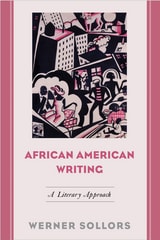
African American Writing
A Literary ApproachWerner Sollors
Temple University Press, 2016
Werner Sollors’ African American Writing takes a fresh look at what used to be called “Negro literature.” The essays collected here, ranging in topic from Gustavus Vassa/Olaudah Equiano to LeRoi Jones/Amiri Baraka, and in time from the Enlightenment to the Obama presidency, take a literary approach to black writing and present writers as readers and as intellectuals who were or are open to the world.
From W.E.B. Du Bois commenting on Richard Wagner and Elvis Presley, to Zora Neale Hurston attacking Brown v. Board of Ed. in a segregationist newspaper, to Charles Chesnutt’s effigy darkened for the black heritage postage stamp, Sollors alternates between close readings and broader cultural contextualizations to delineate the various aesthetic modes and intellectual exchanges that shaped a series of striking literary works.
Readers will make often-surprising discoveries in the authors’ writing and in their encounters and dialogues with others. The essays, accompanied by Winold Reiss’s pastels, Carl Van Vechten’s photographs, and other portraits, attempt to honor this important literature’s achievement, heterogeneity, and creativity.
Afro-American Literary Study in the 1990s
Edited by Houston A. Baker Jr. and Patricia Redmond
University of Chicago Press, 1989
"This diverse and inspired collection . . . testifies to the Afro-Am academy's extraordinary vitality."—Voice Literary Supplement
Against a Sharp White Background
Infrastructures of African American PrintEdited by Brigitte Fielder and Jonathan Senchyne
University of Wisconsin Press, 2019
At Home in Diaspora
Black International WritingWendy Walters
University of Minnesota Press, 2005
In At Home in Diaspora, Wendy Walters investigates the work of Himes, Cliff, and three other twentieth-century black international writers—Caryl Phillips, Simon Njami, and Richard Wright—who have lived in and written from countries they do not call home. Unlike other authors in exile, those of the African diaspora are doubly displaced, first by the discrimination they faced at home and again by their life abroad. Throughout, Walters suggests that in the absence of a recoverable land of origin, the idea of diaspora comes to represent a home that is not singular or exclusionary. In this way, writing in exile is much more than a literary performance; it is a profound political act.
Wendy W. Walters is assistant professor of literature at Emerson College.
Authentic Blackness
The Folk in the New Negro RenaissanceJ. Martin Favor
Duke University Press, 1999
Authentic Blackness looks at the place of the “folk”—those African Americans “furthest down,” in the words of Alain Locke—and how the representation of the folk and the black middle class both spurred the New Negro Movement and became one of its most serious points of contention. Drawing on vernacular theories of African American literature from such figures as Henry Louis Gates Jr. and Houston Baker as well as theorists Judith Butler and Stuart Hall, Favor looks closely at the work of four Harlem Renaissance fiction writers: James Weldon Johnson, Nella Larsen, George Schuyler, and Jean Toomer. Arguing that each of these writers had, at best, an ambiguous relationship to African American folk culture, Favor demonstrates how they each sought to redress the notion of a fixed black identity. Authentic Blackness illustrates how “race” has functioned as a type of performative discourse, a subjectivity that simultaneously builds and conceals its connections with such factors as class, gender, sexuality, and geography.