Results by title
9 books match the query 'African National Congress'
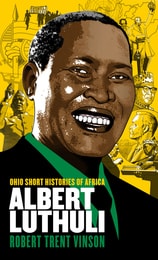
Albert Luthuli
Robert Trent Vinson
Ohio University Press, 2018
In an excellent addition to the Ohio Short Histories of Africa series, Robert Trent Vinson recovers the important but largely forgotten story of Albert Luthuli, Africa’s first Nobel Peace Prize winner and president of the African National Congress from 1952 to 1967. One of the most respected African leaders, Luthuli linked South African antiapartheid politics with other movements, becoming South Africa’s leading advocate of Mahatma Gandhi’s nonviolent civil disobedience techniques. He also framed apartheid as a crime against humanity and thus linked South African antiapartheid struggles with international human rights campaigns.
Unlike previous studies, this book places Luthuli and the South African antiapartheid struggle in new global contexts, and aspects of Luthuli’s leadership that were not previously publicly known: Vinson is the first to use new archival evidence, numerous oral interviews, and personal memoirs to reveal that Luthuli privately supported sabotage as an additional strategy to end apartheid. This multifaceted portrait will be indispensable to students of African history and politics and nonviolence movements worldwide.
Incognegro
A Memoir of Exile and ApartheidFrank B. Wilderson III
Duke University Press, 2008
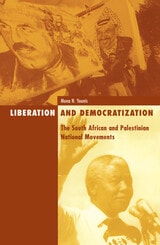
Liberation and Democratization
The South African and Palestinian National MovementsMona N. Younis
University of Minnesota Press, 2000
The first comprehensive comparison of two of the century’s most important liberation movements.
Arising in the 1910s and emerging as legitimate governing bodies in the 1990s, the South African and the Palestinian national liberation movements have exhibited remarkable parallels over the course of their development. The fortunes of the African National Congress and the Palestinian Liberation Organization, however, have proven strikingly different. How the movements, despite similar circumstances and experiences, have arrived at such dissimilar outcomes is described in Liberation and Democratization.
Younis traces the evolution of the movements, from early domination by elites to the ascendancy of mass-based forces in their last phases of expansion. She shows how this latest shift, accompanied by a democratization of the process of liberation, made the movements more effective in the 1980s. Liberation and Democratization also identifies dissimilarities—the balance of class forces and resources—that led to the A.N.C.’s greater success relative to the P.L.O.’s achievements. The first comprehensive comparison of two of the most significant liberation movements of this century, Younis’s work brings to light problems and dynamics that will remain at work well into the future.
National Liberation and the Political Life of Exile
Sex, Gender, and Nation in the Struggle Against ApartheidRachel Sandwell
Ohio University Press, 2025
The first book-length study to reveal how women in exile shaped South Africa’s antiapartheid movement
This groundbreaking book explores the often-overlooked role of women in South Africa’s liberation movements, particularly within the African National Congress during its years in exile from 1960 to 1990. It examines how transformations in gender roles—though contested—were central to imagining a postapartheid South Africa.
Through an analysis of women’s diplomatic work and their advocacy for policies on sexual education, birth control, family life, and childcare, Rachel Sandwell challenges traditional narratives that have ignored or minimized women’s contributions. She highlights how South African women played a crucial role in connecting exiles to left-wing international organizations like the Women’s International Democratic Federation, positioning women as key figures in global anticolonial politics.
The book also explores how gender transformation was at the heart of the exiled antiapartheid movement’s vision for a free South Africa. Women fought for recognition beyond the role of “mothers of the nation,” sparking internal debates over revolutionary morality, the compatibility of motherhood with military service, and responses to sexual and domestic violence within the movement. These struggles mirrored broader ideological conflicts over nation building, belonging, and political identity as the African National Congress sought legitimacy as a government-in-exile.
Ultimately, National Liberation and the Political Life of Exile asks how we write histories of revolutionary movements—especially those that, despite their transformative ambitions, did not fully realize their goals. A vital contribution to feminist history, anticolonial studies, and the history of global liberation struggles, this book reshapes our understanding of gender and politics in the antiapartheid movement.

Short-Changed?
South Africa since ApartheidColin Bundy
Ohio University Press, 2015
What have been the most significant developments—political, social, economic—in South Africa since 1994? How much has changed since the demise of apartheid, and how much remains stubbornly the same? Should one celebrate a robust democracy now two decades old, or lament the corrosive effects of factionalism, greed, and corruption on political life? Colin Bundy tries to answer such questions, while avoiding simplistic or one-sided assessments of life under Mandela, Mbeki, and Zuma. He recognizes real advances under ANC rule but also identifies the limits and contradictions of such progress. Bundy demonstrates, too, how the country’s past permeates the present, complicating and constraining the politics of transition, so that genuine transformation has been short-changed.
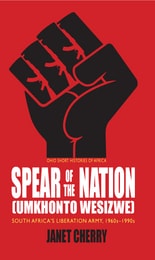
Spear of the Nation
Umkhonto weSizwe: South Africa’s Liberation Army, 1960s–1990sJanet Cherry
Ohio University Press, 2011
Umkhonto weSizwe, Spear of the Nation, was arguably the last of the great liberation armies of the twentieth century—but it never got to “march triumphant into Pretoria.” MK—as it was known—was the armed wing of the African National Congress, South Africa’s liberation movement, that challenged the South African apartheid government. A small group of revolutionaries committed to the seizure of power, MK discovered its principal members engaged in negotiated settlement with the enemy and was disbanded soon after.
The history of MK is one of paradox and contradiction, of successes and failures. In this short study, which draws widely on the personal experiences of—and commentary by—MK soldiers, Janet Cherry offers a new and nuanced account of the Spear of the Nation. She presents in broad outline the various stages of MK’s thirty-year history, considers the difficult strategic and moral problems the revolutionary army faced, and argues that its operations are likely to be remembered as a just war conducted with considerable restraint.

The ANC and the Liberation Struggle
A Critical Political BiographyDale T. McKinley
Pluto Press, 1997
eloquent testimony of the continuing vitality of the South African left' Modern African Studies
The African National Congress, the ANC, negotiated a transition of government and power in South Africa in the early 1990s and gained widespread respect and legitimacy when Nelson Mandela was voted in as President in 1994.
In this controversial and radical critique of the ANC and the struggle for liberation in South Africa, Dale T. McKinley challenges conventional public perceptions of the organisation and its celebrated rise to power. McKinley offers the first detailed analysis of the ANC's leadership, tactics and strategies from the 1920s, through the years of exile, to the 1990s, focusing on its close alliance with the South African Communist Party. he reveals that the organisation, despite historical claims to the contrary, failed to stay in touch with the south African masses. The ANC made fundamental compromises to gain political power, and in so doing has ensured that the economic power-base of the ruling elites in South Africa remains essentially unaltered.
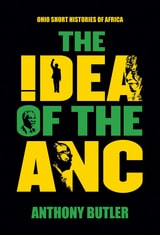
The Idea of the ANC
Anthony Butler
Ohio University Press, 2013
The African National Congress (ANC) is Africa’s most famous liberation movement. It has recently celebrated its centenary, a milestone that has prompted partisans to detail a century of unparalleled achievement in the struggle against colonialism and racial discrimination. Critics paint a less flattering portrait of the historical ANC as a communist puppet, a moribund dinosaur, or an elitist political parasite. For such skeptics, the ANC—now in government for two decades—has betrayed South Africans rather than liberating them.
South Africans endure deep inequality and unemployment, violent community protests, murders of foreign residents, major policy blunders, an AIDS crisis, and deepening corruption. Inside the ANC there are episodes of open rebellion against the leadership, conflicts over the character of a postliberation movement, and debilitating battles for succession to the movement’s presidency. The ANC is nevertheless likely to remain the party of government for the foreseeable future.
This remarkable book explores how ANC intellectuals and leaders interpret the historical project of their movement. It investigates three interlocking ideas: a conception of power, a responsibility for promoting unity, and a commitment to human liberation. Anthony Butler explores how these notions have shaped South African politics in the past and how they will inform ANC leaders’ responses to the challenges of the future.
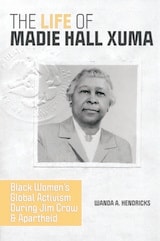
The Life of Madie Hall Xuma
Black Women's Global Activism during Jim Crow and ApartheidWanda A. Hendricks
University of Illinois Press, 2022