Results by title

3 books match the query 'African Nationalism'
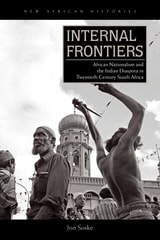
cover of Internal Frontiers: African Nationalism and the Indian Diaspora in Twentieth-Century South Africa

Internal Frontiers

African Nationalism and the Indian Diaspora in Twentieth-Century South Africa

Jon Soske

Ohio University Press, 2017

In this ambitious new history of the antiapartheid struggle, Jon Soske places India and the Indian diaspora at the center of the African National Congress’s development of an inclusive philosophy of nationalism. In so doing, Soske combines intellectual, political, religious, urban, and gender history to tell a story that is global in reach while remaining grounded in the everyday materiality of life under apartheid.

Even as Indian independence provided black South African intellectuals with new models of conceptualizing sovereignty, debates over the place of the Indian diaspora in Africa (the “also-colonized other”) forced a reconsideration of the nation’s internal and external boundaries. In response to the traumas of Partition and the 1949 Durban Riots, a group of thinkers in the ANC, centered in the Indian Ocean city of Durban and led by ANC president and Nobel Peace Prize winner Albert Luthuli, developed a new philosophy of nationhood that affirmed South Africa’s simultaneously heterogeneous and fundamentally African character.

Internal Frontiers is a major contribution to postcolonial and Indian Ocean studies and charts new ways of writing about African nationalism.
[more]
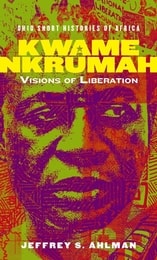
cover of Kwame Nkrumah: The Father of African Nationalism

Kwame Nkrumah

The Father of African Nationalism

Jeffrey S. Ahlman

Ohio University Press, 1998
The first African statesman to achieve world recognition was Kwame Nkrumah (1909-1972), who became president of the new Republic of Ghana in 1960. He campaigned ceaselessly for African solidarity and for the liberation of southern Africa from white settler rule. His greatest achievement was to win the right of black peoples in Africa to have a vote and to determine their own destiny. He turned a dream of liberation into a political reality. He was the leader of Ghana who urged Africa to shed the colonial yoke and who inspired black people everywhere to seek their freedom. This revised edition of Birmingham’s fine and accessible biography chronicles the public accomplishments of this extraordinary leader, who faced some of the century’s most challenging political struggles over colonial transition. African nationalism, and pan-Africanism. It also relates some of the personal trials of a complex individual. As a student in America in the late 1930s, Nkrumah, shy, disorganized, but ambitious and persistent, earned four degrees in ten years. For political training he then went to England. Nkrumah found writing difficult throughout his lifetime, but once back in his African homeland, with its oral heritage, Nkrumah blossomed as a charming conversationalist, a speechmaker, and eventually a visionary and inspiring leader. Nkrumah’s crusades were controversial, however, and in the 1960s he gradually lost his heroic stature both among his own people and among his fellow leaders. He lived his last years in exile. This remarkable life story, which touches on many of the issues facing modern Africa, will open a window of understanding for the general leader as well as for graduate and undergraduate classes. In this new edition, Birmingham also examines Nkrumah’s exile and provides insight into the image of Nkrumah that has emerged in the light of research recently published.
[more]
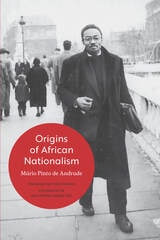
cover of Origins of African Nationalism: Continuity and Rupture in the Movements of Unity Emerging from the Struggle against Portuguese Colonial Domination, 1911–1961

Origins of African Nationalism

Continuity and Rupture in the Movements of Unity Emerging from the Struggle against Portuguese Colonial Domination, 1911–1961

Mário Pinto de Andrade. Translated by Mario Pereira. Introduction by Jean-Michel Mabeko-Tali.

Tagus Press, 2022

Exploring the development and structuring of African nationalist sentiment, the intellectual and sociological foundations of African nationalism, and the origins and social and cultural identities of the participants who helped form the anticolonial movements in the Portuguese colonial empire, Origins of African Nationalism captures the revolutionary energy of a generation. Named one of Africa's hundred best books of the twentieth century, this innovative study traces the emergence of African nationalism starting at the end of the nineteenth century and illuminates how nationalists from across the Portuguese empire were brought together in subsequent decades in a unified struggle that would lead to the overthrow of colonial rule after the Second World War. Mário Pinto de Andrade's insights are now available to English readers for the first time.
[more]