Results by title
17 books match the query 'African literature'
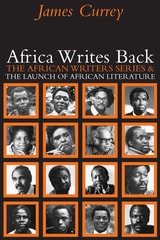
Africa Writes Back
The African Writers Series and the Launch of African LiteratureJames Currey
Ohio University Press, 2008
June 17, 2008, is the fiftieth anniversary of the publication of Chinua Achebe’s Things Fall Apart by Heinemann. This publication provided the impetus for the foundation of the African Writers Series in 1962 with Chinua Achebe as the editorial adviser.
Africa Writes Back: The African Writers Series and the Launch of African Literature captures the energy of literary publishing in a new and undefined field. Portraits of the leading characters and the many consultants and readers providing reports and advice to new and established writers make Africa Writes Back a stand-out book. James Currey’s voice and insights are an added bonus.
CONTENTS
Publishing and selling the African Writers Series
The African Writers Series Portfolio & George Hallett’s covers
Main dates for the African Writers Series
INTRODUCTION: The establishment of African Literature
Publishing Chinua Achebe
1. WRITERS FROM WEST AFRICA
Nigeria: The country where so much started
Negritude from Senegal to Cameroun
Magic & realism from Ghana, The Gambia & Sierra Leone
2. WRITERS FROM EASTERN AFRICA
Towards the oral & the popular in Kenya, Uganda & Tanzania
Publishing Ngugi
3. WRITERS FROM THE HORN & NORTH-EASTERN AFRICA
Emperors in Ethiopia
Publishing Nuruddin Farah
Arab authors in Egypt & Sudan
4. WRITERS FROM SOUTH AFRICA
Resistance in South Africa
Publishing Alex la Guma
Publishing Dennis Brutus
Publishing Bessie Head
Publishing Masizi Kunene
5. WRITERS FROM SOUTHERN AFRICAN
Guns & Guerrillas in Mozambique &Angola
Zambia Shall be Free
Death & detention in Malawi
The struggle to become Zimbabwe
Publishing Dambudzo Marechera
CONCLUSION: Is there still a role for the African Writers Series?

African Intellectuals and Decolonization
Nicholas M. Creary
Ohio University Press, 2012

African Literature in the Twentieth Century
O.R. Dathorne
University of Minnesota Press, 1976
African Literature in the Twentieth Century was first published in 1976. Minnesota Archive Editions uses digital technology to make long-unavailable books once again accessible, and are published unaltered from the original University of Minnesota Press editions.
This paperback makes available the major part of Professor Dathorne's The Black Mind.It concentrates on the writings of Africans in various African and European languages and provides insight, both broad and deep, into the Black intellect. Professor Dathorne examines the literature of Africans as spoken or written in their local languages and in French, Portuguese, and English. This extensive survey and interpretation gives the reader a remarkable pathway to an understanding of the Black imagination and its relevance to thought and creativity throughout the world.
The author himself lived in Africa for ten years, and his view is not that of an outsider, since it is as a Black man that he speaks about Black people. Throughout the book, a major theme is the demonstration that, despite slavery and colonialism, Africans remained very close to their own cultures. Professor Dathorne shows that African writers may be, like some Afro-American writers, "marginal men," but that they are Black men and it is as Black men that they feel the nostalgia of their past and the corrosive influences of their present.
O. R. Dathorne is a member of the Department of Black Studies and of the Department of English at Ohio State University. He has taught at universities in Nigeria and Sierra Leone and served as a UNESCO adviser in Sierra Leone. He also has taught at Ohio State University, Howard University, and the University of Wisconsin and lectured at Yale, Federal City College, Michigan State, and other universities in and out of the United States. He is the author of two novels and editor of a number of anthologies of Black literature, and has written widely in journals on his subject.
African Women Writing Resistance
An Anthology of Contemporary VoicesJennifer Browdy de Hernandez
University of Wisconsin Press, 2010
Contributors include internationally recognized authors and activists such as Wangari Maathai and Nawal El Saadawi, as well as a host of vibrant new voices from all over the African continent and from the African diaspora. Interdisciplinary in scope, this collection provides an excellent introduction to contemporary African women’s literature and highlights social issues that are particular to Africa but are also of worldwide concern. It is an essential reference for students of African studies, world literature, anthropology, cultural studies, postcolonial studies, and women’s studies.
Outstanding Book, selected by the Public Library Association
Best Books for High Schools, Best Books for Special Interests, and Best Books for Professional Use, selected by the American Association of School Libraries
At Penpoint
African Literatures, Postcolonial Studies, and the Cold WarMonica Popescu
Duke University Press, 2020
Calibrations
Reading For The SocialAto Quayson
University of Minnesota Press, 2003
Proposes an entirely new socially and politically conscious way of reading
Ato Quayson explores a practice of reading that oscillates rapidly between domains—the literary-aesthetic, the social, the cultural, and the political—in order to uncover the mutually illuminating nature of these domains. He does this not to assert the often repeated postmodernist view that there is nothing outside the text, but to outline a method of reading he calls calibrations: a form of close reading of literature with what lies beyond it as a way of understanding structures of transformation, process, and contradiction that inform both literature and society.
Quayson surveys a wide array of texts—ranging from Bob Marley lyrics, Toni Morrison’s work, Walter Benjamin’s Theses on the Philosophy of History, and Althusser’s reflections on political economy—and treats a broad range of themes: the comparative structures of alienation in literature and anthropology, cultural heroism as a trope in African society and politics, literary tragedy as a template for reading the life and activism of Ken Saro-Wiwa, trauma and the status of citizenship in post-apartheid South Africa, representations of physical disability, and the clash between enchanted and disenchanted time in postcolonial texts.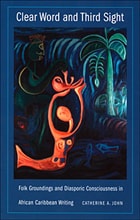
Clear Word and Third Sight
Folk Groundings and Diasporic Consciousness in African Caribbean WritingCatherine A. John
Duke University Press, 2003
Contesting popular discourses about what constitutes culture and maintaining that neglected strains in negritude discourse provide a crucial philosophical perspective on the connections between folk practices, cultural memory, and collective consciousness, John examines the diasporic principles in the work of the negritude writers Léon Damas, Aimé Césaire, and Léopold Senghor. She traces the manifestations and reworkings of their ideas in Afro-Caribbean writing from the eastern and French Caribbean, as well as the Caribbean diaspora in the United States. The authors she discusses include Jamaica Kincaid, Earl Lovelace, Simone Schwarz-Bart, Audre Lorde, Paule Marshall, and Edouard Glissant, among others. John argues that by incorporating what she calls folk groundings—such as poems, folktales, proverbs, and songs—into their work, Afro-Caribbean writers invoke a psychospiritual consciousness which combines old and new strategies for addressing the ongoing postcolonial struggle.
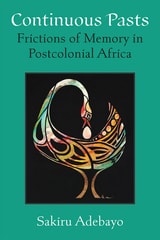
Continuous Pasts
Frictions of Memory in Postcolonial AfricaSakiru Adebayo
University of Michigan Press, 2023
Finalist: Memory Studies Association 2025 First Book Award Shortlist | April 7, 2025
In Continuous Pasts, author Sakiru Adebayo claims that the post-conflict fiction of memory in Africa depicts the intricate ways in which the past is etched on bodies and topographies, resonant in silences and memorials, and continuous even in experiences as well as structures of migration. Adebayo argues that the post-conflict fiction of memory in Africa invites critical deliberations on the continuity of the past within the realm of positionality and the domain of subjectivity—that is to say, the past is not merely present; instead, it survives, lives on, and is mediated through the subject positions of victims, perpetrators, as well as secondary and transgenerational witnesses. The book also argues that post-conflict fiction of memory in Africa shows the unfinished business of the past produces fragile regimes of peace and asynchronous temporalities that challenge progressive historicism. It contends that, in most cases in Africa, the post-conflict present is beset with a tight political economy wherein the scramble for survival trumps the ability to imagine a just future among survivors—and that it is precisely this despairing disposition toward the future that some writers of post-conflict fiction attempt to confront in their works. On the whole, Continuous Pasts shows how post-conflict fictions of memory in Africa recalibrate discourses of futurity, solidarity, responsibility, justice, survival, and reconciliation. It also contends that post-conflict fictions of memory in Africa provide the tools for imagining and theorizing a collective African memory. Each text analyzed in the book provides, in very interesting ways, an imaginative possibility and template for how post-independence African countries can ‘remember together’ using what the author describes as an African transnational memory framework.
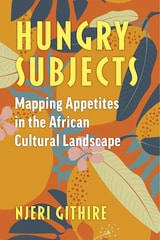
Hungry Subjects
Mapping Appetites in the African Cultural LandscapeNjeri Githire
University of Michigan Press, 2026
Against the backdrop of media representations of Africa through persistent and pervasive images of emaciated, starving Africans and the critical need to marshall food aid in response, Hungry Subjects places Africa’s food anxiety within a broader historical context and expands ongoing food scholarship beyond its current confines in the social sciences. Njeri Githire weaves together coming-of-age texts across the African and African diasporic literary landscape in English, French, and Portuguese expression to ask how African writers incorporate food into their storylines to transmit cultural information, question norms, and propose alternatives. Eating is an intimately personal yet inherently social experience codified by public rituals and commerce, invariably linked to a larger tapestry of historical, cultural, economic, and political dynamics. Delving into the political dynamics of food as a tool of power and control alongside subversive potentialities, Hungry Subjects appraises the narrative and political thrust of (not-)eating and exposes the ways in which postcolonial manifestations of colonial-era power relations are symbolized in food’s many functions and meanings.
The Algorithmic Age of Personality
African Literature and Cancel CultureJames Yékú
Michigan State University Press, 2025
The Black Mind
A History of African LiteratureO.R. Dathorne
University of Minnesota Press, 1974
The Black Mind was first published in 1974. Minnesota Archive Editions uses digital technology to make long-unavailable books once again accessible, and are published unaltered from the original University of Minnesota Press editions.
The comprehensive account of the development of African literature from its beginnings in oral tradition to its contemporary expression in the writings of Africans in various African and European languages provides insight, both broad and deep, into the Black intellect. Professor Dathorne examines the literature of Africans as spoken or written in their local languages and in Latin, French, Portuguese, and English. This extensive survey and interpretation gives the reader a remarkable pathway to an understanding of the Black imagination and its relevance to thought and creativity throughout the world.
The author himself lived in Africa for ten years, and his view in not that of an outsider, since it is as a Black man that he speaks about Black people. Throughout the book, a major theme is the demonstration that, despite slavery and colonialism, Africans remained very close to their own cultures. Professor Dathorne shows that African writers may be, like some Afro-American writers, "marginal men," but that they are Black men and it is as Black men that they feel the nostalgia of their past and the corrosive influences of their present.
The chapters are divided into sections: Tradition; Heritage; The Presence of Europe; and Crosscurrents. In the final chapters the author extends the thread of continuity to the New World—Africa as present in the work of Black writers in the United States and in the Caribbean.
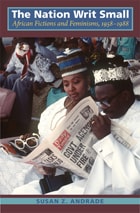
The Nation Writ Small
African Fictions and Feminisms, 1958-1988Susan Z. Andrade
Duke University Press, 2011
The Passport That Does Not Pass Ports
African Literature of Travel in the Twenty-First CenturyIsabel Balseiro
Michigan State University Press, 2020
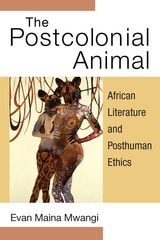
The Postcolonial Animal
African Literature and Posthuman EthicsEvan Maina Mwangi
University of Michigan Press, 2019
Despite the central role that animals play in African writing and daily life, African literature and African thinkers remain conspicuously absent from the field of animal studies. The Postcolonial Animal: African Literature and Posthuman Ethics demonstrates the importance of African writing to animal studies by analyzing how postcolonial African writing—including folktales, religion, philosophy, and anticolonial movements—has been mobilized to call for humane treatment of nonhuman others. Mwangi illustrates how African authors grapple with the possibility of an alternative to eating meat, and how they present postcolonial animal-consuming cultures as shifting toward an embrace of cultural and political practices that avoid the use of animals and minimize animal suffering. The Postcolonial Animal analyzes texts that imagine a world where animals are not abused or used as a source of food, clothing, or labor, and that offer instruction in how we might act responsibly and how we should relate to others—both human and nonhuman—in order to ensure a world free of oppression. The result is an equitable world where even those who are utterly foreign to us are accorded respect and where we recognize the rights of all marginalized groups.
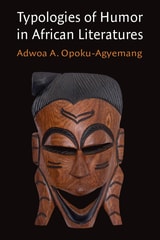
Typologies of Humor in African Literatures
Adwoa A. Opoku-Agyemang
University of Michigan Press, 2024
The book analyzes four comedic archetypes: the Trickster, who is unapologetically amoral and entertaining; the Mimic, whose everyday dealings exude ambiguity; the Interpreter, who demonstrates the comic potential of language differences while showing how a single message can mean contrasting things; and the Deviant, who throws norms into question all the while reinforcing them. These character types and the humor they produce present a constant pursuit of balance between contrasting worldviews and frames of reference within the imbrication of different languages, classes, political factions, genders, and (un)officialdoms. The product of these rowdy relations are people who take the weirdness and run with it to generate diegetic and intradiegetic laughs. By analyzing Francophone and Anglophone African writing and how it overlays local languages, Opoku-Agyemang contributes a uniquely African voice to the primarily Western-dominated field of humor studies.
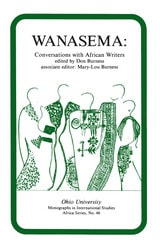
Wanasema
Conversations with African WritersDon Burness
Ohio University Press, 1985
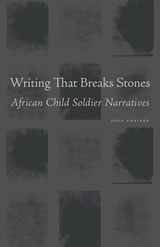
Writing That Breaks Stones
African Child Soldier NarrativesJoya Uraizee
Michigan State University Press, 2020