Results by title
7 books match the query 'African literature (French)'
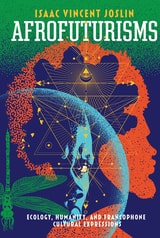
Afrofuturisms
Ecology, Humanity, and Francophone Cultural ExpressionsIsaac Vincent Joslin
Ohio University Press, 2023
An exploration of Francophone African literary imaginations and expressions through the lens of Afrofuturism Generally attributed to the Western imagination, science fiction is a literary genre that has expressed projected technological progress since the Industrial Revolution. However, certain fantastical elements in African literary expressions lend themselves to science fiction interpretations, both utopian and dystopian. When the concept of science is divorced from its Western, rationalist, materialist, positivist underpinnings, science fiction represents a broad imaginative space that supersedes the limits of this world. Whether it be on the moon, under the sea, or elsewhere within the imaginative universe, Afrofuturist readings of select films, novels, short stories, plays, and poems reveal a similarly emancipatory African future that is firmly rooted in its own cultural mythologies, cosmologies, and philosophies. Isaac Joslin identifies the contours and modalities of a speculative, futurist science fiction rooted in the sociocultural and geopolitical context of continental African imaginaries. Constructing an arc that begins with gender identity and cultural plurality as the bases for an inherently multicultural society, this project traces the essential role of language and narrativity in processing traumas that stem from the violence of colonial and neocolonial interventions in African societies. Joslin then outlines the influential role of discursive media that construct divisions and create illusions about societal success, belonging, and exclusion, while also identifying alternative critical existential mythologies that promote commonality and social solidarity. The trajectory proceeds with a critical analysis of the role of education in affirming collective identity in the era of globalization; the book also assesses the market-driven violence that undermines efforts to instill and promote cultural and social autonomy. Last, this work proposes an egalitarian and ecological ethos of communal engagement with and respect for the diversity of the human and natural worlds.
[more]
As She Was Discovering Tigony
Olympe Bhêly-Quenum
Michigan State University Press, 2016
Dorcas Keurléonan-Moricet is a brilliant white geophysicist posted on assignment in Africa. She falls in love with a young African man, Ségué n’Di, and enters into an extramarital affair with him. In her professional work, she discovers deposits of minerals of inestimable worth. Reading the current age of globalization and neoliberalism as one in which the riches of Africa are again being cynically exploited by multinational companies—including her own—Keurléonan-Moricet’s views and her life gradually change. As the popular resistance against the dictatorial regime in power grows, she comes to play a key role in the unfolding political drama.
[more]

Black Paris
THE AFRICAN WRITERS' LANDSCAPEBennetta Jules-Rosette
University of Illinois Press, 1998
Black Paris documents the struggles and successes of three generations of African writers as they strive to establish their artistic, literary, and cultural identities in France. Based on long-term ethnographic, archival, and historical research, the work is enriched by interviews with many writers of the new generation.
Bennetta Jules-Rosette explores African writing and identity in France from the early négritude movement and the founding of the Présence Africaine publishing house in 1947 to the mid-1990s. Examining the relationship between African writing and French anthropology as well as the emergence of new styles and discourses, Jules-Rosette covers French Pan-Africanism and the revolutionary writing of the 1960s and 1970s. She also discusses the new generation of African writers who appeared in Paris during the 1980s and 1990s.
Bennetta Jules-Rosette explores African writing and identity in France from the early négritude movement and the founding of the Présence Africaine publishing house in 1947 to the mid-1990s. Examining the relationship between African writing and French anthropology as well as the emergence of new styles and discourses, Jules-Rosette covers French Pan-Africanism and the revolutionary writing of the 1960s and 1970s. She also discusses the new generation of African writers who appeared in Paris during the 1980s and 1990s.
[more]
Decolonizing Memory
Algeria and the Politics of TestimonyJill Jarvis
Duke University Press, 2021
The magnitude of the legal violence exercised by the French to colonize and occupy Algeria (1830–1962) is such that only aesthetic works have been able to register its enduring effects. In Decolonizing Memory Jill Jarvis examines the power of literature to provide what demographic data, historical facts, and legal trials have not in terms of attesting to and accounting for this destruction. Taking up the unfinished work of decolonization since 1962, Algerian writers have played a crucial role in forging historical memory and nurturing political resistance—their work helps to make possible what state violence has rendered almost unthinkable. Drawing together readings of multilingual texts by Yamina Mechakra, Waciny Laredj, Zahia Rahmani, Fadhma Aïth Mansour Amrouche, Assia Djebar, and Samira Negrouche alongside theoretical, juridical, visual, and activist texts from both Algeria’s national liberation war (1954–1962) and war on civilians (1988–1999), this book challenges temporal and geographical frameworks that have implicitly organized studies of cultural memory around Euro-American reference points. Jarvis shows how this literature rewrites history, disputes state authority to arbitrate justice, and cultivates a multilingual archive for imagining decolonized futures.
[more]
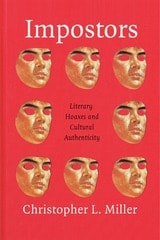
Impostors
Literary Hoaxes and Cultural AuthenticityChristopher L. Miller
University of Chicago Press, 2018
Writing a new page in the surprisingly long history of literary deceit, Impostors examines a series of literary hoaxes, deceptions that involved flagrant acts of cultural appropriation. This book looks at authors who posed as people they were not, in order to claim a different ethnic, class, or other identity. These writers were, in other words, literary usurpers and appropriators who trafficked in what Christopher L. Miller terms the “intercultural hoax.”
In the United States, such hoaxes are familiar. Forrest Carter’s The Education of Little Tree and JT LeRoy’s Sarah are two infamous examples. Miller’s contribution is to study hoaxes beyond our borders, employing a comparative framework and bringing French and African identity hoaxes into dialogue with some of their better-known American counterparts. In France, multiculturalism is generally eschewed in favor of universalism, and there should thus be no identities (in the American sense) to steal. However, as Miller demonstrates, this too is a ruse: French universalism can only go so far and do so much. There is plenty of otherness to appropriate. This French and Francophone tradition of imposture has never received the study it deserves. Taking a novel approach to this understudied tradition, Impostors examines hoaxes in both countries, finding similar practices of deception and questions of harm.
In the United States, such hoaxes are familiar. Forrest Carter’s The Education of Little Tree and JT LeRoy’s Sarah are two infamous examples. Miller’s contribution is to study hoaxes beyond our borders, employing a comparative framework and bringing French and African identity hoaxes into dialogue with some of their better-known American counterparts. In France, multiculturalism is generally eschewed in favor of universalism, and there should thus be no identities (in the American sense) to steal. However, as Miller demonstrates, this too is a ruse: French universalism can only go so far and do so much. There is plenty of otherness to appropriate. This French and Francophone tradition of imposture has never received the study it deserves. Taking a novel approach to this understudied tradition, Impostors examines hoaxes in both countries, finding similar practices of deception and questions of harm.
[more]
Nationalists and Nomads
Essays on Francophone African Literature and CultureChristopher L. Miller
University of Chicago Press, 1999
How does African literature written in French change the way we think about nationalism, colonialism, and postcolonialism? How does it imagine the encounter between Africans and French? And what does the study of African literature bring to the fields of literary and cultural studies? Christopher L. Miller explores these and other questions in Nationalists and Nomads.
Miller ranges from the beginnings of francophone African literature—which he traces not to the 1930s Negritude movement but to the largely unknown, virulently radical writings of Africans in Paris in the 1920s—to the evolving relations between African literature and nationalism in the 1980s and 1990s. Throughout he aims to offset the contemporary emphasis on the postcolonial at the expense of the colonial, arguing that both are equally complex, with powerful ambiguities. Arguing against blanket advocacy of any one model (such as nationalism or hybridity) to explain these ambiguities, Miller instead seeks a form of thought that can read and recognize the realities of both identity and difference.
Miller ranges from the beginnings of francophone African literature—which he traces not to the 1930s Negritude movement but to the largely unknown, virulently radical writings of Africans in Paris in the 1920s—to the evolving relations between African literature and nationalism in the 1980s and 1990s. Throughout he aims to offset the contemporary emphasis on the postcolonial at the expense of the colonial, arguing that both are equally complex, with powerful ambiguities. Arguing against blanket advocacy of any one model (such as nationalism or hybridity) to explain these ambiguities, Miller instead seeks a form of thought that can read and recognize the realities of both identity and difference.
[more]
Theories of Africans
Francophone Literature and Anthropology in AfricaChristopher L. Miller
University of Chicago Press, 1990
"Situating literature and anthropology in mutual interrogation, Miller's...book actually performs what so many of us only call for. Nowhere have all the crucial issues been brought together with the sort of critical sophistication it displays."—Henry Louis Gates, Jr.
". . . a superb cross-disciplinary analysis."—Y. Mudimbe
". . . a superb cross-disciplinary analysis."—Y. Mudimbe
[more]