Results by title
3 books match the query 'Afro-Asian politics'
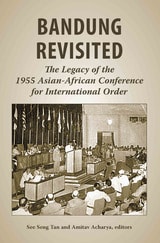
Bandung Revisited
The Legacy of the 1955 Asian-African Conference for International OrderEdited by Amitav Acharya and Tan See Seng
National University of Singapore Press, 2008
The authors in the present volume argue that the Bandung Conference had a lasting normative influence on the contemporary regional order of Asia, and that it underlies the diplomatic principles and loosely defined normative framework that characterize present-day Asian international relations.
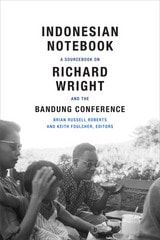
Indonesian Notebook
A Sourcebook on Richard Wright and the Bandung ConferenceBrian Russell Roberts and Keith Foulcher, editors
Duke University Press, 2016
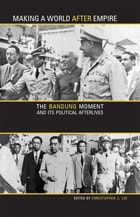
Making a World after Empire
The Bandung Moment and Its Political AfterlivesChristopher J. Lee
Ohio University Press, 2010
In April 1955, twenty-nine countries from Africa, Asia, and the Middle East came together for a diplomatic conference in Bandung, Indonesia, intending to define the direction of the postcolonial world. Representing approximately two-thirds of the world’s population, the Bandung conference occurred during a key moment of transition in the mid-twentieth century—amid the global wave of decolonization that took place after the Second World War and the nascent establishment of a new cold war world order in its wake. Participants such as Jawaharlal Nehru of India, Gamal Abdel Nasser of Egypt, Zhou Enlai of China, and Ahmed Sukarno of Indonesia seized this occasion to attempt the creation of a political alternative to the dual threats of Western neocolonialism and the cold war interventionism of the United States and the Soviet Union.
The essays in this volume explore the diverse repercussions of this event, tracing the diplomatic, intellectual, and sociocultural histories that have emanated from it. Making a World after Empire consequently addresses the complex intersection of postcolonial history and cold war history and speaks to contemporary discussions of Afro-Asianism, empire, and decolonization, thus reestablishing the conference’s importance in twentieth-century global history.
Contributors: Michael Adas, Laura Bier, James R. Brennan, G. Thomas Burgess, Antoinette Burton, Dipesh Chakrabarty, Julian Go, Christopher J. Lee, Jamie Monson, Jeremy Prestholdt, Denis M. Tull