Results by title
6 books match the query 'Afro-Caribbean religions'
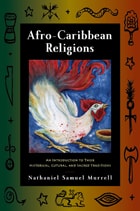
Afro-Caribbean Religions
An Introduction to Their Historical, Cultural, and Sacred TraditionsNathaniel Samuel Murrell
Temple University Press, 2009
This accessibly written introduction to Afro-Caribbean religions examines the cultural traditions and transformations of all of the African-derived religions of the Caribbean along with their cosmology, beliefs, cultic structures, and ritual practices. Ideal for classroom use, Afro-Caribbean Religions also includes a glossary defining unfamiliar terms and identifying key figures.
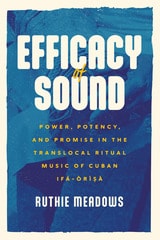
Efficacy of Sound
Power, Potency, and Promise in the Translocal Ritual Music of Cuban Ifá-ÒrìsàRuthie Meadows
University of Chicago Press, 2023
Hailing from Cuba, Nigeria, and various sites across Latin America and the Caribbean, Ifá missionary-practitioners are transforming the landscape of Ifá divination and deity (òrìṣà/oricha) worship through transatlantic travel and reconnection. In Cuba, where Ifá and Santería emerged as an interrelated, Yorùbá-inspired ritual complex, worshippers are driven to “African traditionalism” by its promise of efficacy: they find Yorùbá approaches more powerful, potent, and efficacious.
In the first book-length study on music and Ifá, Ruthie Meadows draws on extensive, multisited fieldwork in Cuba and Yorùbáland, Nigeria, to examine the controversial “Nigerian-style” ritual movement in Cuban Ifá divination. Meadows uses feminist and queer of color theory along with critical studies of Africanity to excavate the relation between utility and affect within translocal ritual music circulations. Meadows traces how translocal Ifá priestesses (ìyánífá), female batá drummers (bataleras), and priests (babaláwo) harness Yorùbá-centric approaches to ritual music and sound to heighten efficacy, achieve desired ritual outcomes, and reshape the conditions of their lives. Within a contentious religious landscape marked by the idiosyncrasies of revolutionary state policy, Nigerian-style Ifá-Òrìṣà is leveraged to transform femininity and masculinity, state religious policy, and transatlantic ritual authority on the island.
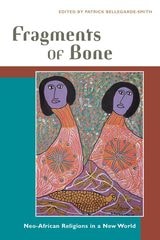
Fragments of Bone
Neo-African Religions in a New WorldEdited by Patrick Bellegarde-Smith
University of Illinois Press, 2005
Contributors: Osei-Mensah Aborampah, Niyi Afolabi, Patrick Bellegarde-Smith, Randy P. Conner, T. J. Desch-Obi, Ina Johanna Fandrich, Kean Gibson, Marilyn Houlberg, Nancy B. Mikelsons, Roberto Nodal, Rafael Ocasio, Miguel "Willie" Ramos, and Denise Ferreira da Silva
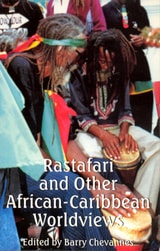
Rastafari & Other African-Caribbean Worldviews
Chevannes, Barry
Rutgers University Press, 1997
Rastafari has been seen as a political organization, a youth movement, and a millenarian cult. This lively collection of papers challenges these categories and offers a "new approach" to the study of Rastafari. Chevannes and his contributors suggest that we can better understand Rastafari-and Caribbean culture, for that matter-by seeing the movement as both a departure from and a continuance of Revivalism, an African-Caribbean folk religion. By linking Rastafari to Revival, we can enrich our understanding of an African-Caribbean worldview, and we can appreciate Rastafari not only as a political force but as a powerful expression of African-Caribbean culture and tradition.
Barry Chevannes provides a concise overview of Rastafari and Revivalism and clearly lays out the volume's "new approach." Leading scholars of Rastafari illustrate and develop the theme with chapters on Rastafari as resistance, the origin of the dreadlocks, Rastafari and language, women in African-Caribbean religions and more. With chapters that range from the specific to the general, this volume will be important to specialists of Caribbean religion and the African diaspora and to those with a burgeoning interest in Rastafari.
The contributors include Jean Besson, Ellis Cashmore, Barry Chevannes, John P. Homiak, Roland Littlewood, H.U.E Thoden van Velzen, and Wilhelmina van Wetering.
Spirited Things
The Work of "Possession" in Afro-Atlantic ReligionsEdited by Paul Christopher Johnson
University of Chicago Press, 2014
The Cooking of History
How Not to Study Afro-Cuban ReligionStephan Palmié
University of Chicago Press, 2013