Results by title

21 books match the query 'Afterlives'
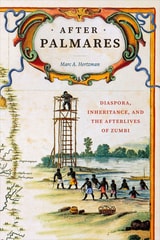
cover of After Palmares: Diaspora, Inheritance, and the Afterlives of Zumbi

After Palmares

Diaspora, Inheritance, and the Afterlives of Zumbi

Marc A. Hertzman

Duke University Press, 2024
In After Palmares, Marc A. Hertzman tells the rise, fall, and afterlives of Palmares, one of history’s largest and longest-lasting maroon societies. Forged during the seventeenth century by formerly enslaved Africans in what would become northeast Brazil, Palmares stood for a century, withstanding sustained attacks from two European powers. In 1695, colonial forces assassinated its most famous leader, Zumbi. Hertzman examines the remarkable ways that Palmares and its inhabitants lived on after Zumbi’s death, creating vivid portraits of those whose lives and voices scholars have often assumed are inaccessible. With an innovative approach to African languages, and paying close attention to place as well as African and diasporic spiritual beliefs, Hertzman reshapes our understanding of Palmares and Zumbi and advances a new framework for studying fugitive slave communities and marronage in the African diaspora.
[more]
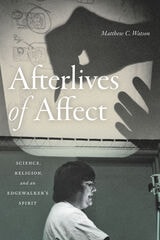
cover of Afterlives of Affect: Science, Religion, and an Edgewalker’s Spirit

Afterlives of Affect

Science, Religion, and an Edgewalker’s Spirit

Matthew C. Watson

Duke University Press, 2020
In Afterlives of Affect Matthew C. Watson considers the life and work of artist and Mayanist scholar Linda Schele (1942–98) as a point of departure for what he calls an excitable anthropology. As part of a small collective of scholars who devised the first compelling arguments that Maya hieroglyphs were a fully grammatical writing system, Schele popularized the decipherment of hieroglyphs by developing narratives of Maya politics and religion in popular books and public workshops. In this experimental, person-centered ethnography, Watson shows how Schele’s sense of joyous discovery and affective engagement with research led her to traverse and disrupt borders between religion, science, art, life, death, and history. While acknowledging critiques of Schele’s work and the idea of discovery more generally, Watson contends that affect and wonder should lie at the heart of any reflexive anthropology. With this singular examination of Schele and the community she built around herself and her work, Watson furthers debates on more-than-human worlds, spiritualism, modernity, science studies, affect theory, and the social conditions of knowledge production.
[more]
cover of Afterlives of Discovery: Speculative Geographies in the Settler Colonial Imaginary

Afterlives of Discovery

Speculative Geographies in the Settler Colonial Imaginary

heidi andrea restrepo rhodes

Duke University Press, 2025
In Afterlives of Discovery, heidi andrea restrepo rhodes traces global and national histories as they entangle through the concept and material life of Discovery across Colombia’s evolution into a liberal settler colonial state. Rather than seeing Discovery as a singular event or bygone era, rhodes theorizes Discovery as a globally encompassing, racialized formation of domination and geographic speculation that continues to structure settler colonialism. Discovery’s logics, they argue, are rooted in colonial and capitalist fantasies projected onto the racialized space and place of the colonized other. rhodes draws on critical theory, human rights research, and Colombian archives to challenge dominant narratives that maintain the Colombian armed conflict began as a Marxist insurgency in 1964. Instead, rhodes shows that the conflict is an extension of Discovery’s ongoingness via projects of dispossession, extraction, whitening, and epistemic and political hegemony. Given that Colombia’s national past, present, and future are grounded in Discovery, rhodes asks: How is it possible to build futures that escape Discovery’s grasp?
[more]
cover of Afterlives of Indigenous Archives

Afterlives of Indigenous Archives

Edited by Ivy Schweitzer and Gordon Henry

Dartmouth College Press, 2019
Afterlives of Indigenous Archives offers a compelling critique of Western archives and their use in the development of “digital humanities.” The essays collected here present the work of an international and interdisciplinary group of indigenous scholars; researchers in the field of indigenous studies and early American studies; and librarians, curators, activists, and storytellers. The contributors examine various digital projects and outline their relevance to the lives and interests of tribal people and communities, along with the transformative power that access to online materials affords. The authors aim to empower native people to re-envision the Western archive as a site of community-based practices for cultural preservation, one that can offer indigenous perspectives and new technological applications for the imaginative reconstruction of the tribal past, the repatriation of the tribal memories, and a powerful vision for an indigenous future. This important and timely collection will appeal to archivists and indigenous studies scholars alike.
[more]
cover of Afterlives of Modernism: Liberalism, Transnationalism, and Political Critique

Afterlives of Modernism

Liberalism, Transnationalism, and Political Critique

John Carlos Rowe

Dartmouth College Press, 2015

In times of liberal despair it helps to have someone like John Carlos Rowe put things into perspective, in this case, with a collection of essays that asks the question, “Must we throw out liberalism’s successes with the neoliberal bathwater?” Rowe first lays out a genealogy of early twentieth-century modernists, such as Gertrude Stein, John Dos Passos, William Faulkner, and Ralph Ellison, with an eye toward stressing their transnationally engaged liberalism and their efforts to introduce into the literary avant-garde the concerns of politically marginalized groups, whether defined by race, class, or gender. The second part of the volume includes essays on the works of Harper Lee, Thomas Berger, Louise Erdrich, and Philip Roth, emphasizing the continuity of efforts to represent domestic political and social concerns. While critical of the increasingly conservative tone of the neoliberalism of the past quarter-century, Rowe rescues the value of liberalism’s sympathetic and socially engaged intent, even as he criticizes modern liberalism’s inability to work transnationally.
[more]
cover of Afterlives of Romanticism, Volume 102

Afterlives of Romanticism, Volume 102

Ian Baucom and Jennifer Kennedy

Duke University Press, 0
[more]
cover of Bulletproof: Afterlives of Anticolonial Prophecy in South Africa and Beyond

Bulletproof

Afterlives of Anticolonial Prophecy in South Africa and Beyond

Jennifer Wenzel

University of Chicago Press, 2009

In 1856 and 1857, in response to a prophet’s command, the Xhosa people of southern Africa killed their cattle and ceased planting crops; the resulting famine cost tens of thousands of lives. Much like other millenarian, anticolonial movements—such as the Ghost Dance in North America and the Birsa Munda uprising in India—these actions were meant to transform the world and liberate the Xhosa from oppression. Despite the movement’s momentous failure to achieve that goal, the event has continued to exert a powerful pull on the South African imagination ever since. It is these afterlives of the prophecy that Jennifer Wenzel explores in Bulletproof.

Wenzel examines literary and historical texts to show how writers have manipulated images and ideas associated with the cattle killing—harvest, sacrifice, rebirth, devastation—to speak to their contemporary predicaments. Widening her lens, Wenzel also looks at how past failure can both inspire and constrain movements for justice in the present, and her brilliant insights into the cultural implications of prophecy will fascinate readers across a wide variety of disciplines.
[more]
cover of Caribes 2.0: New Media, Globalization, and the Afterlives of Disaster

Caribes 2.0

New Media, Globalization, and the Afterlives of Disaster

Jossianna Arroyo

Rutgers University Press, 2023

In Caribes 2.0, author Jossianna Arroyo looks at the Caribbean mediasphere in the twenty-first century. Arroyo argues that we have seen a return to tropes such as blackface, brownface, cultural and ethnic stereotypes, and violent representations of the poor, the marginalized, and the racialized. Caribes 2.0 looks at these tropes as well as the work of writers, vloggers, performers, and photographers that have become media figures or have used new media platforms to promote their work and examines how they are challenging and negotiating these media representations. It analyzes contemporary Caribbean cultures to discuss, taste, guides, and actions (social and virtual) that shape Caribbean global communities today. Departing from Edouard Glissant’s insight that “Caribbean reality might not be accessed by remote control” the book considers what types of political and social agencies are created by mediation. Caribes 2.0 deviates from these historical-globalized views of subjected, colonized Caribbean bodies, and their material conditions, to examine the relationship between the local and the global in contemporary Caribbean cultures, and the role that media is playing in the invisibility or hyper-visibilty of Caribbean cultures in the islands and the U.S. diaspora.
 
[more]
cover of From Page to Place: American Literary Tourism and the Afterlives of Authors

From Page to Place

American Literary Tourism and the Afterlives of Authors

Jennifer Harris

University of Massachusetts Press, 2017

Literary tourism has existed in the United States since at least the early nineteenth century, and now includes sites in almost every corner of the country. From Page to Place examines how Americans have taken up this form of tourism, offering an investigation of the places and practices of literary tourism from literary scholars, historians, tour guides, and collectors. The essays here begin to trace for the first time the histories of some of these sites, the rituals associated with literary tourism, and the ways readers and visitors consume popular literature through touristic endeavors.

In addition to the editors, contributors include Rebecca Rego Barry, Susann Bishop, Ben de Bruyn, Erin Hazard, Caroline Hellman, Michelle McClellan, Mara Scanlon, and Klara-Stephanie Szlezák.
[more]
cover of Infamous Bodies: Early Black Women’s Celebrity and the Afterlives of Rights

Infamous Bodies

Early Black Women’s Celebrity and the Afterlives of Rights

Samantha Pinto

Duke University Press, 2020
The countless retellings and reimaginings of the private and public lives of Phillis Wheatley, Sally Hemings, Sarah Baartman, Mary Seacole, and Sarah Forbes Bonetta have transformed them into difficult cultural and black feminist icons. In Infamous Bodies, Samantha Pinto explores how histories of these black women and their ongoing fame generate new ways of imagining black feminist futures. Drawing on a variety of media, cultural, legal, and critical sources, Pinto shows how the narratives surrounding these eighteenth- and nineteenth-century celebrities shape key political concepts such as freedom, consent, contract, citizenship, and sovereignty. Whether analyzing Wheatley's fame in relation to conceptions of race and freedom, notions of consent in Hemings's relationship with Thomas Jefferson, or Baartman's ability to enter into legal contracts, Pinto reveals the centrality of race, gender, and sexuality in the formation of political rights. In so doing, she contends that feminist theories of black women's vulnerable embodiment can be the starting point for future progressive political projects.
[more]
cover of Learning Places: The Afterlives of Area Studies

Learning Places

The Afterlives of Area Studies

Masao Miyoshi and H.D. Harootunian, eds.

Duke University Press, 2002

Under globalization, the project of area studies and its relationship to the fields of cultural, ethnic, and gender studies has grown more complex and more in need of the rigorous reexamination that this volume and its distinguished contributors undertake. In the aftermath of World War II, area studies were created in large part to supply information on potential enemies of the United States. The essays in Learning Places argue, however, that the post–Cold War era has seen these programs largely degenerate into little more than public relations firms for the areas they research.

A tremendous amount of money flows—particularly within the sphere of East Asian studies, the contributors claim—from foreign agencies and governments to U.S. universities to underwrite courses on their histories and societies. In the process, this volume argues, such funds have gone beyond support to the wholesale subsidization of students in graduate programs, threatening the very integrity of research agendas. Native authority has been elevated to a position of primacy; Asian-born academics are presumed to be definitive commentators in Asian studies, for example. Area studies, the contributors believe, has outlived the original reason for its construction. The essays in this volume examine particular topics such as the development of cultural studies and hyphenated studies (such as African-American, Asian-American, Mexican-American) in the context of the failure of area studies, the corporatization of the contemporary university, the prehistory of postcolonial discourse, and the problematic impact of unformulated political goals on international activism.

Learning Places points to the necessity, the difficulty, and the possibility in higher education of breaking free from an entrenched Cold War narrative and making the study of a specific area part of the agenda of education generally. The book will appeal to all whose research has a local component, as well as to those interested in the future course of higher education generally.

Contributors. Paul A. Bové, Rey Chow, Bruce Cummings, James A. Fujii, Harry Harootunian, Masao Miyoshi, Tetsuo Najita, Richard H. Okada, Benita Parry, Moss Roberts, Bernard S. Silberman, Stefan Tanaka, Rob Wilson, Sylvia Yanagisako, Mitsuhiro Yoshimoto
[more]
cover of Life, Emergent: The Social in the Afterlives of Violence

Life, Emergent

The Social in the Afterlives of Violence

Yasmeen Arif

University of Minnesota Press, 2016

How does an inquiry into life as it lives (or dies) amid mass violence look like from the perspective of the “social”? Taking us from Sierra Leone to India to Lebanon, Life, Emergent challenges conventional understandings of biopolitics, weaving a politics of life through the lens of life, not death. 

Arguing that the “letting die” element of biopolitics has been overemphasized, Yasmeen Arif zeros in on biopolitics’ other pole: “making live.” She does so by highlighting the various means and the forms of life configured in the aftermath—or afterlives—of violent events in contexts of law, justice, community, and identity. Her analysis of the social repercussions is both global and local in scope. Arif examines the convictions made in the Special Court of Sierra Leone, the first hybrid court of its nature under international criminal law. Next, she explores the making of a justice movement in the context of Hindu–Muslim violence in 2002 in the state of Gujarat, India. From there she revisits the Sikh carnage in Delhi of 1984. Finally, she explores a span of civil violence in Lebanon, and particularly, its effects on the city of Beirut. 

This rigorously argued book brings together the various strands of life and the social that each chapter has disentangled—and in doing so it begins to frame a politics of, and in, life. 
[more]
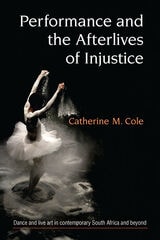
cover of Performance and the Afterlives of Injustice

Performance and the Afterlives of Injustice

Catherine M. Cole

University of Michigan Press, 2020
 In the aftermath of state-perpetrated injustice, a façade of peace can suddenly give way, and in South Africa and the Democratic Republic of Congo, post-apartheid and postcolonial framings of change have exceeded their limits. Performance and the Afterlives of Injustice reveals how the voices and visions of artists can help us see what otherwise evades perception. Embodied performance in South Africa has particular potency because apartheid was so centrally focused on the body: classifying bodies into racial categories, legislating where certain bodies could move and which bathrooms and drinking fountains certain bodies could use, and how different bodies carried meaning. The book considers key works by contemporary performing artists Brett Bailey, Gregory Maqoma, Mamela Nyamza, Robyn Orlin, Jay Pather, and Sello Pesa, artists imagining new forms and helping audiences see the contemporary moment as it is: an important intervention in a country long predicated on denial. They are also helping to conjure, anticipate, and dream a world that is otherwise. The book will be of particular interest to scholars of African studies, black performance, dance studies, transitional justice, as well as theater and performance studies.
[more]
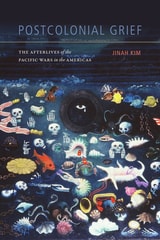
cover of Postcolonial Grief: The Afterlives of the Pacific Wars in the Americas

Postcolonial Grief

The Afterlives of the Pacific Wars in the Americas

Jinah Kim

Duke University Press, 2019

In Postcolonial Grief Jinah Kim explores the relationship of mourning to transpacific subjectivities, aesthetics, and decolonial politics since World War II. Kim argues that Asian diasporic subjectivity exists in relation to afterlives because the deaths of those killed by U.S. imperialism and militarism in the Pacific remain unresolved and unaddressed. Kim shows how primarily U.S.-based Korean and Japanese diasporic writers, artists, and filmmakers negotiate the necropolitics of Asia and how their creative refusal to heal from imperial violence may generate transformative antiracist and decolonial politics. She contests prevalent interpretations of melancholia by engaging with Frantz Fanon's and Hisaye Yamamoto's decolonial writings; uncovering the noir genre's relationship to the U.S. war in Korea; discussing the emergence of silenced colonial histories during the 1992 Los Angeles riots; and analyzing the 1996 hostage takeover of the Japanese ambassador's home in Peru. Kim highlights how the aesthetic and creative work of the Japanese and Korean diasporas offers new insights into twenty-first-century concerns surrounding the state's erasure of military violence and colonialism and the difficult work of remembering histories of war across the transpacific.
[more]
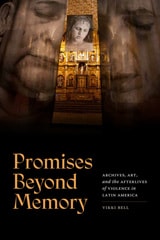
cover of Promises Beyond Memory: Archives, Art, and the Afterlives of Violence in Latin America

Promises Beyond Memory

Archives, Art, and the Afterlives of Violence in Latin America

Vikki Bell

Duke University Press, 2026

In Promises Beyond Memory, Vikki Bell shows how archives of contemporary political violence in Argentina, Chile, and Colombia challenge the idea that simply sheltering the documentation of violence is sufficient to fulfill the obligations of attending to the past. Beyond mere preservation, these archives, museums, and sites of memory invite exploratory modes of enlivening the past through aesthetic practices like photography, installation, film, and performance. These practices foster the “survivance” of memory where populations still grapple with legacies of violence and often state-sponsored mass disappearance and torture. Rather than produce a definitive account of the past, such survivance facilitates polyvocal articulations that open deeply political and ethical questions around contested histories. They may even create moments for what Bell terms “tender forgetting”—the ability to remember without reawakening trauma. Integrating theory, extensive archival work, and interviews with artists, archivists, museum workers, and survivors of state violence, Bell analyses the creative ways that archives pass on stories of violence as they seek to defend against attempts to rewrite the past.
[more]
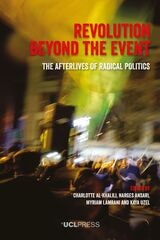
cover of Revolution Beyond the Event: The Afterlives of Radical Politics

Revolution Beyond the Event

The Afterlives of Radical Politics

Edited by Charlotte Al-Khalili, Narges Ansari, Myriam Lamrani, and Kaya Uzel

University College London, 2023

A critical perspective on the lived realities of revolutionary afterlives.

Revolution Beyond the Event brings together leading international anthropologists and emerging scholars to examine revolutionary legacies from the MENA region, Latin America, and the Caribbean. It explores the idea that revolutions have varied afterlives that complicate the assumptions about their duration, pace, and progression, and argues that a renewed focus on the temporality of radical politics is essential to our understanding of revolution. Through a careful selection of case studies, the book provides a critical perspective on the lived realities of revolutionary afterlives, challenging the liberal humanist assumptions implicit in the modern idea of revolution and reappraising the political agency of people caught up in revolutionary situations across a variety of ethnographic contexts.
[more]
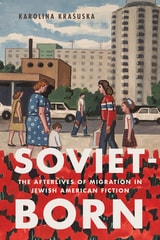
cover of Soviet-Born: The Afterlives of Migration in Jewish American Fiction

Soviet-Born

The Afterlives of Migration in Jewish American Fiction

Karolina Krasuska

Rutgers University Press, 2024

In 2010, when The New Yorker published a list of twenty writers under the age of forty who were “key to their generation,” it included five Jewish-identified writers, two of whom—American Gary Shteyngart and Canadian David Bezmozgis—were Soviet-born. This publicity came after nearly a decade of English-language literary output by Soviet-born writers of all genders in North America. Soviet-Born: The Afterlives of Migration in Jewish American Fiction traces the impact of these now numerous authors—among others, David Bezmozgis, Boris Fishman, Keith Gessen, Sana Krasikov, Ellen Litman, Gary Shteyngart, Anya Ulinich, and Lara Vapnyar—on major coordinates of the Jewish American imaginary.

Entering an immigrant, Soviet-born standpoint creates an alternative and sometimes complementary pattern of how the Eastern and Central European past and present resonate with American Jewishness. The novels, short stories, and graphic novels considered here often stage strikingly fresh variations on key older themes, including cultural geography, the memory of World War II and the Holocaust, communism, gender and sexuality, genealogy, and finally, migration. Soviet-Born demonstrates how these diasporic writers, with their critical stance toward identity categories, open up the field of what is canonically Jewish American to broader contemporary debates.

This book is also freely available online as an open-access digital edition.
 
[more]
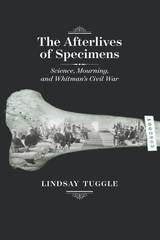
cover of The Afterlives of Specimens: Science, Mourning, and Whitman's Civil War

The Afterlives of Specimens

Science, Mourning, and Whitman's Civil War

Lindsay Tuggle

University of Iowa Press, 2017

The Afterlives of Specimens explores the space between science and sentiment, the historical moment when the human cadaver became both lost love object and subject of anatomical violence. Walt Whitman witnessed rapid changes in relations between the living and the dead. In the space of a few decades, dissection evolved from a posthumous punishment inflicted on criminals to an element of preservationist technology worthy of the presidential corpse of Abraham Lincoln. Whitman transitioned from a fervent opponent of medical bodysnatching to a literary celebrity who left behind instructions for his own autopsy, including the removal of his brain for scientific study.

Grounded in archival discoveries, Afterlives traces the origins of nineteenth-century America’s preservation compulsion, illuminating the influences of botanical, medical, spiritualist, and sentimental discourses on Whitman’s work. Tuggle unveils previously unrecognized connections between Whitman and the leading “medical men” of his era, such as the surgeon John H. Brinton, founding curator of the Army Medical Museum, and Silas Weir Mitchell, the neurologist who discovered phantom limb syndrome. Remains from several amputee soldiers whom Whitman nursed in the Washington hospitals became specimens in the Army Medical Museum.

Tuggle is the first scholar to analyze Whitman’s role in medically memorializing the human cadaver and its abandoned parts. 
[more]
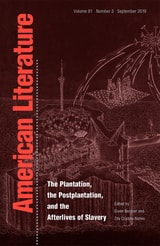
cover of The Plantation, the Postplantation, and the Afterlives of Slavery

The Plantation, the Postplantation, and the Afterlives of Slavery

Gwen Bergner and Zita Nunes, special issue editors

Duke University Press, 0

This special issue interrogates the plantation as a form, logic, and technology that continues to produce inequalities. Attending to the Caribbean, Latin America, and the United States, contributors follow the evolution of plantation slavery in the eighteenth and nineteenth centuries through its subsequent iterations in the Jim Crow and civil rights eras, and into the neoliberal present, where the carceral state props up fantasies of postracialism. The contributors rethink the necro- and biopolitics of plantation slavery, uncovering laborers' strategies of self-determination, affiliation, and communication in spite of the plantation's mechanisms of control.

Essay topics include the circulation of a weekly newspaper published by black tenant farmers in the 1920s, a nineteenth-century trial of an enslaved woman, and the fetish-making of Haitian revolutionary François Makandal. Reconsidering the time and space of the plantation, contributors analyze Western processes of racialization and uncover the experience and agency of the oppressed. This search for modes of being within the plantation structure offers one way to rewrite histories of slavery.

Contributors. Monique Allewaert, Gwen Bergner, Benjamin Child, Jeannine Marie DeLombard, Julius B. Fleming Jr., Jarvis C. McInnis, Zita Nunes, Roberta Wolfson
[more]
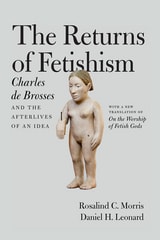
cover of The Returns of Fetishism: Charles de Brosses and the Afterlives of an Idea

The Returns of Fetishism

Charles de Brosses and the Afterlives of an Idea

Charles de Brosses, Rosalind C. Morris, and Daniel H. Leonard

University of Chicago Press, 2017

For more than 250 years, Charles de Brosses’s term “fetishism” has exerted great influence over our most ambitious thinkers. Used as an alternative to “magic,” but nonetheless expressing the material force of magical thought, de Brosses’s term has proved indispensable to thinkers as diverse as Kant, Hegel, Marx, Freud, Lacan, Baudrillard, and Derrida. With this book, Daniel H. Leonard offers the first fully annotated English translation of the text that started it all, On the Worship of Fetish Gods, and Rosalind C. Morris offers incisive commentary that helps modern readers better understand it and its legacy. 
           
The product of de Brosses’s autodidactic curiosity and idiosyncratic theories of language, On the Worship of Fetish Gods is an enigmatic text that is often difficult for contemporary audiences to assess. In a thorough introduction to the text, Leonard situates de Brosses’s work within the cultural and intellectual milieu of its time. Then, Morris traces the concept of fetishism through its extraordinary permutations as it was picked up and transformed by the fields of philosophy, comparative religion, political economy, psychoanalysis, and anthropology. Ultimately, she breaks new ground, moving into and beyond recent studies by thinkers such as William Pietz, Hartmut Böhme, and Alfonso Iacono through illuminating new discussions on topics ranging from translation issues to Africanity and the new materialisms. 

[more]
cover of Thomas Holcroft’s Revolutionary Drama: Reception and Afterlives

Thomas Holcroft’s Revolutionary Drama

Reception and Afterlives

Amy Garnai

Bucknell University Press, 2023

A key figure in British literary circles following the French Revolution, novelist and playwright Thomas Holcroft promoted ideas of reform and equality informed by the philosophy of his close friend William Godwin. Arrested for treason in 1794 and released without trial, Holcroft was notorious in his own time, but today appears mainly as a supporting character in studies of 1790s literary activism. Thomas Holcroft’s Revolutionary Drama authoritatively reintroduces and reestablishes this central figure of the revolutionary decade by examining his life, plays, memoirs, and personal correspondence. In engaging with theatrical censorship, apostacy, and the response of audiences and critics to radical drama, this thoughtful study also demonstrates how theater functions in times of political repression. Despite his struggles, Holcroft also had major successes: this book examines his surprisingly robust afterlife, as his plays, especially The Road to Ruin, were repeatedly revived worldwide in the nineteenth century.
[more]