Results by title
12 books match the query 'Agents'

Agents and Patients
A NovelAnthony Powell
University of Chicago Press, 1936
In Agents and Patients, we return to London with the newly wealthy, memorably named Blore-Smith: an innocent, decent enough chap . . . and a drip. Vulnerable to the machinations of those with less money and more lust, Blore-Smith falls victim to two con artists whose ploys carry him through to the art galleries and whorehouses of Paris, Berlin, and beyond.
Written from a vantage point both high and necessarily narrow, Powell’s early novels nevertheless deal in the universal themes that would become a substantial part of his oeuvre: pride, greed, and what makes people behave as they do. Filled with eccentric characters and piercing insights, Powell’s work is achingly hilarious, human, and true.
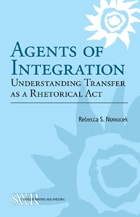
Agents of Integration
Understanding Transfer as a Rhetorical ActRebecca S. Nowacek
Southern Illinois University Press, 2011
While many studies of transfer are longitudinal, with data collected over several years, Nowacek’s is synchronous, a rich cross-section of the writing and classroom discussions produced by a team-taught learning community—three professors and eighteen students enrolled in a one-semester general education interdisciplinary humanities seminar that consisted of three linked courses in history, literature, and religious studies. With extensive field notes, carefully selected student and teacher self-reports in the form of interviews and focus groups, and thorough examinations of recorded classroom discussions, student papers with professor comments, and student notebooks, Nowacek presents a nuanced and engaging analysis that outlines how transfer is not simply a cognitive act but a rhetorical one that involves both seeing connections and presenting them to the instructors who are institutionally positioned to recognize and value them.
Considering the challenges facing instructors teaching for transfer and the transfer of writing-related knowledge, Nowacek develops and outlines a new theoretical framework and methodological model of transfer and illustrates the practical implications through case studies and other classroom examples. She proposes transfer is best understood as an act of recontextualization, and she builds on this premise throughout the book by drawing from previous work in cognitive psychology, activity theory, and rhetorical genre theory, as well as her own analyses of student work.
This focused examination complements existing longitudinal studies and will help readers better understand not only the opportunities and challenges confronting students as they work to become agents of integration but also the challenges facing instructors as they seek to support that student work.
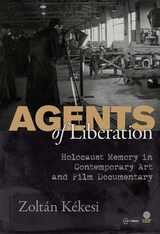
Agents of Liberations
Holocaust Memory in Contemporary Art and Documentary FilmZoltán Kékesi
Central European University Press, 2015
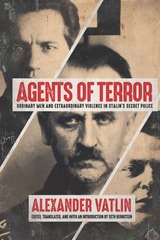
Agents of Terror
Ordinary Men and Extraordinary Violence in Stalin's Secret PoliceAlexander Vatlin; Edited, translated, and with an introduction by Seth Bernstein
University of Wisconsin Press, 2018
Agents of Terror reveals stunning, detailed evidence from archives available for a limited time in the 1990s. Going beyond the central figures of the terror, Vatlin takes readers into the offices and interrogation rooms of secret police at the district level. Spurred at times by ambition, and at times by fear for their own lives, agents rushed to fulfill quotas for arresting “enemies of the people”—even when it meant fabricating the evidence. Vatlin pulls back the curtain on a Kafkaesque system, forcing readers to reassess notions of historical agency and moral responsibility in Stalin-era crimes.

Agents of War
A History of Chemical and Biological Weapons, Second Expanded EditionEdward M. Spiers
Reaktion Books, 2021

Arts Integration in Education
Teachers and Teaching Artists as Agents of ChangeEdited by Gail Humphries Mardirosian and Yvonne Pelletier Lewis
Intellect Books, 2018

Bringing Powerful Knowledge into Classrooms
Subject teachers as agents of recontextualisationEdited by Mark Hardman, Marie Nilsberth, and Mikko Puustinen
University College London, 2026
An empirically grounded, yet theoretically sound, study of how teachers bring powerful knowledge into classrooms and develop effective thinking among their students.
Powerful knowledge equips students with the capacity to engage with systematic, disciplinary thinking, to imagine futures that are not yet conceived, and to think what is yet to be thought. Bringing Powerful Knowledge into Classrooms explores how teachers develop such knowledge in classrooms by transforming disciplinary understandings through subject teaching that responds to the educational needs of society.
Drawing on sociologist Basil Bernstein’s concept of recontextualization and theories of teacher agency, this book examines how teachers navigate the boundaries between academic disciplines, school subjects, and everyday knowledge. Through empirical case studies from the UK, Finland, and Sweden, it illustrates how teachers’ decisions are shaped by national expectations, institutional frameworks, and classroom dynamics. Combining Anglophone and Nordic traditions in subject teaching with curriculum theory and classroom research, the book offers a theoretically grounded yet practical account of how teachers recontextualize knowledge. It develops new insights into teacher agency and recontextualization that are highly relevant to teacher education, curriculum design, and educational policy. By focusing on real-life teaching across a range of subjects, the book deepens our understanding of how powerful knowledge is brought into classrooms and how teachers can be supported in this vital work.

Gender and Violence in Haiti
Women’s Path from Victims to AgentsBenedetta Faedi Duramy
Rutgers University Press, 2014
Gender and Violence in Haiti is the product of more than a year of extensive firsthand observations and interviews with the women who have been caught up in the widespread violence plaguing Haiti. Drawing from the experiences of a diverse group of Haitian women, Faedi Duramy finds that both the victims and perpetrators of violence share a common sense of anger and desperation. Untangling the many factors that cause these women to commit violence, from self-defense to revenge, she identifies concrete measures that can lead them to feel vindicated and protected by their communities.
Faedi Duramy vividly conveys the horrifying conditions pervading Haiti, even before the 2010 earthquake. But Gender and Violence in Haiti also carries a message of hope—and shows what local authorities and international relief agencies can do to help the women of Haiti.

Modern Spanish Women as Agents of Change
Essays in Honor of Maryellen BiederSmith, Jennifer
Bucknell University Press, 2019
Published by Bucknell University Press. Distributed worldwide by Rutgers University Press.

Rebirth of the Clinic
Places and Agents in Contemporary Health CareCindy Patton
University of Minnesota Press, 2010
Combining theory, history, and ethnography, the contributors to this volume ground today's clinic in a larger scheme of power relations, identifying the cultural, political, and economic pressures that frame clinical relationships, including the instrumentalist definition of health, actuarial-based medical practices, and patient self-help movements, which simultaneously hem in and create the conditions under which agents creatively change ideas of illness and treatment.
From threatened community health centers in poor African American locales to innovative nursing practices among the marginally housed citizens of Canada's poorest urban neighborhood, this volume addresses not just the who, what, where, and how of place-specific clinical practices, but also sets these local experiences against a theoretical backdrop that links them to the power of modern medicine in shaping fundamental life experiences.
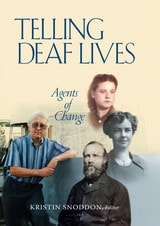
Telling Deaf Lives
Agents of ChangeKristin Snoddon
Gallaudet University Press, 2014
Due to the dearth of formal research on deaf people, Deaf community historians drove the preservation of the stories in this collection. Their diversity is remarkable: Melissa Anderson and Breda Carty describe the Cosmopolitan Correspondence Club, a group of Deaf individuals who corresponded in the early 20th century from Australia to Western Europe to the United States; Ulla-Bell Thorin recounts first-hand growing up deaf in Sweden and her process in authoring six memoirs; Harry Lang reflects on writing biographies of numerous Deaf Americans in the arts and science; Akio Suemori profiles the first Deaf president of a Japanese school for the Deaf; Tatiana Davidenko writes about her Deaf family’s experience during the World War II siege of Leningrad; Theara Yim and Julie Chateauvert look at the evolution of ASL poetry by analyzing works of prominent ASL poets Clayton Valli, Peter Cook, and Kenny Lerner. These and the other contributions here enshrine Deaf people in collective memory by virtue of disseminating and preserving their stories.
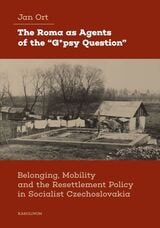
The Roma as Agents of the “G*psy Question”
Belonging, Mobility, and Resettlement Policy in Socialist Czechoslovakia in the 1960sJan Ort
Karolinum Press, 2024
The story of Romani people in communist Czechoslovakia has long been framed by a discriminatory policy of assimilation, and thus by fatal interventions into Romani family ties and their broader socio-cultural systems. Paradoxically, such a narrative failed to integrate the perspective of the Roma themselves, who often associated the same period with an unprecedented experience of social inclusion and material security. In this book, Jan Ort examines the state policy that in the mid-1960s aimed at the definitive elimination of "G*psy backwardness" through the placement of thousands of Roma families in non-Roma society, thus becoming a symbol of the social engineering interventions of the Communist regime in the lives of Czechoslovak Roma. In contrast to the predominant focus on the perspective of state authorities, Ort seeks to map the practice of this policy in specific places with an emphasis on the experiences and agency of the Roma themselves, especially those who had their homes in eastern Slovakia. In the empirical richness of a micro-historical approach, Roma as Agents of the “G*psy Question” uncovers the diverse stories of ordinary Roma who were able to incorporate various aspects of state policy into their own lives without necessarily giving up their distinctive cultural identity.