Results by title
5 books match the query 'Aging in literature'
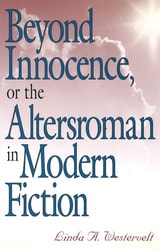
Beyond Innocence, or the Altersroman in Modern Fiction
Linda A. Westervelt
University of Missouri Press, 1997
In this groundbreaking work, Linda A. Westervelt defines an important yet previously unidentified and therefore unnamed type of novel, the altersroman, or age novel. Fictions focusing on a protagonist's confrontation with mortality toward the end of middle age are likely to become ever more prominent in a Western world in which the average age of the population increases and more people reach late middle age and old age.
Working from a diverse sample of modern literature, Westervelt analyzes the variety of responses to the life evaluation. Some characters achieve a level of affirmation that allows renewal, redirection, or simply peace, while others confront feelings of disgust or despair that so little time is left them. Her altersromane are books about seeking wisdom, though not everyone of this age becomes wise. The use of the term altersroman highlights the fact that the altersroman is a classification comparable to but also clearly distinguishable from the bildungsroman, wherein characters make the transition from youth to adulthood. Westervelt contrasts her older protagonists' characteristics with the equivalent characteristics in the bildungsroman through an examination of Don Quixote, part 2, as well as six American novels: The Ambassadors, by Henry James; The Professor's House, by Willa Cather; The Mansion, by William Faulkner; The Angle of Repose, by Wallace Stegner; A Book of Common Prayer, by Joan Didion; and Jazz, by Toni Morrison. These seven works, though remarkably different, share the common features of the altersroman. Westervelt articulates the traits clearly, rests them on the psychological literature, and then shows in depth how the characteristics of the altersroman can enrich and more deeply inform our reading of a significant subset of modern literature that previously went unheralded. Readers can use Westervelt's analysis to identify altersromane in literature other than their own, and she begins this process by identifying exemplars written in other languages.
Beyond Innocence, or the Altersroman in Modern Fiction introduces readers to the altersroman as a tool for classification and analysis and demonstrates the power and utility of that tool. It offers a meaningful and enriching complement to the more established category of the bildungsroman.
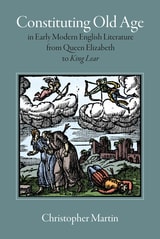
Constituting Old Age in Early Modern English Literature, from Queen Elizabeth to King Lear
Christopher Martin
University of Massachusetts Press, 2012
How did Shakespeare and his contemporaries, whose works mark the last quarter century of Elizabeth I's reign as one of the richest moments in all of English literature, regard and represent old age? Was late life seen primarily as a time of withdrawal and preparation for death, as scholars and historians have traditionally maintained? In this book, Christopher Martin examines how, contrary to received impressions, writers and thinkers of the era—working in the shadow of the kinetic, long-lived queen herself—contested such prejudicial and dismissive social attitudes.
In late Tudor England, Martin argues, competing definitions of and regard for old age established a deeply conflicted frontier between external, socially “constituted” beliefs and a developing sense of an individual's “constitution” or physical makeup, a usage that entered the language in the mid-1500s. This space was further complicated by internal divisions within the opposing camps. On one side, reverence for the elder's authority, rooted in religious and social convention, was persistently challenged by the discontents of an ambitious younger underclass. Simultaneously, the aging subject grounded an enduring social presence and dignity on a bodily integrity that time inevitably threatened. In a historical setting that saw both the extended reign of an aging monarch and a resulting climate of acute generational strife, this network of competition and accommodation uniquely shaped late Elizabethan literary imagination. Through fresh readings of signature works, genres, and figures, Martin redirects critical attention to this neglected aspect of early modern studies.
Late Stage
Theatrical Perspectives on Age and AgingEdited by Benjamin Gillespie and Cindy Rosenthal, with Elinor Fuchs
University of Michigan Press, 2026
The Creative Crone
Aging and the Poetry of May Sarton and Adrienne RichSylvia Henneberg
University of Missouri Press, 2010
Uncanny Subjects
Aging in Contemporary NarrativeAmelia DeFalco
The Ohio State University Press, 2009
In the United States anti-aging is a multibillion-dollar industry, and efforts to combat signs of aging have never been stronger, or more lucrative. Although there are many sociological studies of aging and culture, there are few studies that examine the ways cultural texts construct multiple narratives of aging that intersect and sometimes conflict with existing social theories of aging. In Uncanny Subjects, Amelia DeFalco incorporates methodologies and theories derived from the humanities in her investigation into contemporary representations of aging.
Both aging and narrative are a function of time, of change, of one event happening after another. Subjects understand their lives through narrative trajectories—not necessarily as they are living moment to moment, but in the sort of reflection that many argue becomes more prevalent with age. As a result, narrative fiction provides compelling representations of the strange—indeed uncanny—familiarity of the aging self.
DeFalco examines a range of contemporary fiction and film by authors and directors such as John Banville, John Cassavetes, and Alice Munro. As these texts suggest, old age involves a growing awareness of the otherness within, an awareness that reveals identity as multiple, shifting, and contradictory—in short, uncanny. Drawing together theories of the uncanny with research on aging and temporality, DeFalco argues that aging is a category of difference integral to a contemporary understanding of identity and alterity.