Results by title
2 books match the query 'Aging in motion pictures'
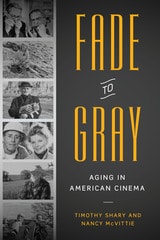
Fade to Gray
Aging in American CinemaTimothy Shary and Nancy McVittie
University of Texas Press, 2016
Winner, Choice Outstanding Academic Title, 2017
Americans are living longer and reinventing both work and retirement, but Hollywood movies barely hint at this reality of contemporary society. In many popular films, older characters fade into irrelevance, inactivity, or absurdity, or else they stay in the background as wise elders while younger characters provide the action. Most American films do not attempt to portray the rich variety of experiences or the sensitive aging issues that people confront in the years beyond fifty.
Fade to Gray offers one of the first extended studies of the portrayal of older people in American cinema from the silent era to the present. Writing in an accessible style for both general audiences and scholars, Timothy Shary and Nancy McVittie examine social attitudes toward aging through an analysis of hundreds of individual films, including such classics as You Can’t Take It With You (1938), Rosemary’s Baby (1968), Grumpy Old Men (1993), and Nebraska (2013). They show how representations of the aging process and depictions of older people embracing or enduring the various experiences of longer lives have evolved over the past century, as well as how film industry practices have both reflected and influenced perceptions of aging in American society. Exposing the social and political motivations for negative cinematic portrayals of the elderly, Fade to Gray also gives visibility to films that provide opportunities for better understanding and appreciation of the aged and the aging process.
Uncanny Subjects
Aging in Contemporary NarrativeAmelia DeFalco
The Ohio State University Press, 2009
In the United States anti-aging is a multibillion-dollar industry, and efforts to combat signs of aging have never been stronger, or more lucrative. Although there are many sociological studies of aging and culture, there are few studies that examine the ways cultural texts construct multiple narratives of aging that intersect and sometimes conflict with existing social theories of aging. In Uncanny Subjects, Amelia DeFalco incorporates methodologies and theories derived from the humanities in her investigation into contemporary representations of aging.
Both aging and narrative are a function of time, of change, of one event happening after another. Subjects understand their lives through narrative trajectories—not necessarily as they are living moment to moment, but in the sort of reflection that many argue becomes more prevalent with age. As a result, narrative fiction provides compelling representations of the strange—indeed uncanny—familiarity of the aging self.
DeFalco examines a range of contemporary fiction and film by authors and directors such as John Banville, John Cassavetes, and Alice Munro. As these texts suggest, old age involves a growing awareness of the otherness within, an awareness that reveals identity as multiple, shifting, and contradictory—in short, uncanny. Drawing together theories of the uncanny with research on aging and temporality, DeFalco argues that aging is a category of difference integral to a contemporary understanding of identity and alterity.