Results by title
10 books match the query 'Agosín, Marjorie'
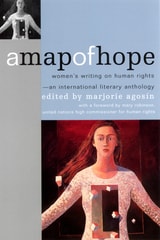
A Map of Hope
Women's Writing on Human Rights—An International Literary AnthologyAgosín, Marjorie
Rutgers University Press, 1999
The first international anthology to explore women’s human rights from a literary perspective.
More than half a century after the United Nations Declaration of Human Rights, women throughout the world still struggle for social and political justice. Many fight back with the only tools of resistance they possess—words. A Map of Hope presents a collection of 77 extraordinary literary works documenting the ways women writers have spoken out about human rights issues.
Writers young and old, known and unknown, explore the dimensions of terror, the unspeakable atrocities of war, and the possibilities of resistance and refusal against all odds. Their poems, essays, memoirs, and brief histories examine issues that affect the condition of women in war, prison camps, exile, and as victims of domestic and political violence.
A Map of Hope presents diverse women writers who have created a literature of global consciousness and justice. Their works give a face, an image, and a human dimension to the dehumanization of human rights violations. The collection allows readers to hear voices that have decided to make a difference. It goes beyond geography and ethnic groups; writers from around the globe are united by the universal dimensions of horror and deprivation, as well as the unique common struggle for justice and solidarity.
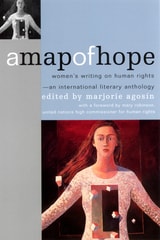
A Map of Hope
Women's Writing on Human Rights—An International Literary AnthologyAgosín, Marjorie
Rutgers University Press, 1999
The first international anthology to explore women’s human rights from a literary perspective.
More than half a century after the United Nations Declaration of Human Rights, women throughout the world still struggle for social and political justice. Many fight back with the only tools of resistance they possess—words. A Map of Hope presents a collection of 77 extraordinary literary works documenting the ways women writers have spoken out about human rights issues.
Writers young and old, known and unknown, explore the dimensions of terror, the unspeakable atrocities of war, and the possibilities of resistance and refusal against all odds. Their poems, essays, memoirs, and brief histories examine issues that affect the condition of women in war, prison camps, exile, and as victims of domestic and political violence.
A Map of Hope presents diverse women writers who have created a literature of global consciousness and justice. Their works give a face, an image, and a human dimension to the dehumanization of human rights violations. The collection allows readers to hear voices that have decided to make a difference. It goes beyond geography and ethnic groups; writers from around the globe are united by the universal dimensions of horror and deprivation, as well as the unique common struggle for justice and solidarity.
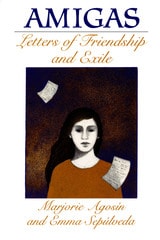
Amigas
Letters of Friendship and ExileBy Marjorie Agosín and Emma Sepúlveda
University of Texas Press, 2001
This collection of letters chronicles a remarkable, long-term friendship between two women who, despite differences of religion and ethnicity, have followed remarkably parallel paths from their first adolescent meeting in their native Chile to their current lives in exile as writers, academics, and political activists in the United States. Spanning more than thirty years (1966-2000), Agosín's and Sepúlveda's letters speak eloquently on themes that are at once personal and political—family life and patriarchy, women's roles, the loneliness of being a religious or cultural outsider, political turmoil in Chile, and the experience of exile.
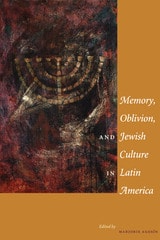
Memory, Oblivion, and Jewish Culture in Latin America
Edited by Marjorie Agosín
University of Texas Press, 2005
Latin America has been a refuge for Jews fleeing persecution from 1492, when Sepharad Jews were expelled from Spain, until well into the twentieth century, when European Jews sought sanctuary there from the horrors of the Nazi Holocaust. Vibrant Jewish communities have deep roots in countries such as Argentina, Mexico, Guatemala, and Chile—though members of these communities have at times experienced the pain of being "the other," ostracized by Christian society and even tortured by military governments. While commonalities of religion and culture link these communities across time and national boundaries, the Jewish experience in Latin America is irreducible to a single perspective. Only a multitude of voices can express it.
This anthology gathers fifteen essays by historians, creative writers, artists, literary scholars, anthropologists, and social scientists who collectively tell the story of Jewish life in Latin America. Some of the pieces are personal tales of exile and survival; some explore Jewish humor and its role in amalgamating histories of past and present; and others look at serious episodes of political persecution and military dictatorship. As a whole, these challenging essays ask what Jewish identity is in Latin America and how it changes throughout history. They leave us to ponder the tantalizing question: Does being Jewish in the Americas speak to a transitory history or a more permanent one?
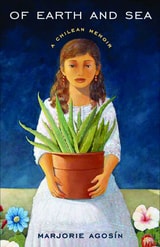
Of Earth and Sea
A Chilean MemoirMarjorie Agosín
University of Arizona Press, 2008
This collection of prose vignettes and free verse draws upon her experiences as a child in Chile, an expatriate abroad, and a minority Jew—even in the land she calls home—to create a striking portrait of a life of exile. The tone of the book varies as it lyrically explores the geography of Chile and weaves into it the themes of exile and oppression. At times the words become hymns to the physical beauty of her country, evoking the grandeur of this land extending to the southernmost tip of the world. At times they are intimate and melancholy, exploring personal and familial history through miniature portraits that reveal the pain of being different. Finally the tone becomes angry as she denounces the injustices committed against her friends and against the families of the disappeared during the seventeen-year dictatorship of Augusto Pinochet.
Combining themes of memory, childhood, minority issues, Judaism, and political oppression, this collection contains some of Agosín’s strongest work. Of Earth and Sea is a poetic autobiography that explores the world of Chile with eyes that see both despair and hope.
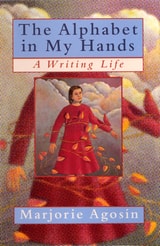
The Alphabet in My Hands
A Writing LifeAgosín, Marjorie
Rutgers University Press, 1999
Marjorie Agosín writes of a beloved childhood nanny: "Since I was Jewish she baptized me with holy water brought forth from the fonts of nearby churches. She told me to stay very still so I wouldn't sprout horns. . . . I was somewhere between taciturn and happy gazing into the mirror as if approaching the edge of a cliff . . . and I watched myself in the deep, transparent veil of this night of all nights." Many of the themes expressed in this vignette—cultural dissonance, family, and community—are poetically intertwined throughout The Alphabet in My Hands. Agosín takes us on a personal journey of discovery that is as much internal reflection as it is an exodus across continents and decades.
Agosín's childhood and early adolescence were spent with her Jewish family in Chile. While her family raised her to regard her Jewish heritage with loving awareness, they also participated in the dominant Catholic culture—an aunt organized Easter egg hunts and her mother admired the beauty of Chile's Catholic churches. The young Agosín became keenly aware of her dual identity in her country, both as a participant and an outsider.
The second half of The Alphabet in My Hands recounts the events that forced her family to emigrate to America: the overthrow of Salvador Allende by General Augusto Pinochet. Agosín writes of her new life in Athens, Georgia, of the sudden loss of all that was familiar. Ostracized as an emigrant—a "non-white" with a strange foreign accent—her high school years were made even more painful by the news from Chile: prisoners taken and classmates disappearing or shot.
Years later, Agosín goes back to Chile and she travels there with her own children. As she stares down at her old homeland from the plane, she writes: "Why do I love this place that forced us into exile, that punished my father for being a Jew?" And in the final chapter of The Alphabet in My Hands, this award-winning poet addresses two important topics: her current residence in New England and the central role of writing and literature in her life.
The Light of Desire
La Luz del DeseoMarjorie Agosín
Swan Isle Press, 2009
Marjorie Agosín’s intensely personal long poem The Light of Desire is both a secular and sacred meditation on love and its meanings in the land of Israel. Following the tradition of the Song of Songs and the secular poetry of Sepharad, the beloved in The Light of Desire is both physical and metaphorical. The lovers’ bodies are the paths, the geography, leading not only from desire to sensual pleasure, but to memory and illumination. The light on the pink stones of Jerusalem, the sunlight of Galilee, from hills to the sea, the fragrant air and “mantle of stars,” all become one in this tender, rhapsodic expression of longing and desire. This is not unrequited love, but rather a reciprocal passion that brings exquisite pleasure, pain, a sense of fragility, and the hope and belief in that which is eternal.
The poem was written over a four-year span in Jerusalem’s Mishkenot Sha’ananim neighborhood, overlooking the wall of the Second Temple, and these hallowed surroundings imbued Agosín’s poetic voice. Lori Marie Carlson’s sensitive translation maintains the spirit of the original Spanish in this bilingual edition.
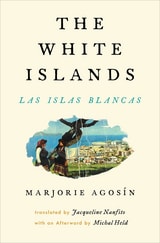
The White Islands / Las Islas Blancas
Marjorie Agosín
Swan Isle Press, 2015
Presented in a beautiful bilingual Spanish-English edition, Agosín’s poems speak to a wandering life of exile on distant shores. We hear the rhythm of the waves and the Ladino-inflected voices of Sephardi women past and present: Paloma, Estrella, and Luna in the fullness of their lives, loves, dreams, and faith. An evocative and sensual voyage to communities mostly lost after the Holocaust, The White Islands offers a lighthouse of remembrance, a lyrical world recovered with language and song, lament and joy, longing and hope.
Women Warriors in Early Modern Spain
A Tribute to Barbara MujicaSusan L. Fischer
University of Delaware Press, 2019
Published by University of Delaware Press. Distributed worldwide by Rutgers University Press.
Women, Gender, and Human Rights
A Global PerspectiveAgosín, Marjorie
Rutgers University Press, 2001
The 1948 United Nations Universal Declaration of Human Rights expresses the credo that all human beings are created free and equal. But not until 1995 did the United Nations declare that women’s rights to be human rights, and bring gender issues into the global arena for the first time. The subordination of indigenous and minority women, ethnic cleansing, and the struggle for reproductive rights are some of the most pressing issues facing women worldwide.
Women, Gender, and Human Rights is the first collection of essays that encompass a global perspective on women and a wide range of issues, including political and domestic violence, education, literacy, and reproductive rights. Most of the articles were written expressly for this volume by internationally known experts in the fields of government, bioethics, medicine, public affairs, literature, history, anthropology, law, and psychology.