Results by title
2 books match the query 'Agrarian Change'
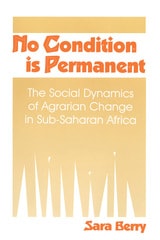
No Condition Is Permanent
The Social Dynamics of Agrarian Change in Sub-Saharan AfricaSara S. Berry
University of Wisconsin Press, 1993
“No condition is permanent,” a popular West African slogan, expresses Sara S. Berry’s theme: the obstacles to African agrarian development never stay the same. Her book explores the complex way African economy and society are tied to issues of land and labor, offering a comparative study of agrarian change in four rural economies in sub-Saharan Africa, including two that experienced long periods of expanding peasant production for export (southern Ghana and southwestern Nigeria), a settler economy (central Kenya), and a rural labor reserve (northeastern Zambia).
The resources available to African farmers have changed dramatically over the course of the twentieth century. Berry asserts that the ways resources are acquired and used are shaped not only by the incorporation of a rural area into colonial (later national) and global political economies, but also by conflicts over culture, power, and property within and beyond rural communities. By tracing the various debates over rights to resources and their effects on agricultural production and farmers’ uses of income, Berry presents agrarian change as a series of on-going processes rather than a set of discrete “successes” and “failures.”
No Condition Is Permanent enriches the discussion of agrarian development by showing how multidisciplinary studies of local agrarian history can constructively contribute to development policy. The book is a contribution both to African agrarian history and to debates over the role of agriculture in Africa’s recent economic crises.
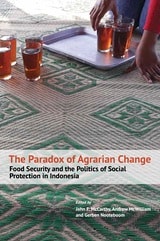
The Paradox of Agrarian Change
Food Security and the Politics of Social Protection in IndonesiaEdited by John McCarthy, Andrew McWilliam, and Gerben Nooteboom
National University of Singapore Press, 2023
Economic growth in the middle-income countries of Southeast Asia over the past few decades has been widely praised for reducing poverty in both absolute and relative terms. Indonesia is a prime example. But while poverty has declined in Indonesia, patterns of food poverty persist across Indonesia. What explains this troubling paradox? How does it relate to Indonesia’s enthusiastic embrace of the “entitlements revolution,” the use of direct cash transfers as a tool for reducing poverty and building social inclusion?
This book analyzes the nature and social consequences of economic development and agrarian change processes in rural Indonesia in relation to the scope and effectiveness of Indonesia’s social protection programs. The findings are based on a series of extensive ground-up case studies in Indonesian communities in a variety of eco-agrarian settings that seek to understand the drivers of food insecurity and vulnerability at a household level. The results show that while high-value farming, diversification, and migration may offer a means of economic progress for poor households, opportunities for accumulation are limited. This, the authors show, is due to the way class, gender, and power work in remote local contexts, and the fact that much surplus income is used for enhanced consumption and changing lifestyles. There are few signs of the classical structural transformation of the countryside which has historically been considered the most decisive pathway out of rural poverty. The authors conclude that social assistance is unlikely to counter the persistence of rural poverty, food insecurity, and precarity in the absence of other redistributive strategies that shift the structural drivers of inequality.