Results by title
5 books match the query 'Agricultural biotechnology'

Agricultural Biotechnology and the Environment
Science, Policy, and Social IssuesSheldon Krimsky and Roger Wrubel
University of Illinois Press, 1996
"Extraordinarily well documented . . . remarkably clear. This is
the most comprehensive coverage of these issues to date. It will be required
reading for some time." -- Lawrence Busch, Michigan State University
"Krimsky and Wrubel not only describe the components of agricultural
biotechnology, they address and analyze controversies involving the risks
and benefits of new technologies. Coverage of technical to social components
of agricultural biotechnology is unusually complete and thorough. Their
even-handed and comprehensive approach to these topics is rare and extremely
valuable." -- Richard Weinzierl, University of Illinois
Modern agriculture is being transformed by the genetic alteration of
seeds, animals, and microorganisms, a process that has produced such products
as flavor saver tomatoes and crops resistant to specific insects or herbicides.
Agricultural Biotechnology and the Environment is the first comprehensive
overview of the ongoing transformation of agriculture, exploring the impact
of genetic engineering from scientific, social, ethical, and ecological
perspectives.
Sheldon Krimsky and Roger Wrubel detail the impact the new generation
of products is expected to have on agricultural practice and the environment
and assess the degree to which current trends in biotechnology match earlier
expectations. They also analyze the social and political response to innovations
resulting from genetic technology.
Closely examined in each of three areas--transgenic plants, genetically
engineered microorganisms, and transgenic animals--are technical and scientific
problems, social controversies, and anticipated environmental impacts.
An objective, detailed look at a subject of interest to a broad spectrum
of readers, Agricultural Biotechnology and the Environment will
be of interest to researchers in the new biotechnology fields as well
as to educated general readers and policymakers.
A volume in the series The Environment and the Human Condition
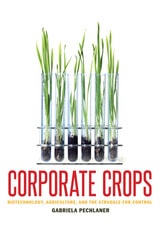
Corporate Crops
Biotechnology, Agriculture, and the Struggle for ControlBy Gabriela Pechlaner
University of Texas Press, 2012
Biotechnology crop production area increased from 1.7 million hectares to 148 million hectares worldwide between 1996 to 2010. While genetically modified food is a contentious issue, the debates are usually limited to health and environmental concerns, ignoring the broader questions of social control that arise when food production methods become corporate-owned intellectual property. Drawing on legal documents and dozens of interviews with farmers and other stakeholders, Corporate Crops covers four case studies based around litigation between biotechnology corporations and farmers. Pechlaner investigates the extent to which the proprietary aspects of biotechnologies—from patents on seeds to a plethora of new rules and contractual obligations associated with the technologies—are reorganizing crop production.
The lawsuits include patent infringement litigation launched by Monsanto against a Saskatchewan canola farmer who, in turn, claimed his crops had been involuntarily contaminated by the company’s GM technology; a class action application by two Saskatchewan organic canola farmers launched against Monsanto and Aventis (later Bayer) for the loss of their organic market due to contamination with GMOs; and two cases in Mississippi in which Monsanto sued farmers for saving seeds containing its patented GM technology. Pechlaner argues that well-funded corporate lawyers have a decided advantage over independent farmers in the courts and in creating new forms of power and control in agricultural production. Corporate Crops demonstrates the effects of this intersection between the courts and the fields where profits, not just a food supply, are reaped.

Food for the Few
Neoliberal Globalism and Biotechnology in Latin AmericaEdited by Gerardo Otero
University of Texas Press, 2008
Recent decades have seen tremendous changes in Latin America's agricultural sector, resulting from a broad program of liberalization instigated under pressure from the United States, the IMF, and the World Bank. Tariffs have been lifted, agricultural markets have been opened and privatized, land reform policies have been restricted or eliminated, and the perspective has shifted radically toward exportation rather than toward the goal of feeding local citizens. Examining the impact of these transformations, the contributors to Food for the Few: Neoliberal Globalism and Biotechnology in Latin America paint a somber portrait, describing local peasant farmers who have been made responsible for protecting impossibly vast areas of biodiversity, or are forced to specialize in one genetically modified crop, or who become low-wage workers within a capitalized farm complex. Using dozens of examples such as these, the deleterious consequences are surveyed from the perspectives of experts in diverse fields, including anthropology, economics, geography, political science, and sociology.
From Kathy McAfee's "Exporting Crop Biotechnology: The Myth of Molecular Miracles," to Liz Fitting's "Importing Corn, Exporting Labor: The Neoliberal Corn Regime, GMOs, and the Erosion of Mexican Biodiversity," Food for the Few balances disturbing findings with hopeful assessments of emerging grassroots alternatives. Surveying not only the Latin American conditions that led to bankruptcy for countless farmers but also the North's practices, such as the heavy subsidies implemented to protect North American farmers, these essays represent a comprehensive, keenly informed response to a pivotal global crisis.
Seeds of Power
Environmental Injustice and Genetically Modified Soybeans in ArgentinaAmalia Leguizamón
Duke University Press, 2020
The Intended and Unintended Effects of U.S. Agricultural and Biotechnology Policies
Edited by Joshua S. Graff Zivin and Jeffrey M. Perloff
University of Chicago Press, 2012
Using economic models and empirical analysis, this volume examines a wide range of agricultural and biofuel policy issues and their effects on American agricultural and related agrarian insurance markets. Beginning with a look at the distribution of funds by insurance programs—created to support farmers but often benefiting crop processors instead—the book then examines the demand for biofuel and the effects of biofuel policies on agricultural price uncertainty. Also discussed are genetically engineered crops, which are assuming an increasingly important role in arbitrating tensions between energy production, environmental protection, and the global food supply. Other contributions discuss the major effects of genetic engineering on worldwide food markets. By addressing some of the most challenging topics at the intersection of agriculture and biotechnology, this volume informs crucial debates.