Results by title
6 books match the query 'Agricultural ecology'

Consumed
Food for a Finite PlanetSarah Elton
University of Chicago Press, 2013
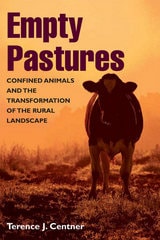
Empty Pastures
Confined Animals and the Transformation of the Rural LandscapeTerence J. Centner
University of Illinois Press, 2004
Just as Rachel Carson's landmark Silent Spring used the disappearance of songbirds as a jumping-off point for a work that raised public awareness of pesticides' devastating environmental impact, Empty Pastures sees the dwindling numbers of livestock in the American countryside as a symptom of a broader transformation, one with serious consequences for the rural landscape and its inhabitants--animal as well as human.
After outlining the rise of the AFO, Centner examines the troubling consequences of consolidation in animal farming and suggests a number of remedies. The issues he tackles include groundwater contamination, the loss of biodiversity, animal welfare, concentrated odors and other nuisances, soil erosion, and the economic effects of the disappearance of the small family farm.
Inspired by largely abandoned traditional practices rather than a radical and unrealistic vision of a return to an idealized past, Centner proposes a series of pragmatic reforms for regulating factory farms to halt ecological degradation and revitalize rural communities.
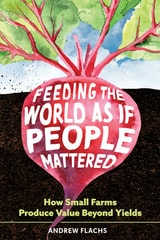
Feeding the World as if People Mattered
How Small Farms Produce Value Beyond YieldsAndrew Flachs
University of Arizona Press, 2026
The dominant view of agriculture has focused only on what we produce. It sees value in terms of capital gains or yield efficiency, masking how our global food system produces tremendous amounts of food commodities while failing to feed people, support rural communities, or enhance ecological well-being. Feeding the World as if People Mattered asks us to look more deeply and more humanely at what we perceive to be most valuable in our agricultural systems.
This book draws on fifteen years of anthropological research, taking readers to fields in South India, Eastern Europe, and North America, where people are already feeding the future amid global change. From these fields, Flachs shows us how a radical rethinking of the value of small farms and farmers is already happening. Bringing together conversations in agriculture, economics, anthropology, and the environmental humanities, Flachs deftly shows how small farms reproduce social and ecological relationships that are the only sustainable path forward.
For anyone who is curious about the food on their plate and the people who helped to get it there, Feeding the World as if People Mattered will offer a new way to find value in the food we grow and the people who grow it.
Settlement Ecology
The Social and Spatial Organization of Kofyar AgricultureGlenn Davis Stone
University of Arizona Press, 1996
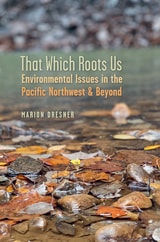
That Which Roots Us
Environmental Issues in the Pacific Northwest & BeyondMarion Dresner
University of Nevada Press, 2023
A work of natural and environmental history.
That Which Roots Us is a work of natural and environmental history that explores the origins of and resolutions to some of the United States’ environmental problems. Marion Dresner discusses the roots of Euro-American environmental exploitative action, starting with the environmental consequences of having treated Pacific Northwest forests as commodities. She shares her experiences visiting sites where animal-centered ice age culture changed to human-centered culture thousands of years ago with the advent of farming. The book explores the origins of the romantic philosophical movement, which arose out of the debilitating conditions of the industrial era. Those romantic attitudes toward nature inspired the twentieth-century preservation movement and America’s progressively modern conservation attitudes.
The book is centered around environmental issues in the Pacific Northwest, contrasting utilitarian views of nature with Native American practices of respect and reciprocity. The elements that make That Which Roots Us a truly unique and important contribution to environmental literature are the author’s personal recollections and interactions with the landscape. Ultimately, Dresner offers hope for a new stewardship of the land and a focus on science literacy and direct experience in the natural world as the most grounded way of knowing the planet.
Tropical Pioneers
Human Agency and Ecological Change in the Highlands of Sri Lanka, 1800–1900James L. A. Webb Jr.
Ohio University Press, 2002
In 1800, the highlands of Sri Lanka had some of the most biologically diverse primary tropical rainforest ecosystems in the world. By 1900, only a few craggy corners and mountain caps had been spared the fire stick. Highland villagers, through the extension of slash-and-burn agriculture, and British managers, through the creation of plantations—first of coffee, then cinchona, and finally tea—had removed virtually the entire primary forest cover.
Tropical Pioneers documents the conversion of a tropical rainforest biome and the collision between what previously had been more discrete ecological zones within South Asia. The ecological impacts were transformational. Author James L. A. Webb, Jr., demonstrates that profound ecological disruption occurred in the central highlands of Sri Lanka during the nineteenth century and suggests that the theme of ecological crisis brought about by the integration of tropical ecological zones during precolonial and colonial periods alike is an important one for historians to investigate elsewhere.
Tropical Pioneers is based on extensive research in the National Archives of Sri Lanka, the National Agricultural Library at Gannaruwa, the Library of the Royal Asiatic Society-Ceylon Branch, the Royal Botanic Gardens at Kew, the Public Record Office of the United Kingdom, and the British Library.