Results by title
4 books match the query 'Agriculture and politics'
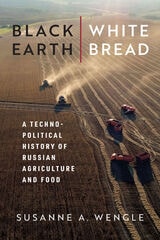
Black Earth, White Bread
A Technopolitical History of Russian Agriculture and FoodSusanne A. Wengle
University of Wisconsin Press, 2023
Examining governance, production, consumption, nature, and the ensuing vulnerabilities of the agrifood system, Wengle reveals the intended and unintended consequences of Russian agricultural policies since 1917. Ultimately, Black Earth, White Bread calls attention to Russian technopolitics and how macro systems of government impact life on a daily, quotidian level.
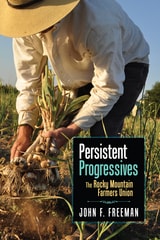
Persistent Progressives
The Rocky Mountain Farmers UnionJohn F. Freeman
University Press of Colorado, 2015
Using data spanning decades, author John Freeman covers the founding of the RMFU in 1907 until the present, demonstrating how members continually sought to control the means of production and marketing by forming cooperatives, providing consumer services, and engaging in politics. Powering this evolution was a group of “practical idealists”—the Farmers Union leaders and titular persistent progressives who shaped the organization’s growth and expansion. Initiated by Jim Patton, who brought the organization out of its oppositional roots and into its cooperative advocacy, the RMFU passed to John Stencel and then David Carter, joining hands with agricultural conservationists and small organic producers along the way to carry the torch for progressive agrarianism in today’s urbanized world. Shaken but undeterred by some notable failures, its leadership remains convinced of the efficacy of cooperatives as a means to achieve justice for all.
Discussing the broader social, economic, political, and environmental issues related to farming, ranching, and urbanization, Persistent Progressives seamlessly blends regional history with ongoing issues of agricultural and economic development.
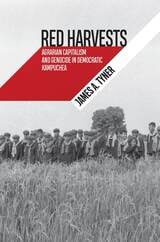
Red Harvests
Agrarian Capitalism and Genocide in Democratic KampucheaJames A. Tyner
West Virginia University Press, 2021
Reassessing the Cambodian genocide through the lens of global capitalist development.
James Tyner reinterprets the place of agriculture under the Khmer Rouge, positioning it in new ways relative to Marxism, capitalism, and genocide. The Cambodian revolutionaries’ agricultural management is widely viewed by critics as irrational and dangerous, and it is invoked as part of wider efforts to discredit leftist movements. Researching the specific functioning of Cambodia’s transition from farms to agriculture within the context of the global economy, Tyner comes to a different conclusion. He finds that analysis of “actually existing political economy”—as opposed to the Marxist identification the Khmer Rouge claimed—points to overlap between Cambodian practice and agrarian capitalism.
Tyner argues that dissolution of the traditional Khmer family farm under the aegis of state capitalism is central to any understanding of the mass violence unleashed by the Khmer Rouge. Seen less as a radical outlier than as part of a global shift in farming and food politics, the Cambodian tragedy imparts new lessons to our understanding of the political economy of genocide.
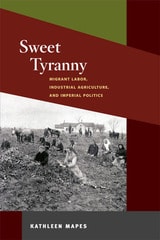
Sweet Tyranny
Migrant Labor, Industrial Agriculture, and Imperial PoliticsKathleen Mapes
University of Illinois Press, 2008