Results by title
4 books match the query 'Agrobiodiversity conservation'
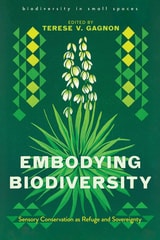
Embodying Biodiversity
Sensory Conservation as Refuge and SovereigntyTerese V. Gagnon
University of Arizona Press, 2024
Harnessing a myriad of methodologies and research spanning multiple continents, this volume delves into the power of everyday forms of biodiversity conservation, motivated by sensory and embodied engagement with plants. Through an array of interdisciplinary contributions, the authors argue that the vast majority of biodiversity conservation worldwide is carried out not by large-scale, hierarchical initiatives but by ordinary people who cultivate sensory-motivated, place-based bonds with plants.
Acknowledging the monumental role of everyday champions in tending biodiversity, the contributors write that this caretaking is crucial to countering ecological harm and global injustice stemming from colonial violence and racial capitalism.
Contributors
Mike Anastario
Ally Ang
Antonia Barreau
Julián Caviedes
Chen Chen
Evelyn Flores
Terese V. Gagnon
José Tomás Ibarra
Fred L. Joiner
Gary Nabhan
Virginia D. Nazarea
Shannon A. Novak
Valentina Peveri
Emily Ramsey
Yasuaki Sato
Justin Simpson
David E. Sutton
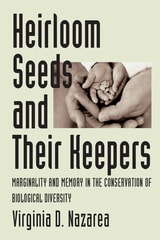
Heirloom Seeds and Their Keepers
Marginality and Memory in the Conservation of Biological DiversityVirginia D. Nazarea
University of Arizona Press, 2005
As scientists grapple with the erosion of genetic diversity of crops and their wild relatives, old-timey farmers and gardeners continue to save, propagate, and pass on folk varieties and heirloom seeds. Virginia Nazarea focuses on the role of these seedsavers in the perpetuation of diversity. She thoughtfully examines the framework of scientific conservation and argues for the merits of everyday conservation—one that is beyond programmatic design. Whether considering small-scale rice and sweet potato farmers in the Philippines or participants in the Southern Seed Legacy and Introduced Germplasm from Vietnam in the American South, she explores roads not necessarily less traveled but certainly less recognized in the conservation of biodiversity.
Through characters and stories that offer a wealth of insights about human nature and society, Heirloom Seeds and Their Keepers helps readers more fully understand why biodiversity persists when there are so many pressures for it not to. The key, Nazarea explains, is in the sovereign spaces seedsavers inhabit and create, where memories counter a culture of forgetting and abandonment engendered by modernity. A book about theory as much as practice, it profiles these individuals, who march to their own beat in a world where diversity is increasingly devalued as the predictability of mass production becomes the norm.
Heirloom Seeds and Their Keepers offers a much-needed, scientifically researched perspective on the contribution of seedsaving that illustrates its critical significance to the preservation of both cultural knowledge and crop diversity around the world. It opens new conversations between anthropology and biology, and between researchers and practitioners, as it honors conservation as a way of life.
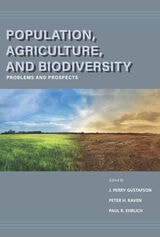
Population, Agriculture, and Biodiversity
Problems and ProspectsJ. Perry Gustafson
University of Missouri Press, 2020
The world population is projected to be nine to ten billion by 2050, signaling the need to increase world food production by more than 70 percent on the same amount of land currently under production—and this without further damaging our fragile environment. The essays in this collection, written by experts for laypersons, present the problems we face with clarity and assess our prospects for solving them, calling for action but holding out viable solutions.
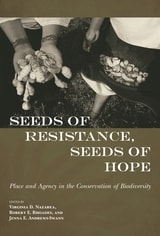
Seeds of Resistance, Seeds of Hope
Place and Agency in the Conservation of BiodiversityEdited by Virginia D. Nazarea, Robert E. Rhoades, and Jenna E. Andrews-Swann
University of Arizona Press, 2013
This broad collection brings to the table a bag full of tools from anthropology, sociology, genetics, plant breeding, education, advocacy, and social activism. By design, multiple voices are included. They cross or straddle disciplinary, generational, national, and political borders. Contributors demonstrate the importance of cultural memory in the persistence of traditional or heirloom crops, as well as the agency exhibited by displaced and persecuted peoples in place-making and reconstructing nostalgic landscapes (including gardens from their homelands). Contributions explore local initiatives to save native and older seeds, the use of modern technologies to conserve heirloom plants, the bioconservation efforts of indigenous people, and how genetically modified organisms (GMOs) have been successfully combated. Together they explore the conservation of biodiversity at different scales, from different perspectives, and with different theoretical and methodological approaches. Collectively, they demonstrate that there is reason for hope.