Results by title
4 books match the query 'Albert Camus'
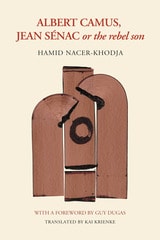
Albert Camus, Jean Sénac, or The Rebel Son
Hamid Nacer-Khodja
Michigan State University Press, 2019
While Albert Camus is an internationally acclaimed figure, Jean Sénac has struggled to gain recognition, even in France and Algeria. The correspondence between the Nobel Prize recipient and the young poet, documented in this illuminating collection, is a testimony to a little-known friendship that lasted for over a decade (1947–1958) and coincided with the escalating conflict between France and Algeria. Their letters shed light on a passionate conflict that opposed two men on two sides of the Algerian War. On one side, Camus distanced himself from an Algerian insurrection that was becoming increasingly violent. On the other, Sénac espoused the armed insurrection of the National Liberation Front and Algeria’s right to independence and freedom. The exchange between Sénac and Camus allows for a deeper and more personal understanding of the Algerian conflict, and of the crucial role of writers, poets, and thinkers in the midst of a fratricidal colonial conflict. The letters translated here are also the intimate dialog between two men who had much in common and who shared a deep love for each other and for their homeland.
[more]
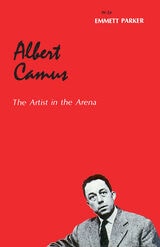
Albert Camus
The Artist in the ArenaEmmett Parker
University of Wisconsin Press, 1966
A Communist Party member in the 1930s, Camus became an independent political critic in the 1950s: an outspoken opponent of all forms of totalitarianism, he defended the libertarian principles of Western democracy. Along the way he involved himself in far-reaching intellectual quarrels such as that over his own L’Homme révolté (The Rebel) with Jean-Paul Sartre, which this book examines in fascinating detail. Albert Camus offers illuminating insights into the relationship between intellectuals and politics; a serious contribution to the history of social, political, and ethical ideas.
[more]
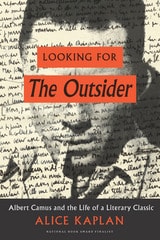
Looking for The Outsider
Albert Camus and the Life of a Literary ClassicAlice Kaplan
University of Chicago Press, 2016
The Outsider is a rite of passage for readers around the world. Since its publication in France in 1942, Camus’s novel has been translated into sixty languages and sold more than six million copies. It’s the rare novel that’s as at likely to be found in a teen’s backpack as in a graduate philosophy seminar. If the twentieth century produced a novel that could be called ubiquitous, The Outsider is it.
How did a young man in his twenties who had never written a novel turn out a masterpiece that still grips readers more than seventy years later? With Looking for “The Outsider”, Alice Kaplan tells that story. In the process, she reveals Camus’s achievement to have been even more impressive—and more unlikely—than even his most devoted readers knew.
Born in poverty in colonial Algeria, Camus started out as a journalist covering the criminal courts. The murder trials he attended, Kaplan shows, would be a major influence on the development and themes of The Outsider. She follows Camus to France, and, making deft use of his diaries and letters, re-creates his lonely struggle with the novel in Montmartre, where he finally hit upon the unforgettable first-person voice that enabled him to break through and complete The Outsider.
Even then, the book’s publication was far from certain. France was straining under German occupation, Camus’s closest mentor was unsure of the book’s merit, and Camus himself was suffering from near-fatal tuberculosis. Yet the book did appear, thanks in part to a resourceful publisher, Gaston Gallimard, who was undeterred by paper shortages and Nazi censorship.
The initial critical reception of The Outsider was mixed, and it wasn’t until after liberation that The Outsider began its meteoric rise. As France and the rest of the world began to move out of the shadow of war, Kaplan shows, Camus’s book— with the help of an aggressive marketing campaign by Knopf for their 1946 publication of the first English translation—became a critical and commercial success, and Camus found himself one of the most famous writers in the world. Suddenly, his seemingly modest tale of alienation was being seen for what it really was: a powerful parable of the absurd, an existentialist masterpiece.
Few books inspire devotion and excitement the way The Outsider does. And it couldn’t have a better biographer than Alice Kaplan, whose books about twentieth-century French culture and history have won her legions of fans. No reader of Camus will want to miss this brilliant exploration.
[more]
Looking for The Stranger
Albert Camus and the Life of a Literary ClassicAlice Kaplan
University of Chicago Press, 2016
The Stranger is a rite of passage for readers around the world. Since its publication in France in 1942, Camus’s novel has been translated into sixty languages and sold more than six million copies. It’s the rare novel that’s as at likely to be found in a teen’s backpack as in a graduate philosophy seminar. If the twentieth century produced a novel that could be called ubiquitous, The Stranger is it.
How did a young man in his twenties who had never written a novel turn out a masterpiece that still grips readers more than seventy years later? With Looking for “The Stranger”, Alice Kaplan tells that story. In the process, she reveals Camus’s achievement to have been even more impressive—and more unlikely—than even his most devoted readers knew.
Born in poverty in colonial Algeria, Camus started out as a journalist covering the criminal courts. The murder trials he attended, Kaplan shows, would be a major influence on the development and themes of The Stranger. She follows Camus to France, and, making deft use of his diaries and letters, re-creates his lonely struggle with the novel in Montmartre, where he finally hit upon the unforgettable first-person voice that enabled him to break through and complete The Stranger.
Even then, the book’s publication was far from certain. France was straining under German occupation, Camus’s closest mentor was unsure of the book’s merit, and Camus himself was suffering from near-fatal tuberculosis. Yet the book did appear, thanks in part to a resourceful publisher, Gaston Gallimard, who was undeterred by paper shortages and Nazi censorship.
The initial critical reception of The Stranger was mixed, and it wasn’t until after liberation that The Stranger began its meteoric rise. As France and the rest of the world began to move out of the shadow of war, Kaplan shows, Camus’s book— with the help of an aggressive marketing campaign by Knopf for their 1946 publication of the first English translation—became a critical and commercial success, and Camus found himself one of the most famous writers in the world. Suddenly, his seemingly modest tale of alienation was being seen for what it really was: a powerful parable of the absurd, an existentialist masterpiece.
Few books inspire devotion and excitement the way The Stranger does. And it couldn’t have a better biographer than Alice Kaplan, whose books about twentieth-century French culture and history have won her legions of fans. No reader of Camus will want to miss this brilliant exploration.
[more]