Results by title
5 books match the query 'Alexander, Jonathan'
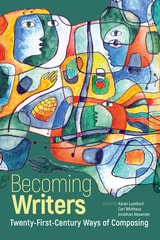
Becoming Writers
Twenty-First-Century Ways of ComposingKaren Lunsford
Utah State University Press, 2026
Becoming Writers draws on phenomenological and lifespan approaches to writing research, reframing writing as a lived process shaped by social contexts, evolving technologies, and a writer’s own sense of self and agency. It moves beyond familiar binaries and offers a more holistic account of what it means to become a writer today.
Bringing together scholars from across the fields of writing studies and rhetoric/composition to consider the ways “writing” is changing in the twenty-first century, this collection tracks how and why people talk about the various forms of writing they do. Contributors address how younger generations understand the role and place of writing in their lives, particularly amid increasing and dramatic economic, social, and political change, as well as the ever-evolving role of writing in what it means to be human.
Becoming Writers builds on the Wayfinding Project (https://thewayfindingproject.com), a multiyear study of writing development focused on college graduates. Rather than focusing solely on the classroom, Becoming Writers investigates how writing functions in people’s professional, civic, personal, and digital lives. By centering lived experiences across domains, it provides a model of the empirical depth and different methodological approaches being used by scholars interested in writing development across the lifespan.
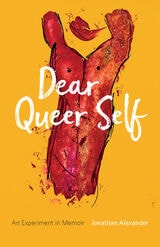
Dear Queer Self
An Experiment in MemoirJonathan Alexander
Acre Books, 2022
In this unconventional memoir, Jonathan Alexander addresses wry and affecting missives to a conflicted younger self. Focusing on three years—1989, 1993, and 1996—Dear Queer Self follows the author through the homophobic heights of the AIDS epidemic, the fall of the Berlin Wall, the election of Bill Clinton, and the steady advancements in gay rights that followed. With humor and wit afforded by hindsight, Alexander relives his closeted college years, his experiments with his sexuality in graduate school, his first marriage to a woman, and his budding career as a college professor.
As he moves from tortured self-denial to hard-won self-acceptance, the author confronts the deeply uncomfortable ways he is implicated in his own story. More than just a coming-out narrative, Dear Queer Self is both an intimate psychological exploration and a cultural examination—a meshing of inner and outer realities and a personal reckoning with how we sometimes torture the truth to make a life. It is also a love letter, an homage to a decade of rapid change, and a playlist of the sounds, sights, and feelings of a difficult, but ultimately transformative, time.
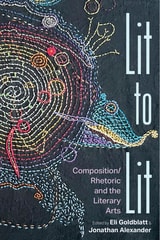
Lit to Lit
Composition/Rhetoric and the Literary ArtsEli Goldblatt
Utah State University Press, 2026
Lit to Lit examines the traditional split between the study of literature and composition and rhetoric programs, asking writing studies scholars to think critically and creatively about the role literature can play in the teaching of writing and the field’s conceptions of its own relation to writing. Grounded in diverse experiences and practices, contributors offer provocative but thoughtful analyses of how composition and literature can be brought together in the study and teaching of writing.
Complex forms of writing should not be the sole territory of one subfield or discipline but rather should benefit from multiple perspectives generated by those with keen and abiding interests in writing writ large. Many in the field of composition and rhetoric also have an active engagement in the literary arts, particularly the flowering of literature from diverse cultural experiences in the last decades. What new teaching and learning approaches could emerge from a synthesis of theoretical, literary, rhetorical, poetic, and compositional methods? This question becomes even more compelling when considering how English departments often house programs in journalism and creative writing, allowing robust opportunities for multiple ways of thinking about and studying complex texts.
Lit to Lit makes visible the generative overlap between subfields already present in the broad field of English, pointing to new ways forward that value each area’s separate endeavors while highlighting the possibilities for what could be built together.
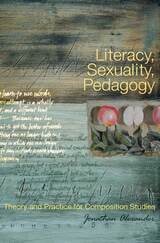
Literacy, Sexuality, Pedagogy
Theory and Practice for Composition StudiesJonathan Alexander
Utah State University Press, 2008
In Literacy, Sexuality, Pedagogy, Jonathan Alexander argues for the development of students' "sexual literacy." Such a literacy is not just concerned with developing fluency with sexuality as a "hot" topic, but with understanding the intimate interconnectedness of sexuality and literacy in Western culture. Using the work of scholars in queer theory, sexuality studies, and the New Literacy Studies, Alexander unpacks what he sees as a crucial--if often overlooked--dimension of literacy: the fundamental ways in which sexuality has become a key component of contemporary literate practice, of the stories we tell about ourselves, our communities, and our political investments.
Alexander then demonstrates through a series of composition exercises and writing assignments how we might develop students' understanding of sexual literacy. Examining discourses of gender, heterosexuality, and marriage allows students (and instructors) a critical opportunity to see how the languages we use to describe ourselves and our communities are saturated with ideologies of sexuality. Understanding how sexuality is constructed and deployed as a way to "make meaning" in our culture gives us a critical tool both to understand some of the fundamental ways in which we know ourselves and to challenge some of the norms that govern our lives. In the process, we become more fluent with the stories that we tell about ourselves and discover how normative notions of sexuality enable (and constrain) narrations of identity, culture, and politics. Such develops not only our understanding of sexuality, but of literacy, as we explore how sexuality is a vital, if vexing, part of the story of who we are.
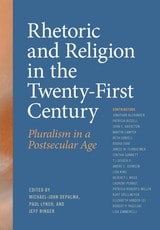
Rhetoric and Religion in the Twenty-First Century
Pluralism in a Postsecular AgeEdited by Michael-John DePalma, Paul Lynch, and Jeff Ringer
Southern Illinois University Press, 2023
Expanding the scope of religious rhetoric
Over the past twenty-five years, the intersection of rhetoric and religion has become one of the most dynamic areas of inquiry in rhetoric and writing studies. One of few volumes to include multiple traditions in one conversation, Rhetoric and Religion in the Twenty-First Century engages with religious discourses and issues that continue to shape public life in the United States.
This collection of essays centralizes the study of religious persuasion and pluralism, considers religion’s place in U.S. society, and expands the study of rhetoric and religion in generative ways. The volume showcases a wide range of religious traditions and challenges the very concepts of rhetoric and religion. The book’s eight essays explore African American, Buddhist, Christian, Indigenous, Islamic, and Jewish rhetoric and discuss the intersection of religion with feminism, race, and queer rhetoric—along with offering reflections on how to approach religious traditions through research and teaching. In addition, the volume includes seven short interludes in which some of the field’s most accomplished scholars recount their experiences exploring religious rhetorics and invite readers to engage these exigent lines of inquiry.
By featuring these diverse religious perspectives, Rhetoric and Religion in the Twenty-First Century complicates the field’s emphasis on Western, Hellenistic, and Christian ideologies. The collection also offers teachers of writing and rhetoric a range of valuable approaches for preparing today’s students for public citizenship in our religiously diverse global context.