Results by title
13 books match the query 'Algonquian Indians'
America's Early Whalemen
Indian Shore Whalers on Long Island, 1650–1750John A. Strong
University of Arizona Press, 2018
America’s Early Whalemen examines this early chapter of an iconic American historical experience. John A. Strong’s research draws on exhaustive sources, domestic and international, including little-known documents such as the whaling contracts of 340 Native American whalers, personal accounting books of whaling company owners, London customs records, estate inventories, and court records. Strong addresses labor relations, the role of alcohol and debt, the patterns of cultural accommodations by Native Americans, and the emergence of corporate capitalism in colonial America.
When Strong began teaching at Long Island University in 1964, he found little mention of the local Indigenous people in history books. The Shinnecocks and the neighboring tribes of Unkechaugs and Montauketts were treated as background figures for the celebratory narrative of the “heroic” English settlers. America’s Early Whalemen highlights the important contributions of Native peoples to colonial America.
Creating New England, Defending the Northeast
Contested Algonquian and English Spatial Worlds, 1500–1700Nathan Braccio
University of Massachusetts Press, 2026
Between 1500 and 1700, Indigenous and English mapmakers across the North Atlantic depicted present-day New England in markedly distinct ways, highlighting how differently their communities understood the landscape. While English cartographers relied on new mathematics and other developing scientific knowledge from Europe, as well as an overhead perspective of the world, Algonquian mapmakers drew on deep knowledge of the landscape, derived from their communities’ long history upon it. Nathan Braccio refers to this phenomenon as “parallel landscapes.”
Creating New England, Defending the Northeast asserts that Algonquian knowledge of the landscape represented a powerful and persistent alternative to English surveying and mapmaking in the Northeast. When English colonists and explorers recognized the unsuitability of their techniques for understanding New England’s unfamiliar landscape, they attempted to appropriate Indigenous knowledge and maps. Algonquian sachems used this as an opportunity to control and benefit from their new English neighbors. Later, as the English became insecure in their dependence on Indigenous people, they began to remake and mark the landscape. Algonquians adapted, maintaining control of important spatial knowledge, even in a place no longer entirely of their making. This story complicates narratives of conquest and highlights the Indigenous spatial knowledge too often overlooked.
Early Native Literacies in New England
A Documentary and Critical AnthologyKristina Bross
University of Massachusetts Press, 2008
Designed as a corrective to colonial literary histories that have excluded Native voices, this anthology brings together a variety of primary texts produced by the Algonquian peoples of New England during the seventeenth, eighteenth, and very early nineteenth centuries. Included among these written materials and objects are letters, signatures, journals, baskets, pictographs, confessions, wills, and petitions, each of which represents a form of authorship. Together they demonstrate the continuing use of traditional forms of memory and communication and the lively engagement of Native peoples with alphabetic literacy during the colonial period. Each primary text is accompanied by an essay that places it in context and explores its significance.
Written by leading scholars in the field, these readings draw on recent trends in literary analysis, history, and anthropology to provide an excellent overview of the field of early Native studies. They are also intended to provoke discussion and open avenues for further exploration by students and other interested readers. Above all, the texts and commentaries gathered in this volume provide an opportunity to see Native American literature as a continuity of expression that reflects choices made long before contact and colonization, rather than as a nineteenth—or even twentieth-century invention.
Contributors include Heidi Bohaker, Heather Bouwman, Joanna Brooks, Kristina Bross, Stephanie Fitzgerald, Sandra Gustafson, Laura Arnold Leibman, Kevin McBride, David Murray, Laura Murray, Jean O'Brien, Ann Marie Plane, Philip Round, Jodi Schorb, David Silverman, and Hilary E. Wyss.
Making Pictures in Stone
American Indian Rock Art of the NortheastEdward J. Lenik
University of Alabama Press, 2008
A full range of rock art appearances, including dendroglyphs, pictographs, and a selection of portable rock objects
The Indians of northeastern North America are known to us primarily through reports and descriptions written by European explorers, clergy, and settlers, and through archaeological evidence. An additional invaluable source of information is the interpretation of rock art images and their relationship to native peoples for recording practical matters or information, as expressions of their legends and spiritual traditions, or as simple doodling or graffiti. The images in this book connect us directly to the Indian peoples of the Northeast, mainly Algonkian tribes inhabiting eastern Pennsylvania, Maryland and the lower Potomac River Valley, New York, New Jersey, the six New EnglandStates, and Atlantic Canada. Lenik provides a full range of rock art appearances in the study area, including some dendroglyphs, pictographs, and a selection of portable rock objects. By providing a full analysis and synthesis of the data, including the types and distribution of the glyphs, and interpretations of their meaning to the native peoples, Lenik reveals a wealth of new information on the culture and lifeways of the Indians of the Northeast.
Papers of the Fiftieth Algonquian Conference
Monica Macaulay
Michigan State University Press, 2021
Papers of the Fifty-Fifth Algonquian Conference
Actes du Cinquante-Cinquième Congrès des AlgonquinistesInge Genee
Michigan State University Press, 2026
Papers of the Algonquian Conference is a collection of peer-reviewed scholarship from an annual international forum that focuses on topics related to the languages and cultures of Algonquian peoples. This series touches on a variety of subject areas, including anthropology, archaeology, education, ethnography, history, Indigenous studies, language studies, literature, music, political science, psychology, religion, and sociology. Contributors often cite never-before-published data in their research, giving the reader a fresh and unique insight into the Algonquian peoples and rendering these papers essential reading for those interested in studying Algonquian society
Papers of the Fifty-First Algonquian Conference
Monica Macaulay
Michigan State University Press, 2022
Papers of the Fifty-Fourth Algonquian Conference
Actes du cinquante-quatrième Congrès des AlgonquinistesInge Genee
Michigan State University Press, 2025
Papers of the Forty-Eighth Algonquian Conference
Monica Macaulay
Michigan State University Press, 2019
Papers of the Forty-Seventh Algonquian Conference
Monica Macaulay
Michigan State University Press, 2018
Papers of the Forty-Sixth Algonquian Conference
Monica Macaulay
Michigan State University Press, 2017
The Deadly Politics of Giving
Exchange and Violence at Ajacan, Roanoke, and JamestownSeth Mallios
University of Alabama Press, 2006
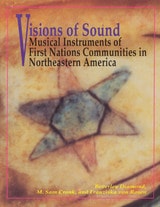
Visions of Sound
Musical Instruments of First Nation Communities in Northeastern AmericaBeverley Diamond, M. Sam Cronk, and Franziska von Rosen
University of Chicago Press, 1995
Featuring over two hundred photographs of instruments, dialogues among the coauthors, numerous interviews with individual music makers, and an appended catalogue of over seven hundred instrument descriptions, this is an important book for all ethnomusicologists and students of Native American culture as well as general readers interested in Native American mythology and religious life.