Results by title
3 books match the query 'Alice (Fictitious character from Carroll)'
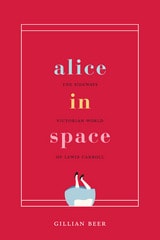
Alice in Space
The Sideways Victorian World of Lewis CarrollGillian Beer
University of Chicago Press, 2016
In Alice’s Adventures in Wonderland and Through the Looking-Glass, Lewis Carroll created fantastic worlds that continue to delight and trouble readers of all ages today. Few consider, however, that Carroll conceived his Alice books during the 1860s, a moment of intense intellectual upheaval, as new scientific, linguistic, educational, and mathematical ideas flourished around him and far beyond. Alice in Space reveals the contexts within which the Alice books first lived, bringing back the zest to jokes lost over time and poignancy to hidden references.
Gillian Beer explores Carroll’s work through the speculative gaze of Alice, for whom no authority is unquestioned and everything can speak. Parody and Punch, evolutionary debates, philosophical dialogues, educational works for children, math and logic, manners and rituals, dream theory and childhood studies—all fueled the fireworks. While much has been written about Carroll’s biography and his influence on children’s literature, Beer convincingly shows him at play in the spaces of Victorian cultural and intellectual life, drawing on then-current controversies, reading prodigiously across many fields, and writing on multiple levels to please both children and adults in different ways.
With a welcome combination of learning and lightness, Beer reminds us that Carroll’s books are essentially about curiosity, its risks and pleasures. Along the way, Alice in Space shares Alice’s exceptional ability to spark curiosity in us, too.
[more]
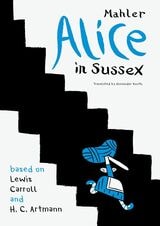
Alice in Sussex
Mahler after Lewis Carroll & H. C. ArtmannNicolas Mahler
Seagull Books, 2022
A twist on the classic tale of Alice in Wonderland told through Nicolas Mahler’s distinctive graphic novel style.
Alice is back in Wonderland. Here she meets the White Rabbit, who leads her down into his rabbit hole in search of an illustrated edition of H. C. Artmann’s Frankenstein in Sussex. Over the course of the novel, Alice repeatedly runs into the Rabbit, who quotes freely from other literary works by the likes of Herman Melville and E. M. Cioran.
Unlike in Lewis Carroll’s classic, Alice is not traveling the Wonderland we know. Rather, in Nicolas Mahler’s whimsical graphic novel retelling, she is in a house deep beneath the ground. On subsequent floors, she encounters the famous creations of Lewis Carroll: the Hookah-Smoking Caterpillar, the Cheshire Cat, the Mock Turtle, and many others. One after the other, these creatures address the terrors of childhood and youth. It is only when Alice reaches the ground floor of the house that we arrive at the inevitable climax: face to face with Frankenstein’s Monster.
[more]
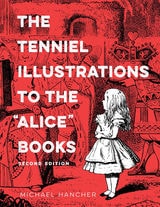
The Tenniel Illustrations to the “Alice” Books, 2nd edition
Michael Hancher
The Ohio State University Press, 2019
Lewis Carroll’s two Alice books are among the most popular works of English literature thanks in part to the ninety-two indelible illustrations that John Tenniel drew for them. The Tenniel Illustrations to the “Alice” Books situates their outstanding success in several historical contexts, including Tenniel’s career as a leading artist for Punch magazine.
This new edition also pays special attention to the material circumstances that enabled and conditioned the printing of the illustrations. The original twelve chapters have been revised and updated throughout, drawing on archival and published resources made available in recent decades. Six chapters are entirely new, explaining how Tenniel’s drawings were professionally hand-engraved on wood blocks; how electrotype replicas were made from those blocks; and what problems could mar the commercial printing of such images—as notoriously happened in the first printing of Alice’s Adventures in Wonderland, which Carroll suppressed on Tenniel’s advice. Also considered for the first time here are the coloring of Tenniel’s black-and-white illustrations, by Tenniel and other artists, and the extraordinary treatment later given to Tenniel’s illustrations by the prestigious Limited Editions Club.
This new edition also pays special attention to the material circumstances that enabled and conditioned the printing of the illustrations. The original twelve chapters have been revised and updated throughout, drawing on archival and published resources made available in recent decades. Six chapters are entirely new, explaining how Tenniel’s drawings were professionally hand-engraved on wood blocks; how electrotype replicas were made from those blocks; and what problems could mar the commercial printing of such images—as notoriously happened in the first printing of Alice’s Adventures in Wonderland, which Carroll suppressed on Tenniel’s advice. Also considered for the first time here are the coloring of Tenniel’s black-and-white illustrations, by Tenniel and other artists, and the extraordinary treatment later given to Tenniel’s illustrations by the prestigious Limited Editions Club.
[more]