Results by title
13 books match the query 'Alienation'
Aesthetics of Alienation
Reassessment of Early Soviet Cultural TheoriesEvgeny Dobrenko
Northwestern University Press, 2005
In chapters on Proletkult, RAPP, LEF, and Pereval, Dobrenko reexamines the theories generated by these major Marxist literary groupings of the early Soviet Union. He shows how each approached the problems of literature's response to the presumed social mandate of the young communist society, and how Socialist Realism emerged as a conglomerate of these earlier, revolutionary theories. With extensive and detailed reference to supporting testimony and documents, Dobrenko clearly demonstrates how Socialist Realism was created from within the revolutionary culture, and how this culture and its disciples fully participated in this creative process. His work represents a major breakthrough in our current understanding of the complex sources that contributed to early Soviet culture.
Army of Hope, Army of Alienation
Culture and Contradiction in the American Army Communities of Cold War GermanyJohn P. Hawkins
University of Alabama Press, 2004
Army life has always been known as a life of sacrifice, challenge, and frustration, yet one filled also with deep satisfactions. This is so for the soldiers’ families as much as for the soldiers themselves. Over the years, military and civilian leaders of the US Army have tried to reduce the hardships of military life by creating an array of community services designed to provide social support for soldiers and families and help them live satisfying lives in military communities.
Unfortunately, this effort has not been particularly successful, and frustration, dissatisfaction, and alienation persist among soldiers and family member in the US Army communities in Germany. Discontent continues because the underlying sources of alienation in the Army and among its families are highly complex, poorly understood, and therefore hardly addressed by the Army’s quality-of-life programs that are intended to make soldier and family life more bearable.
In Army of Hope, Army of Alienation: Culture and Contradiction in the American Army Communities of Cold War Germany, the author seeks to penetrate the logic, social structure, and daily practice of life in the American military communities that lay scattered along the frontier between East and West Germany during the final years of the Cold War. In coming to understand the life and thought of these American soldiers and families, ordinary American citizens can learn much about their military forces and about their own society and culture. In addition, a greater understanding about how people work and live around an institution that is at once so important and yet tasked with a mission so different from that of ordinary pursuits can stimulate social scientists and concerned citizens to think differently about culture, society, and behavior in general.
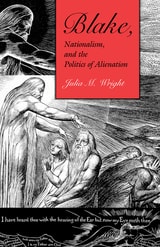
Blake, Nationalism, and the Politics of Alienation
Julia M. Wright
Ohio University Press, 2027
William Blake’s reputation as a staunch individualist is based in large measure on his repeated attacks on institutions and belief systems that constrain the individual’s imagination. Blake, however, rarely represents isolation positively, suggesting that the individual’s absolute freedom from communal pressures is not the ideal. Instead, as Julia Wright argues in her award-winning study Blake, Nationalism, and the Politics of Alienation, Blake’s concern lies with the kind of community that is being established. Moreover, writing at the moment of the emergence of modern nationalism, Blake reveals a concern with the national community in particular.
Beginning with a discussion of the priority of national narrative in late-eighteenth-century art theory and antiquarianism, Blake, Nationalism, and the Politics of Alienation traces its relevance in Blake’s printed works, from The Poetical Sketches and the Lambeth Prophecies to The Laocoön. Professor Wright then turns to Europe, America, and Visions of the Daughters of Albion, focusing on Blake’s portrayals of particular characters’ alienation from the groups and ideologies represented in the texts. The book closes by arguing that Blake’s major printed works, Milton and Jerusalem, are explicit and extensive engagements with the question of nation—and empire.
Although nationalism existed in various forms during the Romantic period, Blake’s contemporaries generally assumed that nations should progress continuously, producing a clear narrative line from an auspicious origin to the perfect fulfillment of that promise. Wright argues that these mutually determining constructs of national character and national narrative inform Blake’s handling of the problem of the individual-within-a-community.
Broken Masculinities
Solitude, Alienation, and Frustration in Turkish Literature after 1970Cimen Günay-Erkol
Central European University Press, 2016
Broken Masculinities portrays the post-dictatorial novel of the 1970s in all its complexity, and introduces the reader to a 1968-era Turkey, a period which challenges Turkey’s now reinforced Islamic image by portraying the quest for sexual liberation and critical student uprisings. Günay-Erkol argues that the literature written after the 1971 coup in Turkey constitutes a coherent sub-genre and needs to be considered together. These novels share a common ground which is rich in images of men and women craving for power: general isolation, sexual-emotional frustration, and a traumatic sense of solitude and alienation.
This book is an original and significant contribution to two major fields of study: (1) gender and sexuality with respect to formation of subjectivity through literature, and (2) modern literature and history through the study of Turkish literature. The chief concern in this book is not only literature’s response to a particular period in Turkey, but also the role of literature in bearing witness to trauma and drastic political acts of violence—and coming to terms with them.B
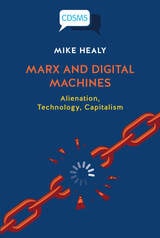
Marx and Digital Machines
Alienation, Technology, CapitalismMike Healy
University of Westminster Press, 2020
“Healy closes his marvellous book by saying that ‘alienation is a constant feature and is experienced as a norm rather than as an aberration’.” - https://marxandphilosophy.org.uk/reviews/19718_marx-and-digital-machines-alienation-technology-capitalism-by-mike-healy-reviewed-by-thomas-klikauer/
This book explores the fundamental contradiction at the heart of the digital environment: technology offers all manner of promises, yet habitually fails to deliver. This failure often arises from numerous problems: the proficiency of the technology or end-user, policy failure at various levels, or a combination of these. Solutions such as better technology and more effective end-user education are often put into place to solve these failures.
Mike Healy argues that such approaches are inherently faulty drawing upon qualitative research informed by Marx’s theory of alienation. Using Marx’s theory, he considers participants in three distinct settings: the workplace of information and communications technology (ICT) professionals; university scholars researching the ethical and societal implications of our digital environment; and a group of pensioners living in South London, UK, undertaking ICT training. By delving beneath the surface of how digital technologies are created, researched and experienced, this study illustrates the contradictory nature of our digital lives, as they directly arise from the needs of capitalism.
The book also places Marx’s theory in contrast to the mainstream approaches derived from Seaman and Blauner. In researching and comprehending ICT, this book reaffirms the superior explanatory power of Marx’s theory of alienation.

Power to Hurt
THE VIRTUES OF ALIENATIONWilliam Monroe
University of Illinois Press, 1998
Chosen as a Choice Magazine's Outstanding Academic Book for 1999.

Revolution in Psychology
Alienation to EmancipationIan Parker
Pluto Press, 2007
Psychology is meant to help people cope with the afflictions of modern society. But how useful is it? Ian Parker argues that current psychological practice has become part of the problem, rather than the solution.
Ideal for undergraduates, this book deconstructs the discipline to reveal the neoliberal sensitivities that underlie its theory and practice. Psychology focuses on the happiness of 'the individual'. Yet it neglects the fact that the happiness of the individual depends on their social and political surroundings.
Ian Parker argues that a new approach to psychology is needed. He offers an alternative vision, outlining how the discipline can be linked to political practice and how it can help people as part of a wider progressive agenda. This groundbreaking book is at the cutting edge of current thinking on the discipline and should be required reading on all psychology courses.
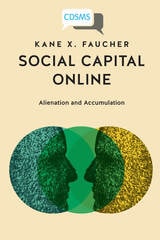
Social Capital Online
Alienation and AccumulationKane X. Faucher
University of Westminster Press, 2018
What is ‘social capital’? The enormous positivity surrounding it conceals the instrumental economic rationality underpinning the notion as corporations silently sell consumer data for profit. Status chasing is just one aspect of a process of transforming qualitative aspects of social interactions into quantifiable metrics for easier processing, prediction, and behavioural shaping.
A work of critical media studies, Social Capital Online examines the idea within the new ‘network spectacle’ of digital capitalism via the ideas of Marx, Veblen, Debord, Baudrillard and Deleuze. Explaining how such phenomena as online narcissism and aggression arise, Faucher offers a new theoretical understanding of how the spectacularisation of online activity perfectly aligns with the value system of neoliberalism and its data worship. Even so, at the centre of all, lie familiar ideas – alienation and accumulation – new conceptions of which he argues are vital for understanding today’s digital society.
The Future of Alienation
Richard Schacht
University of Illinois Press, 1994
They call for a renewed interest in alienation theory; they counter the myth that, with the collapse of the Soviet empire, Marx's thinking has been "refuted"; and they argue for an enhanced sensitivity to the problem of how we describe, interpret, and evaluate the world around us in light of the complexity and diversity that alienation theory reveals.

The Waiting List
An Iraqi Woman's Tales of AlienationBy Daisy Al-Amir
University of Texas Press, 1994
Daisy Al-Amir is one of the more visible figures in women's fiction in the Arab world today. This collection of stories, originally published in Lebanon as Ala La'ihat al-Intizar, is the most recent of her five publications. Her stories intimately reflect women's experiences in the chaotic worlds of the Lebanese civil war and the rise of Saadam Hussain as Iraq's leader. Set in Iraq, Cyprus, and Lebanon, the stories shed light on an unusual Middle East refugee experience—that of a cultural refugee, a divorced woman who is educated, affluent, and alone.
Al-Amir is also a poet and novelist, whose sensual prose grows out of a long tradition of Iraqi poetry. But one also finds existential themes in her works, as Al-Amir tries to balance what seems fated and what seems arbitrary in the turbulent world she inhabits. She deals with time and space in a minimalist, surreal style, while studying the disappointments of life through the subjective lens of memory. Honestly facing the absence of family and the instability of place, Al-Amir gives lifelike qualities to the inanimate objects of her rapidly changing world.
In addition to the stories, two examples of the author's experimental poems are included. In her introduction, Mona Mikhail places these stories and poems in the context of contemporary Islamic literature and gender studies.
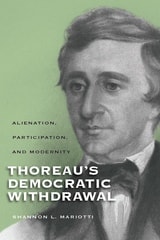
Thoreau’s Democratic Withdrawal
Alienation, Participation, and ModernityShannon L. Mariotti
University of Wisconsin Press, 2009
Separated by time, space, and context, Thoreau and Adorno share a common belief that critical inquiry is essential to democracy but threatened by modern society. While walking, huckleberrying, and picking wild apples, Thoreau tries to recover the capacities for independent perception and thought that are blunted by “Main Street,” conventional society, and the rapidly industrializing world that surrounded him. Adorno’s thoughts on particularity and the microscopic gaze he employs to work against the alienated experience of modernity help us better understand the value of Thoreau’s excursions into nature. Reading Thoreau with Adorno, we see how periodic withdrawals from public spaces are not necessarily apolitical or apathetic but can revitalize our capacity for the critical thought that truly defines democracy.
In graceful, readable prose, Mariotti reintroduces us to a celebrated American thinker, offers new insights on Adorno, and highlights the striking common ground they share. Their provocative and challenging ideas, she shows, still hold lessons on how we can be responsible citizens in a society that often discourages original, critical analysis of public issues.
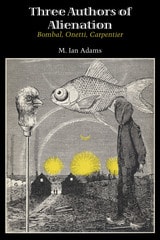
Three Authors of Alienation
Bombal, Onetti, CarpentierBy M. Ian Adams
University of Texas Press, 1975
As a philosophical and social concept, alienation covers a broad range of mental states, both normal and abnormal. Correspondingly, a wide range of literary forms has been employed to deal with this important theme. In Three Authors of Alienation, an exploration of the literary expression of alienation, M. Ian Adams discusses the works of three contemporary Latin American authors.
The fiction of María Luisa Bombal, Juan Carlos Onetti, and Alejo Carpentier reflects alienation, disgust with life, and a feeling of nothingness arising from the conditions of modern society. However, each author treats the theme differently. In La última niebla, María Luisa Bombal uses poetic imagery to create the emotional life of the protagonist. Juan Carlos Onetti portrays the schizoid extreme of alienation with a complex of symbols based on changes of vision caused by the mental states of his characters. In Los pasos perdidos, Alejo Carpentier presents the problem of the modern alienated artist who attempts to rid himself of his social alienation by changing times and cultures.
In his close analysis of the works discussed, Adams considers each literary element in its context and also in terms of its relation to the larger artistic vision of the author. In addition, he places the works of the three authors in the greater perspective of modern social problems by discussing the concepts of social alienation proposed by Erich Fromm and Erich Kahler. His conclusion is that, although disgust with life and feelings of meaninglessness are at the heart of the experiences of the characters of all three authors, only in Alejo Carpentier’s Los pasos perdidos are social conditions the major cause of alienation. In the works of Bombal and Onetti, alienation is a result not of social conditions, but of factors unique to the characters’ personalities and circumstances.
Three Authors of Alienation is a solid contribution to criticism of contemporary Latin American narrative. Adams’s projection of a social problem into the realm of aesthetic experience yields intriguing interpretations of both the problem and the literature.
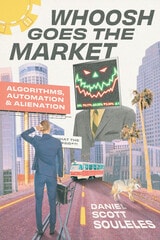
Whoosh Goes the Market
Algorithms, Automation, and AlienationDaniel Scott Souleles
University of Chicago Press, 2024
Markets are messy, and no one knows this better than traders who work tirelessly to predict what they will do next. In Whoosh Goes the Market, Daniel Scott Souleles takes us into the day-to-day experiences of a team at a large trading firm, revealing what it’s actually like to make and lose money on contemporary capital markets.
The traders Souleles shadows have mostly moved out of the pits and now work with automated, glitch-prone computer systems. They remember the days of trading manually, and they are suspicious of algorithmically driven machine-learning systems. Openly musing about their own potential extinction, they spend their time expressing fear and frustration in profanity-laced language. With Souleles as our guide, we learn about everything from betting strategies to inflated valuations, trading swings, and market manipulation. This crash course in contemporary finance vividly reveals the existential anxiety at the evolving front lines of American capitalism.