Results by title
12 books match the query 'Alienation (Social psychology) in literature'

A Poetics of Trauma
The Work of Dahlia RavikovitchIlana Szobel
Brandeis University Press, 2013

Blake, Nationalism, and the Politics of Alienation
Julia M. Wright
Ohio University Press, 2027
William Blake’s reputation as a staunch individualist is based in large measure on his repeated attacks on institutions and belief systems that constrain the individual’s imagination. Blake, however, rarely represents isolation positively, suggesting that the individual’s absolute freedom from communal pressures is not the ideal. Instead, as Julia Wright argues in her award-winning study Blake, Nationalism, and the Politics of Alienation, Blake’s concern lies with the kind of community that is being established. Moreover, writing at the moment of the emergence of modern nationalism, Blake reveals a concern with the national community in particular.
Beginning with a discussion of the priority of national narrative in late-eighteenth-century art theory and antiquarianism, Blake, Nationalism, and the Politics of Alienation traces its relevance in Blake’s printed works, from The Poetical Sketches and the Lambeth Prophecies to The Laocoön. Professor Wright then turns to Europe, America, and Visions of the Daughters of Albion, focusing on Blake’s portrayals of particular characters’ alienation from the groups and ideologies represented in the texts. The book closes by arguing that Blake’s major printed works, Milton and Jerusalem, are explicit and extensive engagements with the question of nation—and empire.
Although nationalism existed in various forms during the Romantic period, Blake’s contemporaries generally assumed that nations should progress continuously, producing a clear narrative line from an auspicious origin to the perfect fulfillment of that promise. Wright argues that these mutually determining constructs of national character and national narrative inform Blake’s handling of the problem of the individual-within-a-community.
Border Writing
The Multidimensional TextD. Emily HicksForeword by Neil Larsen
University of Minnesota Press, 1991
Border Writing was first published in 1991. Minnesota Archive Editions uses digital technology to make long-unavailable books once again accessible, and are published unaltered from the original University of Minnesota Press editions.
Until recently, literary theory has been grounded in the histories of English, French, German, and Spanish literature. The terms and models for the production of literature and its function in culture and society were decided in Western Europe, and any deviations were immediately marginalized. This Eurocentric view has been widely attached by postmodern, feminist, and postcolonial political practices.
Drawing on a variety of critical and theoretical sources, D. Emily Hicks employs the concept of border writing to consider the complexities of contemporary Latin American writing. With its emphasis on the multiplicity of languages and the problems of translation, border writing connotes a perspective that is no longer determined by neat distinctions. Hicks combines Deleuze and Guattari's notion of "deterritorialization" (the geographic, linguistic, or cultural displacement from one's own country, language, or native culture) with a holographic metaphor in provocative readings of Latin America writers, including Gabriel Garcia Marquez, Luisa Valenzuela, and Julio Cortazar. The result is a volume that forces the reader to consider the development of literature in terms of strategies and tactics that contribute to the production of meaning in culturally complex and politically repressive societies.
D. Emily Hicks is associate professor of English and comparative literature and a member of the Latin American studies faculty at San Diego State University. Neil Larsen is associate professor of Spanish and Latin American literature at Northeastern University and the author of Modernism and Hegemony: A Materialist Critique of Aesthetic Agencies (Minnesota, 1990).
Lewd and Notorious
Female Transgression in the Eighteenth CenturyKatharine Kittredge, Editor
University of Michigan Press, 2003

Lost in Time
Locating the Stranger in German ModernityJune J. Hwang
Northwestern University Press, 2014
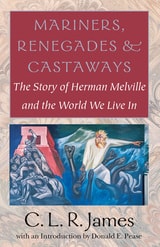
Mariners, Renegades and Castaways
The Story of Herman Melville and the World We Live InC. L. R. James
Dartmouth College Press, 2001
Melancholy, Love, and Time
Boundaries of the Self in Ancient LiteraturePeter Toohey
University of Michigan Press, 2004

Power to Hurt
THE VIRTUES OF ALIENATIONWilliam Monroe
University of Illinois Press, 1998
Chosen as a Choice Magazine's Outstanding Academic Book for 1999.

Private Anarchy
Impossible Community and the Outsider’s Monologue in German Experimental FictionPaul Buchholz
Northwestern University Press, 2018
Buchholz suggests that in their experimental prose Gustav Landauer, Franz Kafka, Thomas Bernhard, and Wolfgang Hilbig each considered how the "void" of mass society could be the precondition for a new, anarchic form of community that would rest not on any assumptions of shared origins or organic unity but on an experience of extreme emptiness that blurs the boundaries of the self and enables intimacy between total strangers. This community, Buchholz argues, is created through the verbal form most closely associated with alienation and isolation: the monologue.
By showing how these authors engaged with the idea of community and by relating these contributions to an extended intellectual genealogy of nihilism, Private Anarchy illustrates the distinct philosophical and sociopolitical stakes of German experimental writing in the twentieth century.
Rebels
Youth and the Cold War Origins of IdentityLeerom Medovoi
Duke University Press, 2005
Alongside the young rebel, the contemporary concept of identity emerged in the 1950s. It was in that decade that “identity” was first used to define collective selves in the politicized manner that is recognizable today: in terms such as “national identity” and “racial identity.” Medovoi traces the rapid absorption of identity themes across many facets of postwar American culture, including beat literature, the young adult novel, the Hollywood teen film, early rock ‘n’ roll, black drama, and “bad girl” narratives. He demonstrates that youth culture especially began to exhibit telltale motifs of teen, racial, sexual, gender, and generational revolt that would burst into political prominence during the ensuing decades, bequeathing to the progressive wing of contemporary American political culture a potent but ambiguous legacy of identity politics.
Searching for Safe Spaces
Afro-Caribbean Women Writers in ExileMyriam Chancy
Temple University Press, 1997
Understanding exile as flight from political persecution or types of oppression that single out women, Chancy concentrates on diasporic writers and filmmakers who depict the vulnerability of women to poverty and exploitation in their homelands and their search for safe refuge. These Afro-Caribbean feminists probe the complex issues of race, nationality, gender, sexuality, and class that limit women's lives. They portray the harsh conditions that all too commonly drive women into exile, depriving them of security and a sense of belonging in their adopted countries -- the United States, Canada, or England.
As they rework traditional literary forms, artists such as Joan Riley, Beryl Gilroy, M. Noubese Philip, Dionne Brand, Makeda Silvera, Audre Lorde, Rosa Guy, Michelle Cliff, and Mari Chauvet give voice to Åfro-Caribbean women's alienation and longing to return home. Whether their return is realized geographically or metaphorically, the poems, fiction, and film considered in this book speak boldly of self-definition and transformation.

Travelers, Immigrants, Inmates
Essays in EstrangementFrances Bartkowski
University of Minnesota Press, 1995
Travelers, Immigrants, Inmates was first published in 1995. Minnesota Archive Editions uses digital technology to make long-unavailable books once again accessible, and are published unaltered from the original University of Minnesota Press editions.
Identities are always mistaken; yet they are as necessary as air to sustain life in and among communities. Frances Bartkowski uses travel writings, U.S. immigrant autobiographies, and concentration camp memoirs to illustrate how tales of dislocation present readers with a picture of the complex issues surrounding mistaken identities. In turn, we learn much about the intimate relation between language and power.
Combining psychoanalytic and political modes of analysis, Bartkowski explores the intertwining of place and the construction of identities. The numerous writings she considers include André Gide's Voyage to the Congo, Eva Hoffman's Lost in Translation, Sandra Cisneros's House on Mango Street, Zora Neale Hurston's Dust Tracks on a Road and Tell My Horse, and Primo Levi's Survival in Auschwitz.
Elegantly written and incisive, Travelers, Immigrants, Inmates stands at the crossroads of contemporary discussions about ethnicity, race, gender, nationalism, and the politics and poetics of identity. It has much to offer readers interested in questions of identity and cultural differences.
Frances Bartkowski is associate professor of English and director of women's studies at Rutgers University in Newark. She is the author of Feminist Utopias (1989).