Results by title
7 books match the query 'All Things'
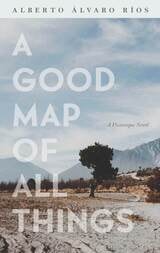
A Good Map of All Things
A Picaresque NovelAlberto Álvaro Ríos
University of Arizona Press, 2020
In Alberto Álvaro Ríos’s new picaresque novel, momentous adventure and quiet connection brings twenty people to life in a small town in northern Mexico. A Good Map of All Things is home to characters whose lives are interwoven but whose stories are their own, adding warmth and humor to this continually surprising communal narrative. The stories take place in the mid-twentieth century, in the high desert near the border—a stretch of land generally referred to as the Pimería Alta—an ancient passage through the desert that connected the territory of Tucson in the north and Guaymas and Hermosillo in the south. The United States is off in the distance, a little difficult to see, and, in the middle of the century, not the only thing to think about. Mexico City is somewhere to the south, but nobody can say where and nobody has ever seen it.
Ríos has created a whimsical yet familiar town, where brightly unique characters love fiercely and nurture those around them. The people in A Good Map of All Things have secrets and fears, successes and happiness, winters and summers. They are people who do not make the news, but who are living their lives for the long haul, without lotteries or easy answers or particular luck. Theirs is the everyday, with its small but meaningful joy. Whether your heart belongs to a small town in Mexico or a bustling metropolis, Alberto Álvaro Ríos has crafted a book that is overflowing with comfort, warmth, and the familiar embrace of a tightly woven community.
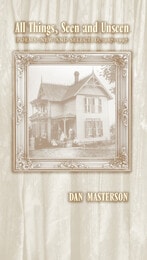
All Things, Seen and Unseen
Poems: New and Selected, 1967-1997Dan Masterson
University of Arkansas Press, 1997
With clarity and precise detail, Dan Masterson creates a narrative of how we live, love, and die. In blank verse and rhymed stanzas, in free verse and taut lyrics, he delivers the story of a woman trap ped in an avalanche, a husband daring himself to death in an ocean swim, or a son arranging the final affairs of his parents. There is always an edge to Masterson’s characters—they are everyday people, but we meet them on the one day when the stakes are highest.
He holds a reverence for the particulars of a place, for gardens and homes, for dresser drawers and work benches, for cabins in the Adirondacks, ponds, tree houses, and ornamental stones. The leavings of loved ones—strong boxes, pajamas, rosaries—are passed on as relics that both heal and trouble. In Masterson’s world, characters learn how to lose, how to change, and even how to survive their most painful memories.
Selected from thirty years of work, and including an eclectic selection of new poems, this book unfurls Masterson’s full canvas of abilities: his penchant for startling descriptions, his keen insight into our nobility and fallibility, and his skill at making us live his poems.
Eve's Longing
The Infinite Possibilities in All ThingsDeborah McKay
University of Alabama Press, 1992
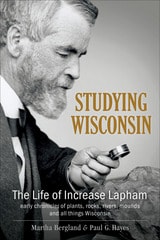
Studying Wisconsin
The Life of Increase Lapham, early chronicler of plants, rocks, rivers, mounds and all things WisconsinMartha Bergland
Wisconsin Historical Society Press, 2014
With masterful storytelling, Bergland and Hayes demonstrate how Lapham blended his ravenous curiosity with an equable temperament and a passion for detail to create a legacy that is still relevant today.
—John Gurda
In this long overdue tribute to Wisconsin’s first scientist, authors Martha Bergland and Paul G. Hayes explore the remarkable life and achievements of Increase Lapham (1811–1875). Lapham’s ability to observe, understand, and meticulously catalog the natural world marked all of his work, from his days as a teenage surveyor on the Erie Canal to his last great contribution as state geologist.
Self-taught, Lapham mastered botany, geology, archaeology, limnology, mineralogy, engineering, meteorology, and cartography. A prolific writer, his 1844 guide to the territory was the first book published in Wisconsin. Asked late in life which field of science was his specialty, he replied simply, “I am studying Wisconsin.”
Lapham identified and preserved thousands of botanical specimens. He surveyed and mapped Wisconsin’s effigy mounds. He was a force behind the creation of the National Weather Service, lobbying for a storm warning system to protect Great Lakes sailors. Told in compelling detail through Lapham’s letters, journals, books, and articles, Studying Wisconsin chronicles the life and times of Wisconsin’s pioneer citizen-scientist.

The Hour of All Things and Other Plays
Caridad Svich
Intellect Books, 2018

The Sea Within
Waves and the Meaning of All ThingsPeter Kreeft
St. Augustine's Press, 2006

The Story of All Things
Writing the Self in English Renaissance Narrative PoetryMarshall Grossman
Duke University Press, 1998
Relating subjectivity to the nature of language, Grossman uses the theories of Lacan to analyze the concept of the self as it encounters a transforming environment. He shows how ideological tensions arose from the reorganization and "modernization" of social life in revolutionary England and how the major poets of the time represented the division of the self in writings that are suspended between lyric and narrative genres. Beginning with the portrayals of the self inherited from Augustine, Dante, and Petrarch, he describes the influence of historic developments such as innovations in agricultural technology, civil war and regicide, and the emergence of republican state institutions on the changing representation of characters in the works of Spenser, Donne, Marvell, and Milton. Furthering this psychoanalytic critique of literary history, Grossman probes the linguistic effects of social and personal factors such as Augustine’s strained relationship with his mother and the marital disharmony of Milton and Mary Powell. With its focus on these and other "literary historical events," The Story of All Things not only proposes a new structural theory of narrative but constitutes a significant challenge to New Historicist conceptions of the self.