Results by title
9 books match the query 'Allegiance'
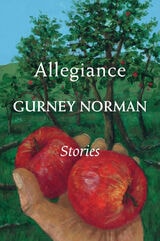
Allegiance
StoriesGurney Norman
Ohio University Press, 2021
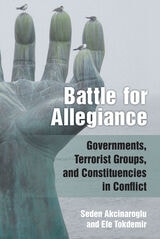
Battle for Allegiance
Governments, Terrorist Groups, and Constituencies in ConflictSeden Akcinaroglu and Efe Tokdemir
University of Michigan Press, 2020
Using a multimethod approach based on exclusive interviews and focus groups from Turkey and large N original data from around the world, Seden Akcinaroglu and Efe Tokdemir present the first systematic empirical analysis of the ways in which terrorist groups, the government, and the citizens relate to each other in a triadic web of action. They study the nonviolent actions of terrorist groups toward their constituencies, the nonviolent actions of governments toward terrorists, and the nonviolent actions of governments toward the terrorist group’s constituencies. By investigating the causes, targets, and consequences of accommodative actions, this book sheds light on an important, but generally ignored, aspect of terrorism: interactive nonviolent strategies.
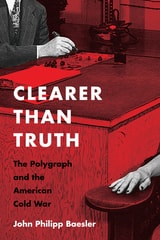
Clearer Than Truth
The Polygraph and the American Cold WarJohn Philipp Baesler
University of Massachusetts Press, 2018
In this first comprehensive history of the polygraph as a tool and symbol of American Cold War policies, John Philipp Baesler tells the story of a technology with weak scientific credentials that was nevertheless celebrated as a device that could expose both internal and external enemies. Considered the go-to technology to test agents' and employees' loyalty, the polygraph's true power was to expose deep ideological and political fault lines. While advocates praised it as America's hard-nosed yet fair answer to communist brainwashing, critics claimed that its use undermined the very values of justice, equality, and the presumption of innocence for which the nation stood.
Clearer Than Truth demonstrates that what began as quick-fix technology promising a precise test of honesty and allegiance eventually came to embody tensions in American Cold War culture between security and freedom, concerns that reach deep into the present day.
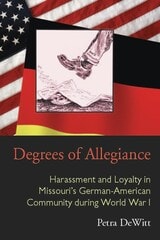
Degrees of Allegiance
Harassment and Loyalty in Missouri’s German-American Community during World War IPetra DeWitt
Ohio University Press, 2012
Historians have long argued that the Great War eradicated German culture from American soil. Degrees of Allegiance examines the experiences of German-Americans living in Missouri during the First World War, evaluating the personal relationships at the local level that shaped their lives and the way that they were affected by national war effort guidelines. Spared from widespread hate crimes, German-Americans in Missouri did not have the same bleak experiences as other German-Americans in the Midwest or across America. But they were still subject to regular charges of disloyalty, sometimes because of conflicts within the German-American community itself.
Degrees of Allegiance updates traditional thinking about the German-American experience during the Great War, taking into account not just the war years but also the history of German settlement and the war’s impact on German-American culture.

Identity and the Failure of America
From Thomas Jefferson to the War on TerrorJohn Michael
University of Minnesota Press, 2008
From Thomas Jefferson to John Rawls, justice has been at the center of America’s self-image and national creed. At the same time, for many of its peoples-from African slaves and European immigrants to women and the poor-the American experience has been defined by injustice: oppression, disenfranchisement, violence, and prejudice.
In Identity and the Failure of America, John Michael explores the contradictions between a mythic national identity promising justice to all and the realities of a divided, hierarchical, and frequently iniquitous history and social order. Through a series of insightful readings, Michael analyzes such cultural moments as the epic dramatization of the tension between individual ambition and communal complicity in Moby-Dick, attempts to effect social change through sympathy in the novels of Lydia Marie Child and Harriet Beecher Stowe, Ralph Waldo Emerson’s antislavery activism and Frederick Douglass’s long fight for racial equity, and the divisive figures of John Brown and Nat Turner in American letters and memory.
Focusing on exemplary instances when the nature of the United States as an essentially conflicted nation turned to force, Michael ultimately posits the development of a more cosmopolitan American identity, one that is more fully and justly imagined in response to the nation’s ethical failings at home and abroad.
John Michael is professor of English and of visual and cultural studies at the University of Rochester. He is the author of Anxious Intellects: Academic Professionals, Public Intellectuals, and Enlightenment Values and Emerson and Skepticism: The Cipher of the World.
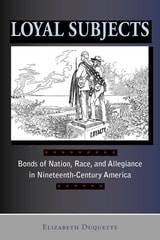
Loyal Subjects
Bonds of Nation, Race, and Allegiance in Nineteenth-Century AmericaDuquette, Elizabeth
Rutgers University Press, 2010
Loyal Subjects considers how the Civil War complicated the cultural value of emotion, especially the ideal of sympathy. Through an analysis of literary works written during and after the conflict-from Nathaniel Hawthorne's "Chiefly About War Matters" through Henry James's The Bostonians and Charles Chestnutt's "The Wife of His Youth," to the Pledge of Allegiance and W.E.B. Du Bois's John Brown, among many others-Duquette reveals that although American literary criticism has tended to dismiss the Civil War's impact, postwar literature was profoundly shaped by loyalty.

Political Support in Canada
The Crisis YearsAllan Kornberg and Harold D. Clarke, editors
Duke University Press, 1983
The nature of popular support is first considered in broad, theoretical terms, then from the standpoint of those agents most responsible for maintaining support in Canadian democracy, then as influenced by particular issues and policies, and finally as it affects and is affected by the separatist movement in Quebec.
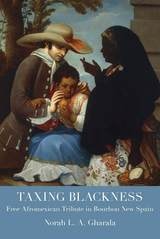
Taxing Blackness
Free Afromexican Tribute in Bourbon New SpainNorah L. A. Gharala
University of Alabama Press, 2019
A definitive analysis of the most successful tribute system in the Americas as applied to Afromexicans
During the eighteenth century, hundreds of thousands of free descendants of Africans in Mexico faced a highly specific obligation to the Spanish crown, a tax based on their genealogy and status. This royal tribute symbolized imperial loyalties and social hierarchies. As the number of free people of color soared, this tax became a reliable source of revenue for the crown as well as a signal that colonial officials and ordinary people referenced to define and debate the nature of blackness.
Taxing Blackness: Free Afromexican Tribute in Bourbon New Spain examines the experiences of Afromexicans and this tribute to explore the meanings of race, political loyalty, and legal privileges within the Spanish colonial regime. Norah L. A. Gharala focuses on both the mechanisms officials used to define the status of free people of African descent and the responses of free Afromexicans to these categories and strategies. This study spans the eighteenth century and focuses on a single institution to offer readers a closer look at the place of Afromexican individuals in Bourbon New Spain, which was the most profitable and populous colony of the Spanish Atlantic.
As taxable subjects, many Afromexicans were deeply connected to the colonial regime and ongoing debates about how taxpayers should be defined, whether in terms of reputation or physical appearance. Gharala shows the profound ambivalence, and often hostility, that free people of African descent faced as they navigated a regime that simultaneously labeled them sources of tax revenue and dangerous vagabonds. Some free Afromexicans paid tribute to affirm their belonging and community ties. Others contested what they saw as a shameful imposition that could harm their families for generations. The microhistory includes numerous anecdotes from specific cases and people, bringing their history alive, resulting in a wealth of rural and urban, gender, and family insight.
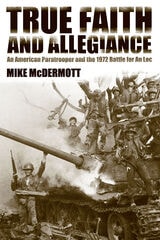
True Faith and Allegiance
An American Paratrooper and the 1972 Battle for An LocMike McDermott
University of Alabama Press, 2012
The battle for An Loc, a key component in the North Vietnamese attempt to overwhelm the South, swept Mike McDermott, then the senior advisor to an elite South Vietnamese paratrooper battalion, into some of the most horrific close-quarters fighting of the war. His in-the-trenches account is augmented by detailed descriptions of a user’s perspective on the parachute resupply, tactical airpower, and B-52 strikes that allowed the An Loc garrison to survive.
True Faith and Allegiance is a riveting recounting of the prism through which a Vietnam veteran views the war as he continues to live with the aftereffects of life-altering experiences in the service of his country.