Results by title
8 books match the query 'Allen, Kieran'
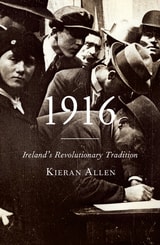
1916
Ireland's Revolutionary TraditionKieran Allen
Pluto Press, 2016
In 1916, Kieran Allen argues that this pivotal moment in Irish history has been obscured by those who see it only as a prelude for a war of independence. Emphasizing an often ignored social and political radicalism at the heart of the rebellion, he shows that it gave birth to a revolutionary tradition that continues to haunt the Irish elite. Socialist aspirations mixed, and sometimes clashed, with the republican current, but both were crushed in a counterrevolution that accompanied the Anglo-Irish treaty of 1921. The result today is a partitioned Ireland that acts as a neoliberal tax haven for multinational corporations—a state of affairs quite alien to both Connolly’s and Pearse’s vision.
Published to coincide with the Rising’s centennial, 1916: Ireland’s Revolutionary Tradition re-establishes the political role of socialist republican figures, offers a highly accessible history of the Easter Rising, and explores the militancy and radicalism that continues to haunt the Irish elite one hundred years later.
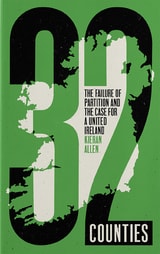
32 Counties
The Failure of Partition and the Case for a United IrelandKieran Allen
Pluto Press, 2021
'This is Irish history seen anew, from below, bristling with practical lessons for working-class struggle today' - Eamonn McCann
The 32 counties of Ireland were divided through imperial terror and gerrymandering. Partition was borne from a Tory strategy to defend the British Empire and has spawned a 'carnival of reaction' in Irish politics ever since. Over the last 100 years, conservative forces have dominated both states offering religious identity as a diversion from economic failures and inequality.
Through a sharp analysis of the history of partition, Kieran Allen rejects the view that the 'two cultures' of Catholic and Protestant communities lock people into permanent antagonism. Instead, the sectarian states have kept its citizens divided through political and economic measures like austerity, competition for reduced services and low wages.
Overturning conventional narratives, 32 Counties evokes the tradition of James Connolly and calls for an Irish unity movement from below to forge the North and the Republic into a secular, socialist and united Ireland.

Austerity Ireland
The Failure of Irish CapitalismKieran Allen and Brian O'Boyle
Pluto Press, 2013
In Austerity Ireland, Kieran Allen challenges this official image and argues that the Irish state's response to the crash has primarily been designed to protect economic privilege. The resulting austerity has been a failure and is likely to produce a decade of hardship.
The book offers a deeply informed and penetrating diagnosis of Ireland's current socio-economic and political malaise, suggesting that a political earthquake is underway which may benefit the left. Austerity Ireland is essential reading for all students of Irish politics and economics, as well as those interested in the politics of austerity and the eurozone crisis.
Durkheim
A Critical IntroductionKieran Allen and Brian O'Boyle
Pluto Press, 2017
This critical introduction argues that Durkheim's defence of Republican France in the 1890s had a considerable influence on his sociology, which cannot be fully understood when removed from its historical and political context. His dismissal of economic factors in suicide rates, the influence of his anti-feminist position on his findings on marriage rates, and the idealism behind his claim that religion is the key determinant in shaping society are all discussed.
Through analysing his writings, including The Division of Labour in Society, Suicide and The Elementary Forms of Religious Life, this book provides a fascinating, critical counterpoint to the existing works on this key figure of sociology.
Marx
The Alternative to CapitalismKieran Allen
Pluto Press, 2017
If we are serious about finding a different way to run the post-credit crunch society, we must start by introducing alternatives to undergraduates. Kieran Allen begins the task with an accessible and comprehensive look at the ideas of Karl Marx.
Dispensing with the dryness of traditional explanations of Marx, Allen shows how Marx's ideas apply to modern society. The first section briefly outlines Marx's life and the development of his work, then goes on to clearly explain his key theories, including historical materialism and surplus value. The second section examines alternatives to capitalism, the concept of 'anti-capitalism' and provides concrete, contemporary examples of Marx’s theories being put into practice in today's world.
Max Weber
A Critical IntroductionKieran Allen
Pluto Press, 2004
Politics of James Connolly
Kieran Allen
Pluto Press, 1990
Kieran Allen breaks this mould, assessing the founder of the Irish Marxist movement ideas from a revolutionary socialist perspective. Allen considers the strengths and weaknesses of Connolly’s revolutionary strategy, the effect of his commitment to international socialism on his nationalist loyalties and arguing that, ultimately, Connolly's enduring relevance derives from his anti-imperialism. Any socialist movement today ignores this book at its peril.
Tax Haven Ireland
Brian O’ Boyle
Pluto Press, 2021
Tax Haven Ireland uncovers the central players in this process and exposes the coverups employed by the Irish state, with the help of accountants, lawyers, and financial services companies. From the lucrative internet porn industry to corruption in the property market, this issue distorts the economy across the state and in the wider international system, and its history runs deep, going back the country’s origins as a British colonial outpost.
Today, in the wake of Brexit and in the shadow of yet another economic crash, what can be done to prevent such dangerous behaviour and reorganize our economies to invest in the people? Can Ireland – and all of us – build an alternative economy based on fairness and democratic values?