Results by title
10 books match the query 'Alterity'

Alterity
Jean-Michel Oughourlian
Michigan State University Press, 2023
Listening Awry
Music And Alterity In German CultureDavid Schwarz
University of Minnesota Press, 2006

Marginality and Alterity in New European Cinemas, Part 1, Volume 15
Randall Halle and Sharon Willis
Duke University Press, 0

Prodigal Son/Elder Brother
Interpretation and Alterity in Augustine, Petrarch, Kafka, LevinasJill Robbins
University of Chicago Press, 1991
"Through a creative reading of the prodigal son parable, Jill Robbins demonstrates the hermeneutical impasse of the Christian exegete who must and yet cannot incorporate the Old Testament. Having disclosed the aporia at the heart of Christian hermeneutics, she proposes an alternative approach to the Hebrew Bible and new interpretations of Augustine, Petrarch, Kafka, and Levinas. Robbins brilliantly integrates the discourses of biblical texts, literary works, and critical analysis."—Mark C. Taylor, Williams College
Self-Awareness and Alterity
A Phenomenological InvestigationDan Zahavi
Northwestern University Press, 1999
In the rigorous and highly original Self-Awareness and Alterity, Dan Zahavi provides a sustained argument that phenomenology, especially in its Husserlian version, can contribute something decisive to the analysis of self-awareness. Taking on recent discussions within both analytical philosophy (Shoemaker, Castaneda, Nagel) and contemporary German philosophy (Henrich, Frank, Tugendhat), Zahavi argues that the phenomenological tradition has much more to offer when it comes to the problem of self-awareness than is normally assumed. As a contribution to the current philosophical debate concerning self-awareness, the book presents a comprehensive reconstruction of Husserl's theory of pre-reflective self-awareness, thereby criticizing a number of prevalent interpretations and a systematic discussion of a number of phenomenological insights related to this issue, including analyses of the temporal, intentional, reflexive, bodily, and social nature of the self.

Self-Awareness and Alterity
A Phenomenological InvestigationDan Zahavi
Northwestern University Press, 2020
As a contribution to the current philosophical debate concerning self-awareness, the book presents a comprehensive reconstruction of Husserl’s theory of pre-reflective self-awareness, thereby criticizing a number of prevalent interpretations. In addition, Zahavi also offers a systematic discussion of a number of phenomenological insights related to the issue of self-awareness, including analyses of the temporal, intentional, reflexive, bodily, and social nature of the self.
The new edition of this prize-winning book has been updated and revised, and all quotations have been translated into English. It also contains a new preface in which Zahavi traces the developments of the debates around self-awareness over the last twenty years and situates this book in the context of his subsequent work.

Stambeli
Music, Trance, and Alterity in TunisiaRichard C. Jankowsky
University of Chicago Press, 2010
Part ethnography, part history of the complex relationship between Tunisia’s Arab and sub-Saharan populations, Stambeli will be welcomed by scholars and students of ethnomusicology, anthropology, African studies, and religion.

The Ethics and Poetics of Alterity in Asian American Poetry
Xiaojing Zhou
University of Iowa Press, 2006
Poetry by Asian American writers has had a significant impact on the landscape of contemporary American poetry, and a book-length critical treatment of Asian American poetry is long overdue. In this groundbreaking book, Xiaojing Zhou demonstrates how many Asian American poets transform the conventional “I” of lyric poetry—based on the traditional Western concept of the self and the Cartesian “I”—to enact a more ethical relationship between the “I” and its others.
Drawing on Emmanuel Levinas’s idea of the ethics of alterity—which argues that an ethical relation to the other is one that acknowledges the irreducibility of otherness—Zhou offers a reconceptualization of both self and other. Taking difference as a source of creativity and turning it into a form of resistance and a critical intervention, Asian American poets engage with broader issues than the merely poetic. They confront social injustice against the other and call critical attention to a concept of otherness which differs fundamentally from that underlying racism, sexism, and colonialism. By locating the ethical and political questions of otherness in language, discourse, aesthetics, and everyday encounters, Asian American poets help advance critical studies in race, gender, and popular culture as well as in poetry.
The Ethics and Poetics of Alterity is not limited, however, to literary studies: it is an invaluable response to the questions raised by increasingly globalized encounters across many kinds of boundaries.
The Poets
Marilyn Chin, Kimiko Hahn, Myung Mi Kim, Li Young Lee, Timothy Liu, David Mura, and John Yau

Uncanny Encounters
Literature, Psychoanalysis, and the End of AlterityJohn Zilcosky
Northwestern University Press, 2015
Winner of the Friedrich Wilhelm Bessel Research Award
Recipient, 2022 Guggenheim Fellowship
Around 1900, when the last blank spaces on their maps were filled, Europeans traveled to far-flung places hoping to find the spectacularly foreign. They discovered instead what Freud called, several years later, the uncannily familiar: disturbing reflections of themselves—either actual Europeans or Westernized natives. This experience was most extreme for German travelers, who arrived in the contact zones late, on the heels of other European colonialists, and it resulted not in understanding or tolerance but in an increased propensity for violence and destruction. The quest for a “virginal,” exotic existence proved to be ruined at its source, mirroring back to the travelers demonic parodies of their own worst aspects. In this strikingly original book, John Zilcosky demonstrates how these popular “uncanny” encounters influenced Freud’s—and the literary modernists’—use of the term, and how these encounters remain at the heart of our cross-cultural anxieties today.
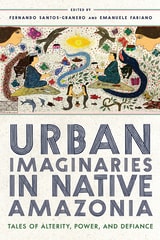
Urban Imaginaries in Native Amazonia
Tales of Alterity, Power, and DefianceFernando Santos-Granero
University of Arizona Press, 2023
Featuring analysis from historical, ethnological, and philosophical perspectives, contributors seek to explain the imaginaries’ widespread diffusion, as well as their influence in present-day migration and urbanization. Above all, it underscores how these urban imaginaries allow Indigenous Amazonians to express their concerns about power, alterity, domination, and defiance.
Contributors
Natalia Buitron
Philippe Erikson
Emanuele Fabiano
Fabiana Maizza
Daniela Peluso
Fernando Santos-Granero
Pirjo Kristiina Virtanen
Robin M. Wright