Results by title

3 books match the query 'Alternative mass media'
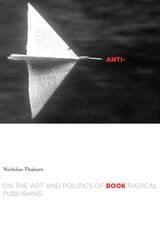
cover of Anti-Book: On the Art and Politics of Radical Publishing

Anti-Book

On the Art and Politics of Radical Publishing

Nicholas Thoburn

University of Minnesota Press, 2016

No, Anti-Book is not a book about books. Not exactly. And yet it is a must for anyone interested in the future of the book. Presenting what he terms “a communism of textual matter,” Nicholas Thoburn explores the encounter between political thought and experimental writing and publishing, shifting the politics of text from an exclusive concern with content and meaning to the media forms and social relations by which text is produced and consumed. Taking a “post-digital” approach in considering a wide array of textual media forms, Thoburn invites us to challenge the commodity form of books—to stop imagining books as transcendent intellectual, moral, and aesthetic goods unsullied by commerce. His critique is, instead, one immersed in the many materialities of text. 

Anti-Book engages with an array of writing and publishing projects, including Antonin Artaud’s paper gris-gris, Valerie Solanas’s SCUM Manifesto, Guy Debord’s sandpaper-bound Mémoires, the collective novelist Wu Ming, and the digital/print hybrid of Mute magazine. Empirically grounded, it is also a major achievement in expressing a political philosophy of writing and publishing, where the materiality of text is interlaced with conceptual production. Each chapter investigates a different form of textual media in concert with a particular concept: the small-press pamphlet as “communist object,” the magazine as “diagrammatic publishing,” political books in the modes of “root” and “rhizome,” the “multiple single” of anonymous authorship, and myth as “unidentified narrative object.” 

An absorbingly written contribution to contemporary media theory in all its manifestations, Anti-Book will enrich current debates about radical publishing, artists’ books and other new genre and media forms in alternative media, art publishing, media studies, cultural studies, critical theory, and social and political theory.
[more]
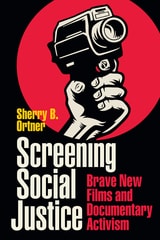
cover of Screening Social Justice: Brave New Films and Documentary Activism

Screening Social Justice

Brave New Films and Documentary Activism

Sherry B. Ortner

Duke University Press, 2023
In Screening Social Justice, award-winning anthropologist Sherry B. Ortner presents an ethnographic study of Brave New Films, a nonprofit film production company that makes documentaries intended to mobilize progressive grassroots activism. Ortner positions the work of the company within a tradition of activist documentary filmmaking and within the larger field of “alternative media” that is committed to challenging the mainstream media and telling the truth about the world today. The company’s films cover a range of social justice issues, with particular focus on the hidden workings of capitalism, racism, and right-wing extremism. Beyond the films themselves, Brave New Films is also famous for its creative distribution strategies. All of the films are available for free on YouTube. Central to the intention of promoting political activism, the films circulate through networks of other activist and social justice organizations and are shown almost entirely in live screenings in which the power of the film is amplified. Ortner takes the reader inside both the production process and the screenings to show how a film can be made and used to mobilize action for a better world.
[more]
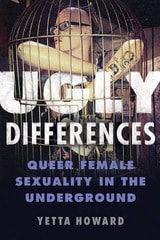
cover of Ugly Differences: Queer Female Sexuality in the Underground

Ugly Differences

Queer Female Sexuality in the Underground

Yetta Howard

University of Illinois Press, 2018

What would it mean to turn to ugliness rather than turn away from it? Indeed, the idea of ugly often becomes synonymous with non-white, non-male, and non-heterosexual physicality and experience. That same pejorative migrates to become a label for practices within underground culture. In Ugly Differences, Yetta Howard uses underground contexts to theorize queer difference by locating ugliness at the intersection of the physical, experiential, and textual. From that nexus, Howard contends that ugliness—as a mode of pejorative identification—is fundamental to the cultural formations of queer female sexuality. Slava Tsukerman's postpunk film Liquid Sky, Sapphire's poetry, Roberta Gregory's Bitchy Butch comix, New Queer Cinema such as High Art—these and other non-canonical works contribute to an audacious critique. Howard reveals how the things we see, read as, or experience as ugly productively account for non-dominant sexual identities and creative practices. Ugly Differences offers eye-opening ways to approach queerness and its myriad underground representations.
[more]