Results by title
9 books match the query 'Alternatives'

Alternatives to Assimilation
The Response of Reform Judaism to American Culture, 1840–1930Alan Silverstein
Brandeis University Press, 1995
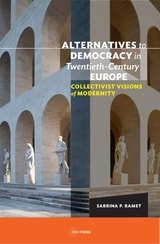
Alternatives to Democracy in Twentieth-Century Europe
Collectivist Visions of ModernitySabrina P. Ramet
Central European University Press, 2019
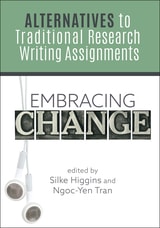
Embracing Change
Alternatives to Traditional Research Writing AssignmentsSilke Higgins
American Library Association, 2022
Embracing Change: Alternatives to Traditional Research Writing Assignments collects existing alternative assignments from librarians and classroom instructors and examines their benefits and drawbacks, impact on various student populations, and the support needed to make them successful. In two parts—Analog-Driven Assignments and Technology-Driven Assignments—authors offer a wealth of insight into the theory and practice of utilizing alternative assignments. Case studies detail the development of assignments, their implementation, lessons learned, and assessment, and provide examples and reference materials for incorporating or refining your own alternative assignments. Projects covered include:
- how students engage with writing gray literature
- producing a local voting guide
- creating museum-level exhibit labels
- composing and printing original poems using a letterpress
- developing finding aids
- writing a children’s book
- creating infographics and lightning talk videos
- learning digital literacy using podcasts
- a variety of digital humanities projects
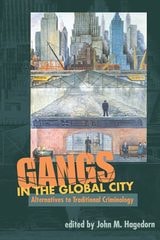
GANGS IN THE GLOBAL CITY
Alternatives to Traditional CriminologyEdited by John M. Hagedorn
University of Illinois Press, 2006
Although they were originally considered an American phenomenon, gangs today have grown and transformed into global enterprises. Despite these changes, criminologists have not yet reassessed worldwide gangs in terms of the other changes associated with globalization.
John M. Hagedorn aims to correct this oversight by incorporating important theoretical advances in urban political economy and understanding changes in gangs around the world as a result of globalization and the growth of the information economy. Contrary to older conceptions, today’s gangs are international, are often institutionalized, and may be explicitly concerned with race and ethnicity. Gangs in the Global City presents the work of an assortment of international scholars that challenges traditional approaches to problems in criminology from many different perspectives and includes theoretical discussions, case studies, and examinations of gang members’ identities. The contributors consider gangs not as fundamentally a crime problem but as variable social organizations in poor communities that are transitioning to the new economy.

Polarizing Development
Alternatives to Neoliberalism and the CrisisEdited by Lucia Pradella and Thomas Marois
Pluto Press, 2015
The global economic crisis has exposed the limits of neoliberalism and dramatically deepened social polarization. Yet, despite increasing social resistance and opposition, neoliberalism prevails globally.
Radical alternatives, moreover, are only rarely debated. And if they are, such alternatives are reduced to new Keynesian and new developmental agendas, which fail to address existing class divisions and imperialist relations of domination.
This collection of essays polarizes the debate between radical and reformist alternatives by exploring head-on the antagonistic structure of capitalist development. The contributors ground their proposals in an international, non-Eurocentric and Marxian inspired analysis of capitalism and its crises. From Latin America to Asia, Africa to the Middle East and Europe to the US, social and labour movements have emerged as the protagonists behind creating alternatives.
This book’s new generation of scholars has written accessible yet theoretically informed and empirically rich chapters elaborating radical worldwide strategies for moving beyond neoliberalism, and beyond capitalism. The intent is to provoke critical reflection and positive action towards substantive change.

Socialism, Capitalism and Alternatives
Area Studies and Global TheoriesEdited by Peter J. S. Duncan and Elisabeth Schimpfössl
University College London, 2019
Through analysis of post-Socialist Russia and Central and Eastern Europe, as well as of the United Kingdom, China, and the United States, Socialism, Capitalism and Alternatives confronts the difficulty we face in articulating alternatives to capitalism, socialism, and threatening populist regimes. Beginning with accounts of the impact of capitalism on countries left behind by the planned economies, the book moves on to consider how China has become a beacon of dynamic economic growth, aggressively expanding its global influence. The final section of the book poses alternatives to the ideological dominance of neoliberalism in the West.

The Bible Without Theology
The Theological Tradition and Alternatives to ItRobert A. Oden, Jr.
University of Illinois Press, 1987
Using cross-cultural and interdisciplinary methodology, Oden investigates three biblical issues--the clothing of Adam and Eve, Jacob's name change to Israel, and ritual prostitution and Deuteronomy--in light of extra-biblical evidence. He also challenges scholars' assumptions of Scripture as monotheistic and proposes treating biblical narrative as myth rather than as historical fact.

The Midwestern Native Garden
Native Alternatives to Nonnative Flowers and PlantsCharlotte Adelman, Bernard L. Schwartz
Ohio University Press, 2011
The Squatters' Movement in Europe
Commons and Autonomy as Alternatives to CapitalismEdited by Squatting Europe Kollective
Pluto Press, 2014
The Squatters' Movement in Europe is the first definitive guide to squatting as an alternative to capitalism. It offers a unique insider's view on the movement – its ideals, actions and ways of life. At a time of growing crisis in Europe with high unemployment, dwindling social housing and declining living standards, squatting has become an increasingly popular option.
The book is written by an activist-scholar collective, whose members have direct experience of squatting: many are still squatters today. There are contributions from the Netherlands, Spain, the USA, France, Italy, Germany, Switzerland and the UK.
In an age of austerity and precarity this book shows what has been achieved by this resilient social movement, which holds lessons for policy-makers, activists and academics alike.