Results by title
7 books match the query 'Alternatives to imprisonment'

Abolition Archives, Feminist Futures
Kathi Weeks
Duke University Press, 2026
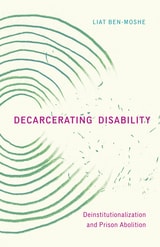
Decarcerating Disability
Deinstitutionalization and Prison AbolitionLiat Ben-Moshe
University of Minnesota Press, 2020
This vital addition to carceral, prison, and disability studies draws important new links between deinstitutionalization and decarceration
Prison abolition and decarceration are increasingly debated, but it is often without taking into account the largest exodus of people from carceral facilities in the twentieth century: the closure of disability institutions and psychiatric hospitals. Decarcerating Disability provides a much-needed corrective, combining a genealogy of deinstitutionalization with critiques of the current prison system.
Liat Ben-Moshe provides groundbreaking case studies that show how abolition is not an unattainable goal but rather a reality, and how it plays out in different arenas of incarceration—antipsychiatry, the field of intellectual disabilities, and the fight against the prison-industrial complex. Ben-Moshe discusses a range of topics, including why deinstitutionalization is often wrongly blamed for the rise in incarceration; who resists decarceration and deinstitutionalization, and the coalitions opposing such resistance; and how understanding deinstitutionalization as a form of residential integration makes visible intersections with racial desegregation. By connecting deinstitutionalization with prison abolition, Decarcerating Disability also illuminates some of the limitations of disability rights and inclusion discourses, as well as tactics such as litigation, in securing freedom.
Decarcerating Disability’s rich analysis of lived experience, history, and culture helps to chart a way out of a failing system of incarceration.

Implicating the System
Judicial Discourses in Sentencing of Indigenous WomenElspeth Kaiser-Derrick
University of Manitoba Press, 2019
Intermediate Sanctions in Corrections
Gail Caputo
University of North Texas Press, 2004

Love and Abolition
The Social Life of Black Queer PerformanceAlison Rose Reed
The Ohio State University Press, 2022
Reed identifies abolition literature as an emergent field of inquiry that emphasizes social relationships in the ongoing struggle to dismantle systems of coercion, criminalization, and control. Focusing on love as an affective modality and organizing tool rooted in the Black radical tradition’s insistence on collective sociality amidst unrelenting state violence, Reed provides fresh readings of visionaries such as James Baldwin, Ntozake Shange, Sharon Bridgforth, and vanessa german. Both abolitionist manifesto and examination of how Black queer performance offers affective modulations of tough and tender love, Love and Abolition ultimately calls for a critical reconsideration of the genre of prison literature—and the role of the humanities—during an age of mass incarceration.
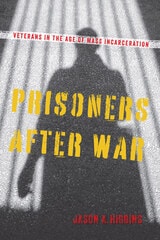
Prisoners after War
Veterans in the Age of Mass IncarcerationJason A. Higgins
University of Massachusetts Press, 2024
Winner of the 2025 Oral History Association Book Award • Winner of Virginia Tech's Albert Lee Sturm Award for Faculty Excellence • Finalist for the 2026 Veterans Studies Association Distinguished Book Award • Honorable Mention, National Council on Public History Book Award
The United States has both the largest, most expensive, and most powerful military and the largest, most expensive, and most punitive carceral system in the history of the world. Since the American War in Vietnam, hundreds of thousands of veterans have been incarcerated after their military service.
Identifying the previously unrecognized connections between American wars and mass incarceration, Prisoners after War reaches across lines of race, class, and gender to record the untold history of incarcerated veterans over the past six decades. Having conducted dozens of oral history interviews, Jason A. Higgins traces the lifelong effects of war, inequality, disability, and mental illness, and explores why hundreds of thousands of veterans, from Vietnam to Afghanistan, were caught up in the carceral system. This original study tells an intergenerational history of state-sanctioned violence, punishment, and inequality, but its pages also resonate with stories of survival and redemption, revealing future possibilities for reform and reparative justice.
Trial by Treatment
Punishing Illness in an Age of Criminal Legal ReformMary Ellen Stitt
University of Chicago Press, 2025
A troubling account of the unexpected impacts of treatment-based alternatives to criminal punishment.
Every year, courts send hundreds of thousands of people to treatment-based programs as alternatives to traditional punishment. These alternatives—known as ‘diversion programs’—are widely celebrated as reforms that reduce the punishment of the mentally ill. But in Trial by Treatment, Mary Ellen Stitt shows that they have, in fact, expanded the reach of the criminal legal system and its power over the lives of the most vulnerable.
The inner workings of diversion programs are obscure, partially by design, and data on outcomes is hard to come by. Stitt draws on two years of fieldwork in criminal courtrooms and court-mandated treatment sessions, as well as an original national dataset, in-depth interviews, and experimental survey data, to document the hidden impacts of diversion. She shows that placing mental healthcare under the control of the courts has helped to legitimize the criminalization of illness, warped treatment environments, and amplified inequalities in punishment. In vivid and humanizing detail, Trial by Treatment shows how reforms that keep power and discretion in the same hands can entrench the very problems they promised to solve.